Caffeine Intake Calculator
Calculate Your Caffeine Intake
Caffeine Intake Results
Enter your information above to see your caffeine intake.
When you down an energy drink before a workout, or take your Adderall with a Monster after a late-night study session, you might think you’re just boosting focus or energy. But what you’re really doing is stacking two powerful stimulants-and your heart is paying the price.
What’s Really in Your Energy Drink?
Energy drinks aren’t just sugary soda with caffeine. They’re engineered to hit you with a one-two punch. A single 16-ounce can of Monster contains 160 mg of caffeine. Bang Energy? That’s 300 mg-more than three cups of coffee. Red Bull’s 8.4-ounce can has 80 mg. And that’s just the start. Many also contain guarana, a plant seed that’s 3.6% to 5.8% caffeine by weight. Then there’s taurine, bitter orange (synephrine), and other unregulated compounds that aren’t even listed as caffeine on the label. These ingredients don’t just add up-they multiply. Caffeine alone makes your heart beat faster. Synephrine tightens blood vessels. Guarana delays caffeine metabolism, making the high last longer. Together, they can spike your systolic blood pressure by 6 to 10 points in under 30 minutes, even in healthy young adults. That’s not a small bump. That’s enough to trigger chest pain, dizziness, or worse in someone with undiagnosed heart issues.Stimulant Medications Are No Different
If you’re taking Adderall, Ritalin, or another prescription stimulant for ADHD, you’re already on a drug that raises your heart rate and blood pressure. The FDA says these medications can increase systolic pressure by 2 to 7 mmHg and heart rate by 3 to 13 beats per minute. That’s mild for most people. But when you combine that with an energy drink, you’re doubling down. A 2024 study tracking 5,000 people found that those who took stimulant meds and drank energy drinks had a 3 to 5 times higher risk of serious heart events-like arrhythmias or heart attacks-than those who used either alone. It’s not just theory. Emergency rooms across the U.S. have seen cases where teens and young adults, on ADHD meds, consumed energy drinks and ended up in cardiac arrest. One 19-year-old in California suffered a heart attack after drinking three Monster Energy drinks in two hours. He was on Adderall.Who’s Most at Risk?
You might think this only affects people with pre-existing heart conditions. But that’s not true. The biggest danger is hidden risk. Many young adults don’t know they have high blood pressure, undiagnosed arrhythmias, or inherited heart conditions like Long QT syndrome. Energy drinks can turn a silent problem into a life-threatening event. Teens are especially vulnerable. The CDC reports that 30% to 50% of adolescents consume energy drinks regularly. Their bodies are still developing. Their hearts haven’t built up tolerance. And they’re often mixing these drinks with sports, gaming, or studying-all activities that already stress the cardiovascular system. Even healthy adults aren’t safe. A 2023 Harvard study found that people over 40 who drank energy drinks regularly had a 24% higher chance of developing hypertension within two years. And if you’re on any kind of heart medication-beta blockers, ACE inhibitors, or even over-the-counter decongestants-the interaction can be deadly.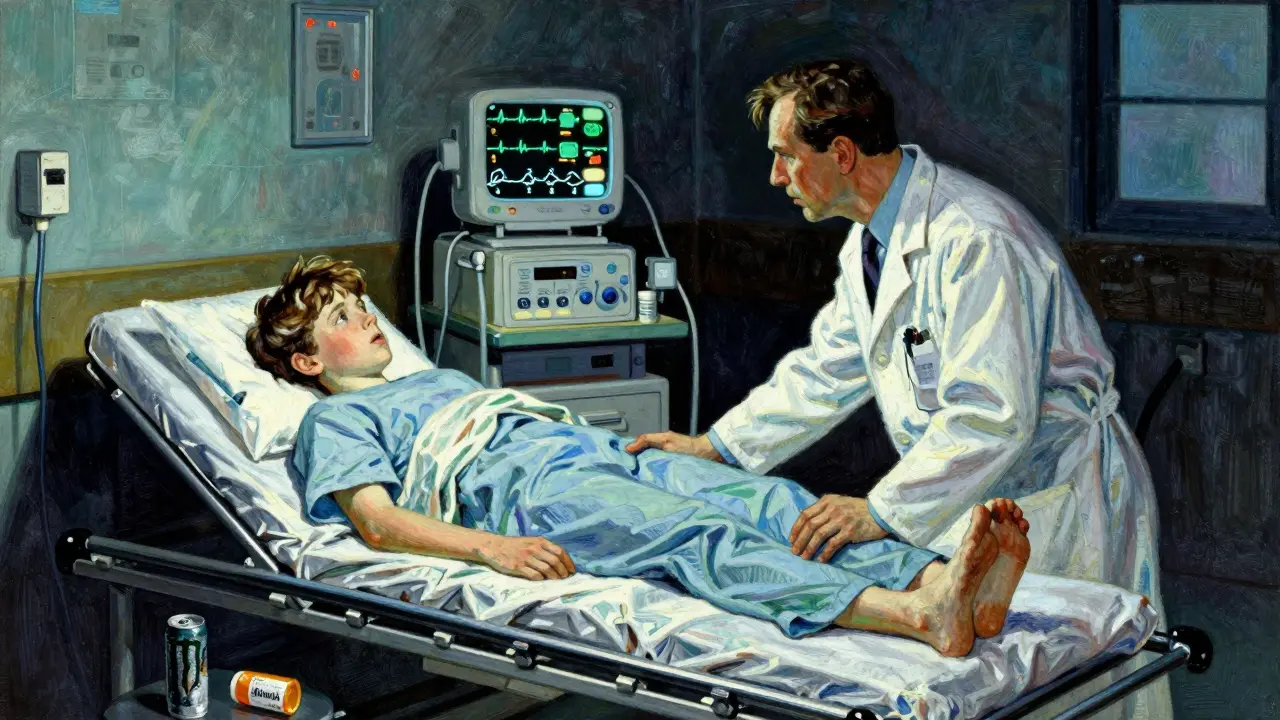
Real Stories, Real Consequences
Reddit threads and medical case reports tell the same story over and over. One user, u/BloodPressureWatcher, documented his BP rising from 120/80 to 145/95 after one 300 mg energy drink. Another, u/HeartPalpitations, said he felt his heart “racing out of his chest” for three hours after two Monster cans. He didn’t go to the ER-until his hands went numb. Emergency room data from America’s Poison Centers shows pediatric exposure to energy drinks jumped 24.2% between 2022 and 2023. Most of those cases were kids under 18, accidentally consuming drinks left on the counter or sharing them with friends. One 14-year-old boy ended up in the hospital with acute cardiomyopathy after drinking three energy drinks in one day. He had no prior health issues. Doctors on forums like Student Doctor Network are seeing a pattern: young patients with new-onset high blood pressure and rapid heart rate-no family history, no obesity, no smoking. Just daily energy drink use. One physician wrote, “I’ve started asking every patient under 25, ‘Do you drink energy drinks?’ If they say yes, I check their BP before anything else.”The Numbers Don’t Lie
Here’s what the science says about typical energy drink consumption and its effects:| Parameter | Average Increase | Peak Increase (Susceptible Individuals) |
|---|---|---|
| Systolic Blood Pressure | 4.8-6.9 mmHg | 20-30 mmHg |
| Diastolic Blood Pressure | 2.6-4.1 mmHg | 15-20 mmHg |
| Heart Rate | 5-12 bpm | 20-30 bpm |
| Circulating Adrenaline | 74.8% increase | Up to 200% in some cases |
The American Heart Association now says: energy drinks have no place in a healthy lifestyle. And if you have heart disease, high blood pressure, or are taking stimulant meds? They’re off-limits.
How Much Caffeine Is Safe?
The FDA says 400 mg of caffeine per day is safe for most adults. But that’s not a target-it’s a ceiling. And it doesn’t include other stimulants. A single 300 mg energy drink already puts you at 75% of that limit. Add a cup of coffee? You’re over. Add Adderall? You’re in danger zone. For teens, the American Academy of Pediatrics recommends no more than 100 mg per day. That’s less than one can of Red Bull. And yet, many teens consume 300-500 mg daily without realizing it. Here’s a quick reality check:- One 8.4 oz Red Bull = 80 mg caffeine
- One 16 oz Monster = 160 mg
- One 16 oz Bang = 300 mg
- One 12 oz coffee (drip) = 95 mg
- One Adderall XR 20 mg = equivalent to 150-200 mg caffeine in stimulant effect
Combine even one energy drink with one ADHD pill? You’re hitting 450-500 mg of stimulant load. That’s above the FDA’s daily limit-and you haven’t even started.
What Should You Do?
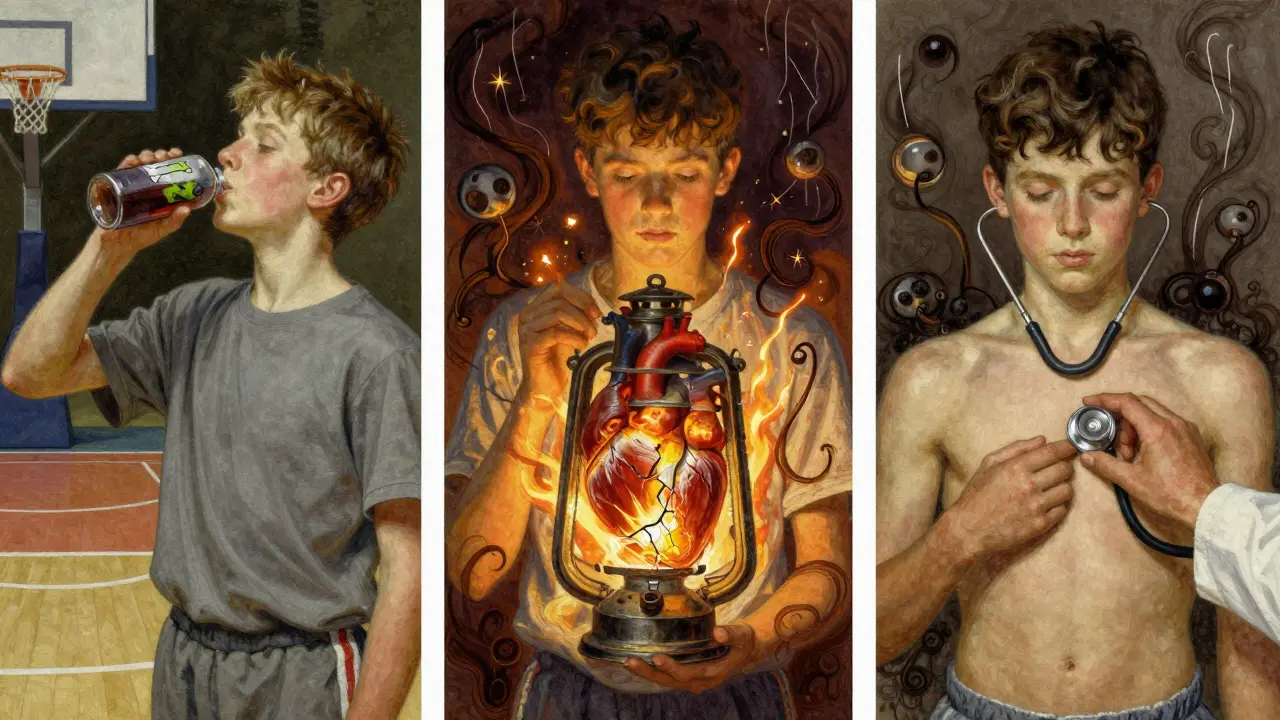
If you’re taking stimulant medication: avoid energy drinks entirely. No exceptions. Not even “one time.” The risk isn’t worth it. If you’re a teen or young adult who drinks energy drinks regularly: cut back slowly. Abruptly stopping can cause withdrawal headaches, fatigue, and irritability for up to a week. Replace them with water, herbal tea, or sparkling water with a splash of lime. Your heart will thank you. If you’re over 35 or have any heart concerns: talk to your doctor. Get your blood pressure checked. Ask if your meds interact with caffeine. Don’t assume you’re fine because you feel “fine.” High blood pressure doesn’t always come with symptoms. And if you’ve ever felt your heart race after an energy drink-really race, like it’s trying to jump out of your chest-that’s not normal. That’s your body screaming for help. Don’t ignore it.What to Watch For
These symptoms mean stop immediately and seek medical help:- Chest pain or pressure
- Heart palpitations lasting more than 5 minutes
- Severe headache or dizziness
- Difficulty breathing
- Blurred vision or fainting
These aren’t side effects. They’re warning signs of a heart attack, stroke, or arrhythmia. And they’re becoming more common in young people.
It’s Not Just About Caffeine
The real danger isn’t just the caffeine. It’s the combination. The marketing tells you “it’s just energy.” But what you’re consuming is a chemical cocktail designed to override your body’s natural limits. And your heart doesn’t have a reset button. Energy drink companies know this. They’ve been sued over 147 times since 2018 for not warning consumers about heart risks. One case in California ended with a $2.5 million settlement after a teenager died. The company didn’t deny it. They just changed the label. The science is clear. The data is overwhelming. And the people who are paying the price? They’re not old. They’re not overweight. They’re students, athletes, shift workers, and people trying to keep up. And they’re being misled. Your heart is not a battery. You can’t recharge it with sugar and stimulants. It needs rest. It needs balance. And it needs you to stop treating energy drinks like they’re harmless.Can energy drinks cause a heart attack?
Yes. Multiple case studies have linked energy drink consumption to heart attacks, especially in young people with no prior heart history. When combined with stimulant medications like Adderall or Ritalin, the risk multiplies. The surge in adrenaline and blood pressure can trigger coronary spasms, blood clots, or fatal arrhythmias.
Is it safe to drink energy drinks if I’m on ADHD medication?
No. Combining stimulant medications with energy drinks significantly increases your risk of dangerous spikes in blood pressure and heart rate. Studies show this combination can raise cardiovascular event risk by 3 to 5 times. Even one energy drink can push your system past a safe threshold. Doctors strongly advise complete avoidance.
How long does it take for energy drinks to raise blood pressure?
Blood pressure can rise within 15 to 30 minutes after consumption. Peak effects usually occur between 30 and 60 minutes. Even in healthy young adults, studies show an average increase of 6-10 mmHg in systolic pressure. In sensitive individuals, spikes of 20-30 mmHg have been documented.
What’s the safe daily caffeine limit for adults?
The FDA considers up to 400 mg of caffeine per day safe for most healthy adults. But this doesn’t include other stimulants like synephrine or guarana found in energy drinks. If you’re also taking stimulant medication, even 200 mg of caffeine can be risky. For teens, the recommended limit is 100 mg or less.
Are sugar-free energy drinks safer?
No. Sugar-free versions still contain the same high levels of caffeine and stimulants. The absence of sugar doesn’t reduce the cardiovascular strain. In fact, some sugar-free drinks contain even more caffeine and synthetic additives, which may worsen heart rhythm disturbances.
Can energy drinks cause long-term heart damage?
Yes. Emerging research from UC Davis Health shows that regular energy drink use may lead to endothelial dysfunction-a condition that damages the lining of blood vessels and is a known precursor to atherosclerosis and heart disease. This damage can build up over time, even if you don’t have immediate symptoms.

Jane Lucas
just drank a monster before my shift and now my heart feels like it’s gonna punch through my ribs. maybe i should stop.
Paula Alencar
It is imperative that we recognize this as a systemic public health failure, not merely an individual behavioral issue. The commodification of stimulant-induced euphoria under the guise of ‘energy’ represents a profound moral collapse in corporate ethics - one that preys upon the vulnerable, the sleep-deprived, the academically overwhelmed, and the emotionally exhausted. The normalization of these chemical cocktails in college dorms, high school locker rooms, and midnight work shifts is not a cultural quirk - it is a slow-motion epidemic masked as convenience. We must demand regulatory intervention, mandatory labeling of all synergistic stimulants, and public education campaigns that do not mince words: this is not a beverage. It is a cardiovascular gamble with odds stacked against the consumer.
Nikki Thames
You think this is about caffeine? No. This is about control. The pharmaceutical-industrial complex wants you dependent - on pills, on drinks, on the illusion that you need external chemical reinforcement to function. Your body is not broken. You are not lazy. You are being manipulated by a system that profits from your exhaustion. And now you’re poisoning your heart to keep up with a world that was never meant to be sustained this way. Wake up. The real drug isn’t in the can - it’s in the belief that you need it.
Chris Garcia
In my village in Nigeria, we drink bitter kola and ginger tea to stay alert - no synthetic chemicals, no hidden guarana, no corporate logos on the bottle. The body knows how to endure. It does not need to be hijacked by a 300mg chemical storm disguised as ‘performance enhancement.’ Modern life has forgotten that rest is not weakness - it is wisdom. To push your heart beyond its rhythm is not discipline - it is arrogance. Let your spirit rise, not your adrenaline. Let your mind find stillness, not chemical fireworks.
Elizabeth Alvarez
Have you noticed how every single energy drink brand uses the same neon colors and space-age fonts? That’s not marketing - that’s mind control. They’re conditioning us to associate hyper-stimulation with success. And the FDA? They’re in bed with the manufacturers. They’ve known for decades. The ‘400mg safe limit’? A joke. It’s based on old studies from the 80s before they added synephrine, taurine, and L-theanine in combo packs. The real danger? They’re testing these on teens and young adults because their hearts are still plastic - malleable. They’re building lifelong arrhythmias in a generation that thinks ‘vibes’ are a health metric. The next pandemic won’t be viral - it’ll be cardiac. And they’ll call it ‘sudden unexplained death in the young.’
Will Neitzer
Thank you for this meticulously researched and profoundly important post. The convergence of prescription stimulant use with unregulated energy drink consumption represents one of the most underreported cardiovascular threats in contemporary American youth culture. The physiological synergy between amphetamine derivatives and proprietary stimulant blends is not merely additive - it is multiplicative, and the clinical literature overwhelmingly confirms this. I have personally counseled three patients under the age of 22 in the past six months who presented with new-onset atrial fibrillation after chronic co-consumption. Their cardiac echoes were normal prior to use. Their lifestyles were otherwise pristine. The only variable? The Monster. The Bang. The Adderall. We must institutionalize screening protocols. We must mandate warning labels on every can. And we must stop treating this as a personal choice - it is a public health emergency.
Janice Holmes
OMG. I just read this and I’m literally shaking. I’ve been drinking 2 Bangs a day with my Adderall for 3 years. My cardiologist said I’m ‘fine’ but I’ve had palpitations since college. I thought it was just anxiety. But now I realize - it’s not anxiety. It’s my heart screaming. I’m done. I’m switching to green tea and meditation. My soul is tired of being electrocuted.
Miriam Piro
This is all part of the Great Reset. The elites want us weak, dependent, and distracted. Energy drinks? They’re laced with microchips - not literally, but chemically. The taurine and synephrine? Designed to destabilize your autonomic nervous system so you’re more compliant. The 300mg caffeine? It’s not to wake you up - it’s to keep you from sleeping so you can’t think clearly. They’re eroding your willpower, your intuition, your connection to your body. And the doctors? They’re paid by Big Pharma to say it’s ‘safe.’ I’ve seen the documents. They’ve known since 2015. This isn’t a health crisis - it’s a social engineering project. Your heart is the battlefield. Stop drinking the poison. Start questioning everything.