Topical Steroid Potency Selector
Find Your Safe Steroid Strength
Select your body area and condition to get personalized guidance on appropriate steroid potency based on medical guidelines.
Recommended Steroid Strength
Potency Class
Duration
Warning: Use only as directed. Prolonged use can cause skin damage.
Fingertip Unit (FTU)

One FTU = amount from first crease to fingertip. Covers two adult palms.
Apply once or twice daily as directed. Do not exceed recommended duration.
Using a topical steroid might feel like a quick fix for eczema, psoriasis, or a stubborn rash-but using the wrong strength can damage your skin faster than it heals it. Skin thinning, redness, stretch marks, and even permanent blood vessel damage aren’t rare side effects. They’re common when people use high-potency steroids on the face, neck, or for too long. The good news? You don’t have to guess what’s safe. A topical steroid potency chart exists for exactly this reason: to match the right strength to your skin condition and body area, so you get relief without the risk.
What Does Steroid Potency Even Mean?
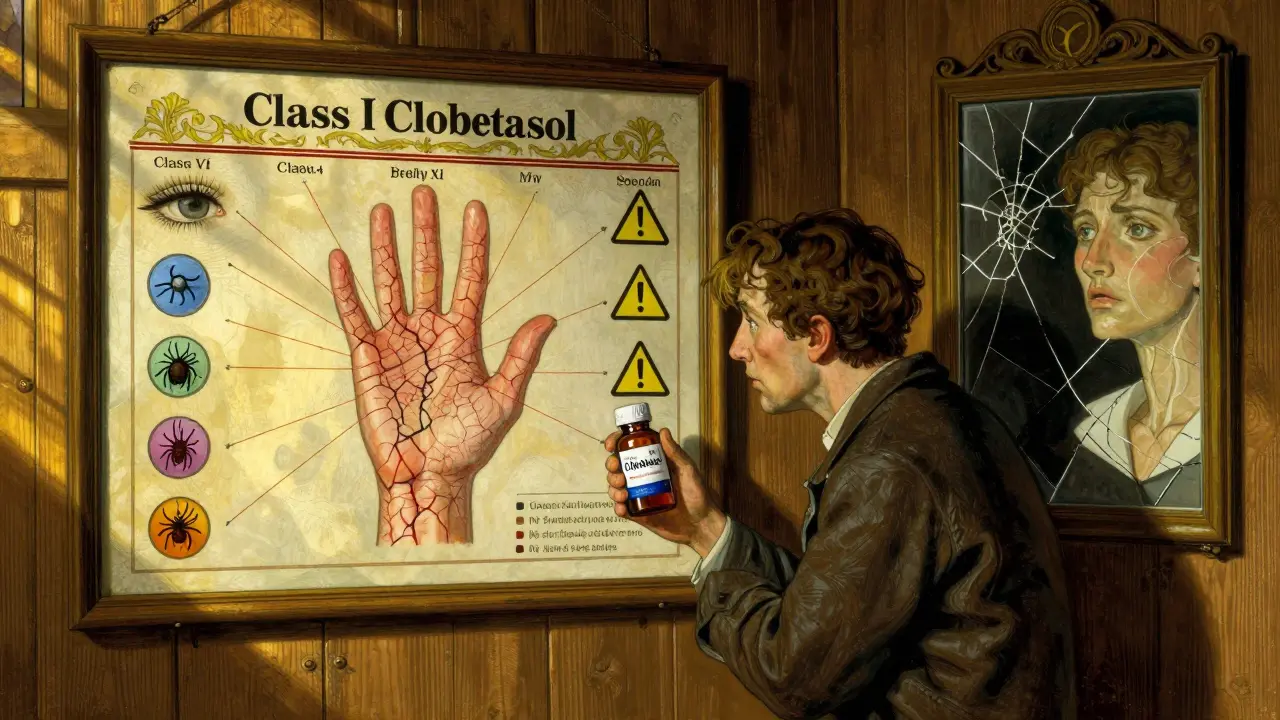
Potency isn’t about how strong you feel it works-it’s a scientifically measured number based on how much the steroid shrinks blood vessels in the skin. This is called a vasoconstrictor assay. The more it shrinks those tiny capillaries, the stronger the steroid. This isn’t opinion. It’s lab-tested, peer-reviewed science. In the U.S., steroids are ranked from Class I (superpotent) to Class VII (least potent). The UK uses a simpler four-tier system: mild, moderate, potent, very potent. Both systems exist to stop people from using a Class I steroid like clobetasol on their eyelids-something that can cause permanent skin thinning in weeks. Here’s what those classes actually look like in real products:- Class I (Superpotent): Clobetasol propionate 0.05% (Temovate), halobetasol 0.05% (Ultravate)
- Class II (High-potent): Betamethasone dipropionate 0.05% (Diprosone), mometasone furoate 0.1% (Elocon)
- Class III (Potent): Triamcinolone acetonide 0.1% (Kenalog)
- Class IV-V (Moderate): Fluticasone propionate 0.005% (Cutivate), clobetasone butyrate 0.05% (Eumovate)
- Class VI-VII (Mild): Hydrocortisone 1% (Cortizone-10), hydrocortisone butyrate 0.1% (Locoid)
Don’t assume a stronger name means a stronger steroid. Advantan (methylprednisolone aceponate) is 30% less potent than Elocon, even though both are in the same general category. The active ingredient and its concentration matter more than the brand.
Why Your Skin Area Changes Everything
Your skin isn’t the same everywhere. The skin on your eyelids, armpits, groin, and inner thighs is 3 to 5 times thinner than the skin on your back or legs. That means it absorbs steroids faster-and gets damaged faster. That’s why guidelines are strict:- Face, eyelids, neck: Only mild steroids (Class VI-VII). Even moderate ones like hydrocortisone 2.5% can cause redness and thinning if used daily for more than 2 weeks.
- Armpits, groin, genitals: Mild to moderate only. Potent steroids here can cause irreversible skin changes.
- Body, arms, legs: Moderate to potent steroids are okay for short bursts (1-2 weeks), but never for months.
- Palms and soles: These are thick skin. You can use potent or superpotent steroids here, but only under doctor supervision.
A 2020 study found that 42% of patients used moderate or high-potency steroids on their faces-often because the label didn’t say “avoid on face.” That’s why the FDA now requires potency class to be printed on every prescription label, starting January 2023.
How Much Should You Use? The Fingertip Unit Rule
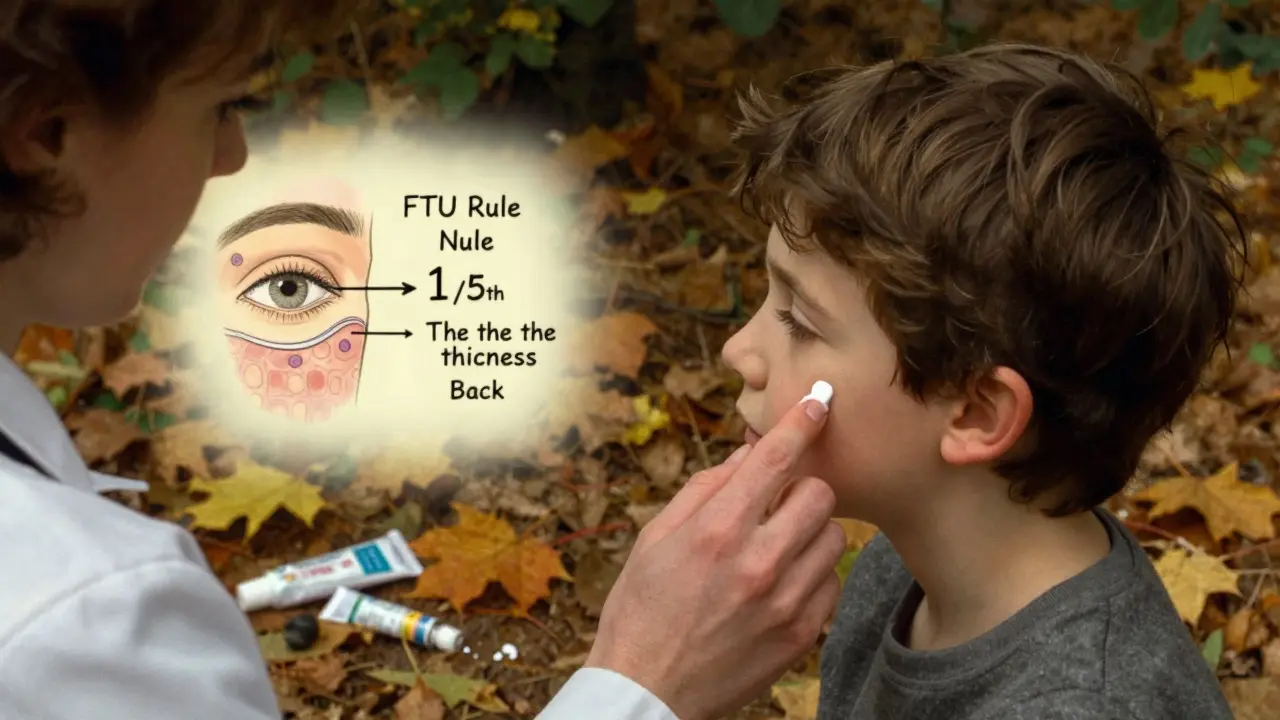
Most people use way too much. One study found 35% of patients apply 2-3 times the recommended amount. That’s not just wasteful-it’s dangerous. The solution? Use the fingertip unit (FTU). One FTU is the amount of cream or ointment you can squeeze from a standard tube onto the tip of your index finger, from the first crease to the tip. One FTU covers an area equal to two adult palms. Here’s how to use it:- Mild steroids (Class VI-VII): Apply once or twice daily for 2-4 weeks.
- Moderate steroids (Class IV-V): Once daily for 1-2 weeks max.
- Potent to superpotent (Class I-III): Once daily for 3-7 days only.
For kids under 12, cut the dose in half-or even by 75%. Their skin absorbs steroids much faster. A child using a potent steroid for 3 weeks can develop adrenal suppression, a serious condition where the body stops making its own cortisol.
When to Stop-and What to Do Next
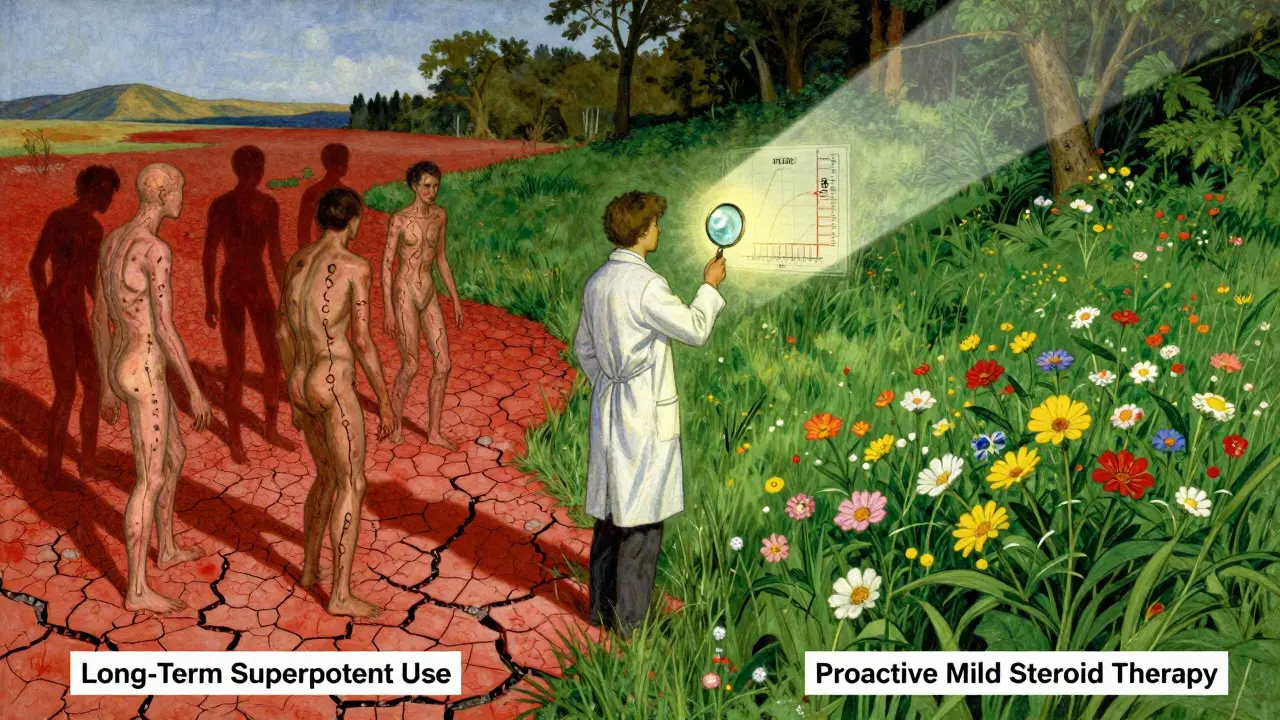
Steroids are not long-term solutions. The American Academy of Family Physicians says no high-potency steroid should be used for more than 3 weeks straight. Even moderate ones shouldn’t go beyond 3 months. If your rash clears up in 5 days, stop the steroid. Don’t keep using it “just in case.” If it comes back, that’s when you need a different approach-not a stronger steroid. Many people now use “proactive therapy”: applying a mild steroid like hydrocortisone 1% twice a week to areas that used to flare up. The 2021 TRAIN study showed this cuts eczema flares by 68% over 16 weeks. It’s safer than waiting for a flare and then hitting it with a potent steroid.What Happens When You Use Too Much?
Side effects aren’t just “possible.” They’re predictable-and preventable.- Skin thinning: Visible veins, easy bruising, stretch marks. Happens in 29% of people using Class I steroids for more than 3 weeks.
- Telangiectasia: Permanent red spider veins. Seen in 12% of those using Class II-III steroids for over 3 months.
- Perioral dermatitis: Red, bumpy rash around the mouth. Often triggered by steroid use on the face.
- Rebound flares: Your skin gets worse after stopping the steroid. This isn’t addiction-it’s withdrawal from overuse.
One Reddit user, u/EczemaWarrior, shared: “I used clobetasol on my arms for 6 months because I thought it was the only thing that worked. When I stopped, my skin burned for weeks. I didn’t know it was supposed to be for 7 days max.”
These aren’t rare horror stories. They’re textbook outcomes of ignoring potency charts.
What About Newer Steroid-Free Options?
The landscape is changing. Drugs like crisaborole (Eucrisa) and ruxolitinib (Opzelura) are now first-line for mild-to-moderate eczema and psoriasis. They don’t cause skin thinning. But they’re slower. In psoriasis, superpotent steroids clear 85% of plaques in 4 weeks. Ruxolitinib does 72%. That’s close-but without the side effects. Many dermatologists now start with non-steroidal options for sensitive areas and reserve steroids for short-term flares. Potency charts help you see when steroids are truly needed-and when they’re just a crutch.What Should You Do Right Now?
If you’re using a topical steroid:- Check the label. Look for the potency class (Class I-VII or mild/moderate/potent/very potent).
- Ask yourself: Where am I applying it? Is it on my face, groin, or eyelids? If yes, and it’s not mild, stop.
- Count how many weeks you’ve used it. If it’s more than 2 weeks for moderate, or 7 days for potent, talk to your doctor.
- Use the fingertip unit. One squeeze per two palm-sized areas. No more.
- Don’t keep it “just in case.” If it’s not flaring, don’t use it.
If you’re unsure, download the National Psoriasis Foundation’s updated potency chart (January 2023 version). It’s free, easy to read, and includes comparisons to non-steroidal options.
Final Thought: Potency Charts Save Skin
A 2021 study showed that when doctors use potency charts, adverse events drop by 45%. That’s not a small number. It means nearly half the skin damage from steroids is preventable. You don’t need to be a dermatologist to use a potency chart. You just need to know that stronger isn’t better. Sometimes, the safest choice is the mildest one that still works.Your skin is not a battleground. It’s a barrier. Treat it like one.
Can I use a potent steroid on my face if I only use it once a week?
No. Even once a week, potent or superpotent steroids can cause skin thinning, redness, and visible blood vessels on the face. The skin there is too thin. Stick to mild steroids (Class VI-VII) like hydrocortisone 1% for facial use, even for maintenance. If your facial rash isn’t improving with mild steroids, see a dermatologist-you may need a non-steroidal option.
Is hydrocortisone 2.5% stronger than hydrocortisone 1%?
Yes, but only slightly. Both are classified as Class VII (least potent) in the U.S. system. The 2.5% version is about 2.5 times stronger, but it’s still not considered a moderate steroid. It’s fine for short-term use on thick skin (like hands or feet), but avoid it on the face, groin, or for children under 2. For most cases, 1% is just as effective and safer.
Why does my doctor say I can’t use clobetasol for more than 2 weeks?
Clobetasol is a Class I (superpotent) steroid. Studies show that using it for longer than 2-3 weeks significantly increases the risk of skin atrophy (thinning), stretch marks, and even adrenal suppression. Your doctor isn’t being overly cautious-they’re following evidence-based guidelines from the FDA and American Academy of Dermatology. If your condition hasn’t improved in 2 weeks, it’s time to reassess the diagnosis, not increase the steroid.
Are ointments stronger than creams?
Yes, and that’s not because of the steroid-it’s because of the base. Ointments are greasier and create a better seal on the skin, which lets more of the steroid absorb. For the same active ingredient, an ointment can be 15-20% more effective than a cream. That’s why doctors often prescribe ointments for dry, thick skin (like on elbows or legs) and creams for weepy or sensitive areas. Always check if your product is an ointment or cream when comparing potency.
Can kids use the same steroids as adults?
No. Children have thinner skin and a higher skin surface area relative to body weight-up to 5 times more absorption than adults. That means even moderate steroids can cause systemic side effects like adrenal suppression in kids. The American Academy of Pediatrics recommends using only mild to moderate steroids for children, cutting the dose by 50-75%, and limiting treatment to 7-14 days. Never use superpotent steroids on children unless under strict specialist supervision.
I used a strong steroid for months and now my skin is thin and red. Can it recover?
It can improve, but not always fully. Skin thinning from long-term steroid use can take months or even years to recover, and some changes like visible blood vessels may be permanent. The first step is stopping the steroid. Then, focus on barrier repair: use fragrance-free moisturizers daily, avoid hot showers, and protect the area from sun. In severe cases, dermatologists may recommend laser treatments for telangiectasia or prescribe non-steroidal anti-inflammatories. Don’t try to fix it with another steroid-that will make it worse.
If you’re unsure about your steroid use, ask your pharmacist or doctor to walk you through your prescription using a potency chart. Most clinics have them printed out. Don’t wait until your skin is damaged-understanding potency now can save you from years of recovery.




Sue Stone
Just used hydrocortisone 1% on my eyelids for three days after a flare-up. No issues. I used to go straight for the strong stuff like it was magic cream. Not anymore. Learned the hard way.
My dermatologist showed me the fingertip rule and it changed everything. I used to waste half a tube a week. Now I’m down to one tube every three months.
Also, ointments are way better for dry patches. Creams just evaporate. I use the ointment version of hydrocortisone on my elbows and it actually works.
Don’t let the brand name fool you. Eumovate and Cortizone-10 are both mild. Same class. Different price tags.
My mom used clobetasol on her face for years. Got telangiectasia. Permanent red veins. Scary stuff.
Stop thinking ‘stronger = better.’ Sometimes the mildest thing is the only thing that doesn’t wreck you.
Also, kids? Use half. Or less. Their skin drinks it up like a sponge.
And yes, you can’t just ‘use it once a week’ on your face. It’s not a cheat code. It’s still damage.
Thanks for the chart. I printed it and taped it to my medicine cabinet.
Anna Pryde-Smith
THIS IS WHY PEOPLE DIE FROM SKIN CARE. I used clobetasol on my neck for six months because my acne didn’t go away. Now my skin looks like tissue paper and I can’t wear collars. I’m 28. I look 60. And I’m not even joking. The doctor laughed when I said I thought it was ‘just a cream.’
NOBODY TELLS YOU THIS. NOT THE ADVERTISEMENTS. NOT THE PHARMACIST. NOT EVEN GOOGLE. YOU JUST GET A PRESCRIPTION AND THINK ‘STRONGER = FASTER.’
IF YOU’RE USING ANYTHING ABOVE HYDROCORTISONE 1% ON YOUR FACE, YOU’RE DOING IT WRONG. STOP. NOW. GO LOOK AT THE CHART. I’M SERIOUS.
THEY SHOULD PUT WARNING STICKERS ON THE TUBES LIKE CIGARETTES.
Janet King
Topical steroids are classified by vasoconstrictor potency in standardized assays. Class I agents such as clobetasol propionate demonstrate >90% vasoconstriction at 0.05% concentration in vivo. Class VII agents like hydrocortisone 1% demonstrate <20%.
Application area determines absorption rate due to stratum corneum thickness. Facial skin has approximately 15 layers versus 30+ on the dorsum of the hand.
Fingertip unit dosing reduces systemic absorption by 60-70% compared to unguided application. This is supported by multiple randomized controlled trials.
Rebound flares occur due to downregulation of glucocorticoid receptors after prolonged exposure. Proactive therapy with low-potency steroids twice weekly reduces relapse by 68% as per the TRAIN study.
Non-steroidal alternatives such as crisaborole inhibit PDE4 and reduce inflammation without dermal atrophy. Efficacy is slightly lower but safety profile is superior for chronic use.
Children under 12 have a 3-5x higher systemic absorption rate per unit area. Adrenal suppression is documented at doses exceeding 1g of potent steroid per week.
Always verify potency class on prescription labels. FDA mandate effective January 2023 requires this information to be printed.
Do not confuse vehicle with potency. Ointment bases enhance penetration by 15-20% due to occlusion. Creams are less effective for lichenified lesions.
Permanent telangiectasia results from capillary endothelial damage. Recovery is incomplete in over 40% of cases after discontinuation.
Consult a dermatologist if flare persists beyond 14 days. Prolonged use without diagnosis reassessment is inappropriate.
Stacy Thomes
OMG I JUST REALIZED I’VE BEEN USING MY DAD’S CLOBETASOL ON MY ARMS FOR TWO YEARS. I THOUGHT IT WAS JUST ‘STUFF THAT WORKS.’
MY SKIN IS SO THIN NOW I CAN SEE THE BLUE LINES UNDER MY ELBOWS. I’M SO SCARED.
HOW DO I FIX THIS??
I JUST STOPPED IT TODAY. I’M GOING TO BUY HYDROCORTISONE AND A LOT OF CERAVE. PLEASE TELL ME I’M NOT TOO LATE.
THIS POST SAVED ME. THANK YOU.
Dawson Taylor
Empirical evidence supports the use of potency classification to reduce iatrogenic dermatopathies. The vasoconstrictor assay remains the gold standard for ranking topical corticosteroids.
Regional skin thickness modulates transdermal absorption. Facial, genital, and axillary regions exhibit 3-5x greater permeability.
Chronic use of Class I-II agents beyond 2 weeks correlates strongly with dermal atrophy and telangiectasia.
FTU dosing reduces overapplication by 70%.
Proactive therapy reduces recurrence by 68%.
Non-steroidal alternatives are viable for maintenance.
Children require dose reduction. Adrenal suppression is preventable.
Labeling changes mandated by FDA are a necessary step.
Education, not fear, is the solution.
Laura Rice
my bestie used to slather clobetasol on her face like it was moisturizer and now she has these red spider veins everywhere and she says she can't wear makeup without it looking like a ghost
she's 24. she looks like she's 65
i showed her this chart and she cried for an hour
we're both using hydrocortisone 1% now and i swear my eczema hasn't flared in 3 months
you don't need magic cream. you need patience. and a chart.
also, ointments are the real MVP. creams are for people who don't care about results.
charley lopez
Topical corticosteroids exert their effect via genomic and non-genomic pathways, primarily through transrepression of NF-κB and AP-1 transcription factors. Potency is directly proportional to receptor binding affinity and lipophilicity.
Class I agents possess high lipophilicity and prolonged tissue retention, increasing risk of cutaneous atrophy.
FTU methodology is validated in multiple clinical guidelines including those from the American Academy of Dermatology and the British Association of Dermatologists.
Systemic absorption in pediatric populations is quantitatively higher due to increased surface area-to-body mass ratio and immature skin barrier function.
Non-steroidal PDE4 inhibitors (e.g., crisaborole) exhibit comparable efficacy in mild-to-moderate atopic dermatitis with superior long-term safety profile.
Rebound phenomena are not 'addiction' but pharmacological withdrawal from chronic receptor modulation.
Adrenal suppression is a documented risk with prolonged use of potent agents, particularly in children.
Recommendation: adhere strictly to potency-class-specific duration guidelines. Do not extrapolate off-label use.
Kerry Evans
People are so irresponsible with medicine. You don’t just use a Class I steroid because your skin is ‘itchy.’ That’s not treatment, that’s self-sabotage.
I’ve seen this exact thing happen in clinics. Someone comes in with thin, red skin and says, ‘I thought it was helping.’ No. It was destroying you.
You don’t get to decide what’s safe. The science does. The charts exist for a reason.
If you’re using anything stronger than hydrocortisone 1% on your face, you’re either ignorant or arrogant. Pick one.
And yes, ointments are stronger. That’s not a feature. It’s a warning.
Stop being lazy. See a doctor. Don’t self-medicate like a toddler with a glue stick.
Susannah Green
Okay, so I just read this and I’m like-WAIT. I’ve been using mometasone (Elocon) on my eyelids for like 8 months. I thought it was ‘just a cream.’
It’s Class II. That’s HIGH potency. I’m supposed to use it for 7 days max. I’ve been using it every day.
My skin feels like tissue paper now. I’m terrified.
But I just stopped. I bought hydrocortisone 1% and CeraVe. I’m using the fingertip rule-ONE SQUEEZE PER TWO PALMS. I’m writing it on my bathroom mirror.
Also-why do pharmacies not explain this? I’ve bought this stuff 10 times and no one ever said ‘don’t use this on your face.’
Thank you for this. I feel like I just got a second chance at my skin.
Kerry Moore
Thank you for this comprehensive and evidence-based overview. The integration of clinical guidelines with real-world application is exceptionally well-articulated.
It is concerning that patient education on topical steroid use remains grossly inadequate, even among those with chronic dermatologic conditions.
The emphasis on potency classification, regional skin differences, and FTU dosing aligns precisely with current best practices as outlined in UpToDate and the JAAD guidelines.
Proactive therapy with low-potency steroids is an underutilized strategy with strong data supporting its efficacy.
I will be sharing this with my patients tomorrow. This is the kind of resource that should be distributed at every pharmacy and dermatology clinic.
Well done.
Oladeji Omobolaji
Man, this is wild. I’m from Nigeria and we don’t even have these charts here. People just buy whatever’s cheapest or looks strong.
My cousin used ‘strong cream’ on his face for 2 years. Now his skin is cracked and red. He thinks it’s ‘just dry.’
I showed him this and he said, ‘But it used to stop the itching!’
Yeah, but now your skin can’t protect you anymore.
Thanks for making this clear. I’m printing it for my family.
Vanessa Barber
Wow. So you’re saying I’m not supposed to use clobetasol on my scalp? But it’s the only thing that stops my dandruff from flaking like snow.
Also, I read somewhere that ‘topical steroids don’t absorb into the blood’-so why are you acting like they’re poison?
I think this is just fear-mongering. My aunt used steroid cream for 20 years and she’s fine.
Also, why do dermatologists make this so complicated? Can’t we just use what works?
dana torgersen
so like… i think this is all kinda overblown? like, sure, steroids can be bad, but people have been using them for decades and we’re still here?
also, i think the ‘fingertip unit’ is just a fancy way of saying ‘use a little’
and why is everyone so scared of clobetasol? i’ve seen people use it on their elbows for months and they’re fine
also, i think the FDA is just trying to make more money off labels
and what about the people who don’t have access to dermatologists? do they just suffer?
also, i think ‘proactive therapy’ sounds like a buzzword
and why is everyone so formal about this? it’s just cream. it’s not rocket science.
also, i think the real problem is that people are too scared to use medicine
Sallie Jane Barnes
I’ve been using hydrocortisone 1% on my hands twice a week for six months now-just on the spots that used to flare. No more burning. No more peeling. No more hiding my hands.
It’s not glamorous. It’s not exciting. But it’s working.
I used to think I needed to ‘fight’ the eczema with strong stuff. Turns out, I just needed to gently hold it back.
This chart is the quiet hero I didn’t know I needed.
Thank you for sharing this. I’m not alone anymore.
Andrew Smirnykh
I used to think potency was about how fast it worked. Now I know it’s about how long it destroys you.
My dermatologist showed me the chart and I felt stupid for not knowing. But I’m glad I know now.
I stopped using my potent steroid on my neck. My skin’s already less red in two weeks.
It’s not about being ‘strong.’ It’s about being smart.
Thanks for the clarity. I’m sharing this with my whole family.