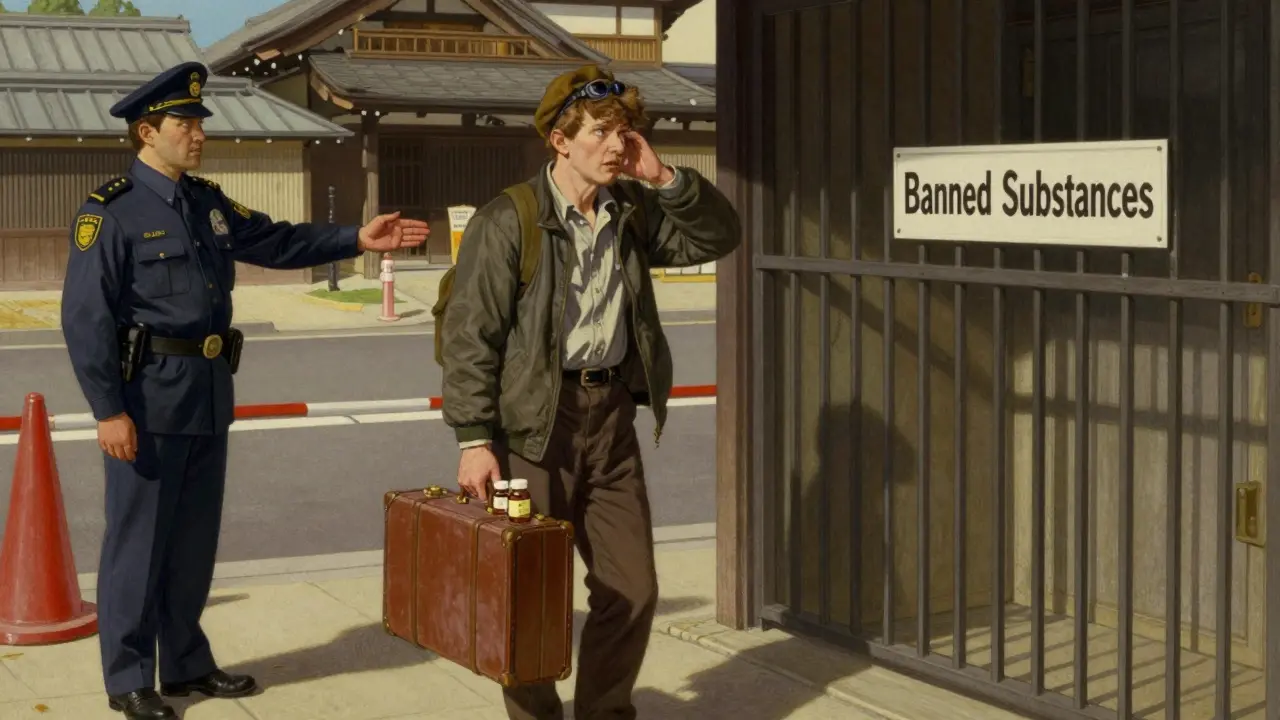
Imagine landing in Tokyo with your anxiety medication in your bag-only to have it confiscated at customs because it’s illegal there, even with a doctor’s note. Or trying to refill your ADHD prescription in Dubai and being told you need a government permit you didn’t know existed. These aren’t rare horror stories. They happen to thousands of travelers every year, and most of them are completely avoidable.
If you’re planning to travel internationally and rely on prescription meds, you can’t just pack your bottles and hope for the best. The rules change with every border. What’s legal in the UK might be a felony in Singapore. What’s over-the-counter in Mexico could require a special permit in Australia. And if you’re carrying controlled substances like opioids, benzodiazepines, or stimulants, you’re walking into a minefield of international drug laws.
Know Your Medication’s Status in Your Destination Country
Before you even pack your suitcase, find out if your medication is allowed where you’re going. This isn’t optional. The International Narcotics Control Board (INCB) keeps a database of country-specific rules, but only 68 out of nearly 200 countries have officially submitted their regulations as of October 2025. That means for more than half the world, you’re flying blind unless you do your own digging.
Start with the embassy or consulate website of your destination country. Look for sections like “Travel Advice,” “Health Requirements,” or “Medications.” Many embassies list banned substances explicitly. For example:
- Japan bans hydrocodone, oxycodone, and even some cough syrups with codeine.
- Singapore allows only 14 days’ supply of any controlled substance-even if your prescription is for 90 days.
- The UAE requires pre-approval for zolpidem (Ambien), alprazolam (Xanax), and even some ADHD meds like Adderall.
- Thailand permits most medications with a prescription, but bans all benzodiazepines without a special license.
- Australia and New Zealand ban pseudoephedrine, which is in many cold and allergy pills sold over the counter in the U.S.
Don’t rely on Google searches or forums alone. Some sites list outdated info. Always cross-check with official government sources. If you can’t find clear info, email the embassy directly. Ask: “Is [generic drug name] permitted for personal use by travelers with a valid prescription?” Include the exact name of your medication, both brand and generic.
Carry the Right Documentation-Every Time
Having your prescription isn’t enough. You need proof that the medication is yours and that it’s legally prescribed. Most countries require three things:
- Original containers with pharmacy labels showing your name, the drug name, dosage, and prescribing doctor.
- A doctor’s letter on official letterhead, written in English, that includes your diagnosis using ICD-11 codes (like F41.1 for generalized anxiety disorder), the reason for the medication, dosage, and duration of treatment.
- A notarized translation if the destination country doesn’t use English. This is mandatory in 62% of non-English-speaking countries.
The CDC’s 2025 Yellow Book says 97% of countries require the patient name on the prescription to match your passport exactly. That’s why you can’t just carry someone else’s prescription-even if it’s the same drug. I’ve seen travelers get detained because their prescription said “J. Smith” but their passport said “Jane Smith.”
Keep copies of everything separate from your meds. Put one set in your checked luggage, one in your carry-on, and email a scanned copy to yourself. If customs seizes your pills, you’ll need these to prove you’re not smuggling drugs.
Quantity Limits Are Not Suggestions
Most countries allow you to bring in a 90-day supply for personal use. That’s the standard. But Japan limits narcotics to 30 days. Singapore caps it at 14. Canada and the EU are more flexible-they let you bring in a full 90-day supply if you have proper documentation.
Don’t assume “enough for your trip” means you’re safe. If you’re staying for 60 days but bring 120 pills, you might be flagged as intending to resell. If you’re bringing 200 pills for a 10-day trip, you’ll raise red flags. Stick to the 90-day rule unless you know the destination has stricter limits.
For controlled substances, it’s smarter to bring the minimum you’ll need. If you’re going to be abroad for three months, consider getting a local prescription once you arrive instead of hauling a huge supply. More on that next.
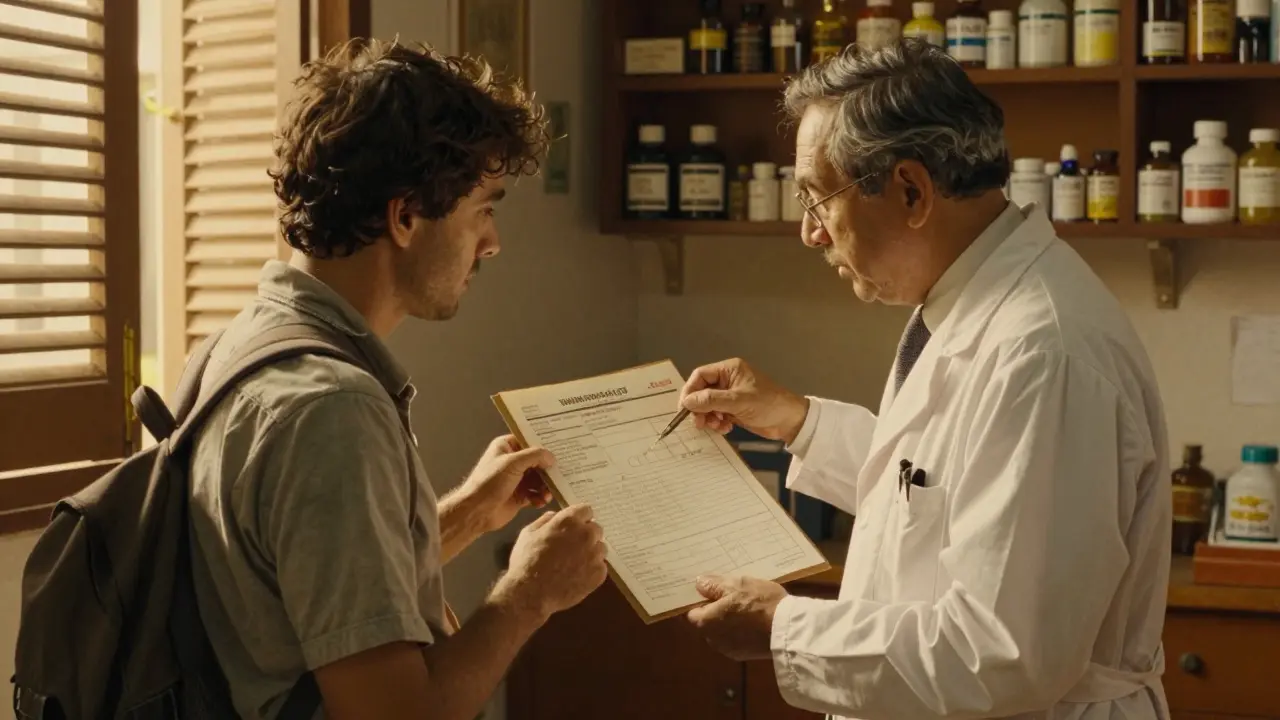
Getting a Local Prescription Abroad
Some countries let you see a local doctor and get a prescription filled right away. Others make it nearly impossible. The EU is the easiest: if you have a valid prescription from an EU country, you can usually get it filled anywhere else in the bloc. That’s thanks to the European Prescription system, which works across 24 countries.
Outside the EU, it’s a gamble. In Thailand, you can walk into a pharmacy with a U.S. prescription and often get the same medication without issue. In Malaysia, even diazepam (Valium) is completely banned-no exceptions. In the UAE, you need a Ministry of Health permit before you even arrive. That process can take weeks.
If you think you’ll need to refill abroad:
- Ask your doctor for a letter explaining your condition and treatment plan. This helps local doctors understand your needs.
- Find a clinic that accepts international patients. Use the International Association for Medical Assistance to Travellers (IAMAT) network-they’ve vetted over 1,400 clinics worldwide.
- Bring your medical records. Some countries require blood tests or recent lab results before prescribing.
- Be ready to pay out-of-pocket. Most foreign clinics don’t take foreign insurance.
One traveler I spoke with, a British expat living in Bangkok, got her sertraline refilled at a local hospital for $5 a month-far cheaper than in the UK. But she had to wait three weeks for a doctor’s appointment and provide a full medical history. Plan ahead.
What Medications Cause the Most Problems?
Some drugs are red flags everywhere. Based on 2025 data from the CDC and WHO, here are the top troublemakers:
- Benzodiazepines (Xanax, Valium, Klonopin): Banned in Malaysia, Singapore, UAE, and parts of Southeast Asia. 43% of all medication-related travel incidents involve these.
- ADHD stimulants (Adderall, Ritalin): Treated as illegal narcotics in Japan, UAE, and Singapore. Even with a prescription, you need special permits.
- Opioids (oxycodone, hydrocodone, codeine): Illegal in Japan, Thailand, and many Middle Eastern countries. Even small amounts can trigger criminal charges.
- Pseudoephedrine: Found in Sudafed and many cold remedies. Banned in Australia, New Zealand, UAE, and parts of Asia because it’s used to make methamphetamine.
- Insulin and injectables: Usually allowed, but always carry a doctor’s note. Some countries require you to declare them at customs.
If you’re on any of these, treat them like high-risk items. Don’t just pack them. Plan for them.
How to Prepare: A 90-Day Checklist
Getting this right takes time. Start early. Here’s a realistic timeline:
- 90 days before travel: Check your destination’s official rules. Contact the embassy. Make a list of every medication you take.
- 75 days before: Schedule an appointment with your doctor. Get the letter with ICD-11 codes. Ask for a copy of your prescription in both brand and generic names.
- 60 days before: If your medication is controlled, apply for any required permits. In the UAE, this means emailing the Ministry of Health with your documents.
- 45 days before: Get translations notarized if needed. Buy a small travel pill organizer with your name on it.
- 30 days before: Pack your meds in original containers. Keep them in your carry-on. Don’t check them.
- 7 days before: Call your airline. Ask about their policy on carrying medications. TSA allows medically necessary liquids over 3.4 oz if declared-so know your rights.
On average, travelers spend 6.2 hours just researching this stuff. If you’re on controlled substances, it’s closer to 19 hours. Don’t wait until the airport to figure it out.
What If Something Goes Wrong?
Even with perfect preparation, things can go sideways. Your meds get seized. A pharmacy refuses to fill your prescription. You run out.
If that happens:
- Stay calm. Don’t argue with customs. It makes things worse.
- Call your country’s embassy immediately. They can’t get your meds back, but they can help you find a local doctor or connect you with support services.
- Use IAMAT’s network. They have clinics in 1,400 cities that know how to handle international patients.
- Check if your destination allows telemedicine. As of September 2025, 41 countries let tourists consult local doctors online and get prescriptions emailed to pharmacies.
One traveler in Dubai lost her zolpidem to customs. She spent three days in her hotel room unable to sleep. She called the British Embassy, who connected her with a local psychiatrist. Within 48 hours, she had a new prescription-same dosage, same effect. She didn’t need to cancel her trip.
What’s Changing in 2026?
Good news: things are slowly getting better. The WHO introduced a new standardized international medication form in May 2025. By 2026, it’ll be adopted by more countries, making doctor’s letters easier to accept.
The U.S. is also moving forward. The Affordable and Safe Prescription Drug Importation Act of 2025 lets Americans legally import 90-day supplies from certified pharmacies in Canada, the UK, EU, and Switzerland. It starts May 1, 2026.
And the EU is working toward full prescription interoperability by 2028. That means your e-prescription from Germany will work in Italy, Poland, or Greece without a hitch.
But until then, the system is still a patchwork. You still need to do the work.
Final Tips from Real Travelers
Here’s what experienced travelers say works:
- Always carry meds in original bottles. No ziplock bags.
- Never put your entire supply in one bag. Split it between carry-on and checked luggage.
- Take a photo of your prescription and doctor’s letter on your phone. Backup, backup, backup.
- Use the TSA Cares program if flying from the U.S.-they’ll help you get through security faster.
- Don’t assume your pharmacy will ship abroad. Most won’t, and it’s illegal in many places.
- When in doubt, leave it behind and refill locally. It’s safer than risking arrest.
Traveling with medication isn’t about luck. It’s about preparation. The world doesn’t have one set of rules-it has hundreds. Your job isn’t to change them. It’s to understand them.
Can I bring my prescription meds on a plane?
Yes, but only if they’re in their original containers with pharmacy labels showing your name. You can carry them in your carry-on. The TSA allows medically necessary liquids over 3.4 ounces if you declare them at security. Never check your meds-they can get lost or stolen.
What if my medication is banned in the country I’m visiting?
If your medication is banned, don’t bring it. Even with a prescription, you risk arrest, fines, or deportation. Contact the embassy for alternatives. Some countries allow you to get a local prescription if you provide medical records. Use IAMAT to find clinics that help international patients.
Do I need a doctor’s letter for every medication?
For controlled substances-like opioids, benzodiazepines, or stimulants-yes. Even for non-controlled meds, it’s smart to have one. The letter should be on letterhead, include your diagnosis using ICD-11 codes, and list the dosage and reason for use. Many countries require it.
Can I get my prescription filled abroad?
Sometimes. In the EU, yes-with your original prescription. In places like Thailand or Mexico, often yes. In Japan, UAE, or Singapore, rarely without special permits. Always call ahead to local pharmacies or use IAMAT’s vetted clinics. Bring your medical records and a doctor’s letter to help them understand your needs.
Are there services that help find medications abroad?
Yes. The International Association for Medical Assistance to Travellers (IAMAT) has a network of 1,400 clinics worldwide that help travelers get prescriptions filled. Services like MediFind and MyTravelMed also assist, but success rates vary. IAMAT is the most trusted and widely used by long-term travelers and expats.



Nader Bsyouni
So we're just supposed to bow to the arbitrary whims of every nation's drug policy like obedient little serfs? The fact that a man in Tokyo can't have his anxiety meds because some bureaucrat decided opioids are evil is a symptom of a broken global system. We're not criminals for needing medicine. We're just inconvenient data points in their nationalist fantasy.
Why don't we demand a universal medical passport? Why is this even a conversation in 2025? The world is connected but our prescriptions are stuck in the 19th century.
Candy Cotton
It is absolutely imperative that travelers adhere to the sovereign laws of the nations they visit. To suggest otherwise is not only irresponsible, it is a direct affront to national sovereignty. The United States does not permit foreign nationals to import controlled substances without proper authorization, and neither should we tolerate foreign travelers flouting our own regulations. This article is not a guide to circumventing the law-it is a guide to respecting it.
Jeremy Hendriks
Let’s be real: the real problem isn’t the laws, it’s the hypocrisy. America lets you buy fentanyl patches online with a click, but if you take them to Japan, you’re a drug lord? The global pharmaceutical cartels control the narrative. They profit from the chaos. They design the bans to keep people dependent on their own overpriced brands.
They don’t want you to have access. They want you to be afraid. And they win when you panic at customs.
Stop treating medicine like contraband. It’s not a crime to need help. It’s a crime that we let governments weaponize health.
Aliyu Sani
Man this hit different. I been in Lagos with my insulin and they just asked for the bottle and said 'oja oja' and gave me more. No paperwork, no drama. But then I went to Germany and they wanted my bloodwork from 2022, my doctor's letter in German, and a signed affidavit from my auntie in Abuja. Why? Because bureaucracy loves paperwork even when it makes zero sense.
Medicine ain't a passport. It's a lifeline. And the world treats it like a visa.
Still, I respect the process. Just wish it was less... colonial.
Gabriella da Silva Mendes
Okay but like... why is this even a thing?? 😩 I mean I get that Dubai is strict but like... I had to get my Xanax refilled in Thailand last year and the pharmacist just handed me a little box like it was a pack of gum. No questions, no forms, just ‘here you go, sweetie’. 🤷♀️
Meanwhile my friend got arrested in Singapore for having 14 pills of Adderall. FOURTEEN. That’s like... two weeks of school. How is that not a joke??
Also can we talk about how the US government is literally the worst at this? We make it impossible to travel with your own meds and then act shocked when people get sick abroad. 🤦♀️ #MedicalTravelNightmare
Kiranjit Kaur
Thank you for writing this. I’m from India and I’ve seen friends get stranded because they didn’t know about the UAE’s rules on benzodiazepines. One girl had to fly back early because her Klonopin was confiscated-she had panic attacks for days.
But here’s the beautiful part: when she called an IAMAT clinic in Dubai, they connected her with a local psychiatrist who prescribed her a safe alternative in 48 hours. No arrest. No trauma. Just care.
It’s not about breaking rules. It’s about bridging gaps. And this guide? It’s a bridge. 🌉❤️
Cara Hritz
Wait so you’re saying you can’t bring Sudafed to Australia? That’s not right. I’ve brought it 5 times and never had a problem. Maybe you just got unlucky? Also I think you meant ‘ICD-10’ not ‘ICD-11’? Just saying. 😅
Art Van Gelder
I’ve been traveling with bipolar meds for 12 years. I’ve been detained in Bangkok, questioned in Tokyo, ignored in Mexico City, and once, miraculously, welcomed in Lisbon like a returning prodigal son.
Here’s the truth no one says: the real danger isn’t the law. It’s the silence. The fact that no one talks about this until someone’s locked up. We normalize the fear. We laugh off ‘oh I had to leave my Xanax at the border’ like it’s a funny anecdote.
But imagine if it was your insulin. Your epilepsy meds. Your antidepressants. Would you laugh then?
This isn’t travel advice. It’s survival documentation. And we’re lucky someone took the time to write it. Thank you.
Tarun Sharma
Respect for the legal frameworks of sovereign nations is paramount. The article provides accurate and necessary guidance. Travelers must comply with local regulations, regardless of personal convenience. This is not a matter of opinion, but of legal and ethical responsibility.
Jim Brown
The world is a patchwork quilt of moral contradictions stitched together by bureaucracy. One nation sees a pill as salvation; another sees it as sin. We’ve turned medicine into a political litmus test.
And yet-we still reach for it. We still need it. We still carry it across oceans like sacred relics.
Perhaps the real revolution isn’t in changing laws. It’s in changing how we see each other. Not as threats. Not as criminals. But as humans who need help.
Let’s not just map the rules. Let’s map the mercy.
Sai Keerthan Reddy Proddatoori
Who really controls these rules? Big Pharma. The CIA. The UN. They want you dependent. They want you scared. That’s why they make you jump through hoops. Why do you think Adderall is banned in 7 countries? Because it makes people think too clearly. And clear thinking is dangerous.
They don’t want you to travel with your meds. They want you to buy new ones from their partners in each country. Pay more. Stay quiet.
Don’t be fooled. This is control. Not care.
Sam Black
As an Aussie, I’ve seen the pseudoephedrine ban up close. It’s not about paranoia-it’s about meth labs. We had a crisis. We acted. But here’s what no one tells you: we also created a national network of pharmacists trained to help travelers. You walk in with your prescription, they call the health hotline, and within an hour you’ve got a legal alternative.
It’s not perfect. But it’s human.
That’s what this article misses. The system’s broken, but people are still trying to fix it-one patient at a time.