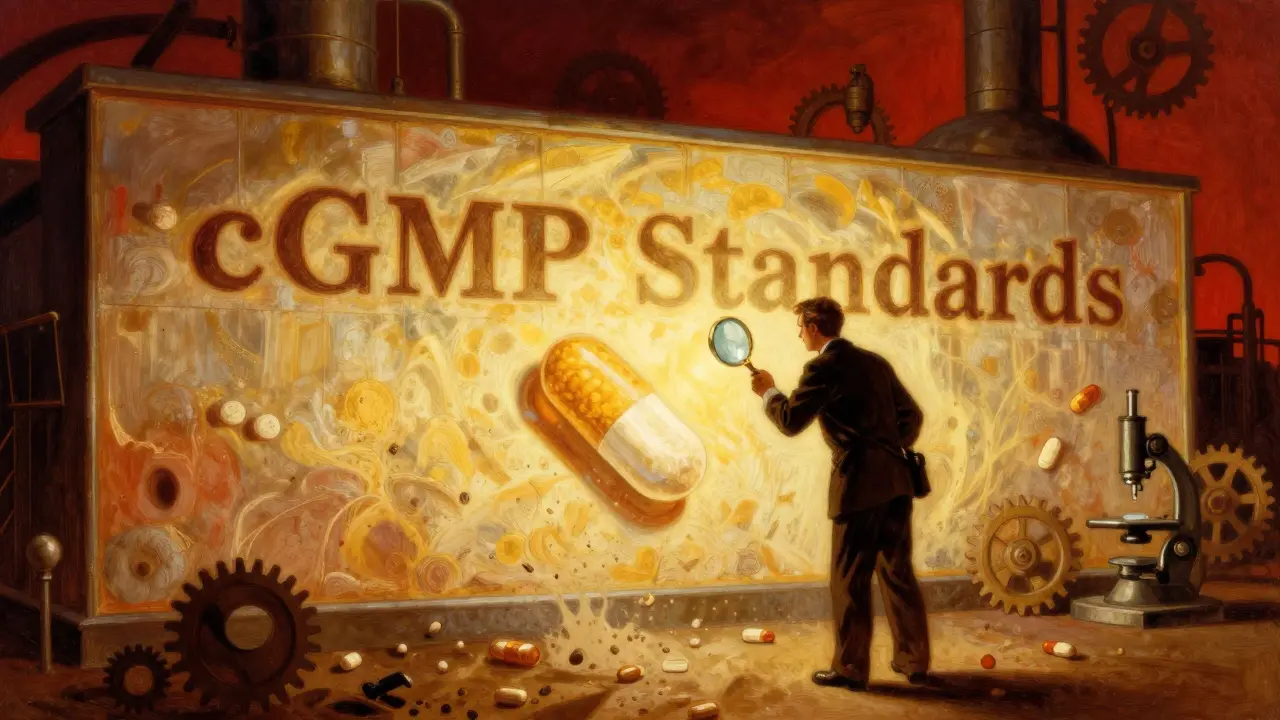
When you pick up a generic pill, you expect it to work just like the brand-name version. But what if it doesn’t? What if it’s fake? Counterfeit drugs are not just a problem in faraway countries-they’re a real threat to patients everywhere. The good news? There’s a system in place designed to stop them before they ever reach your medicine cabinet. That system is built on generic manufacturing standards-strict, science-backed rules that make it nearly impossible for fake drugs to slip through.
Why Quality Can’t Be Tested After the Fact
You can’t tell if a pill is fake by looking at it. A counterfeit drug can look identical to the real thing: same color, same shape, same imprint. Even the packaging might be perfect. But inside? It could have no active ingredient, too little, or worse-harmful chemicals. That’s why the FDA says it plainly: "Quality cannot be tested into a finished product; it must be built into the design and manufacturing process at every single step." This isn’t just a slogan. It’s the core of Current Good Manufacturing Practices (cGMP), the legal standard that governs every step of making generic drugs in the U.S. and most of the world. These rules were forged after the 1938 sulfanilamide tragedy, where 107 people died because a drug was dissolved in toxic solvent. Since then, the system has evolved into one of the most rigorous quality frameworks in any industry.Today, cGMP requires manufacturers to control everything: the air in the room, the water used to clean equipment, the temperature during mixing, even how workers wash their hands. Every batch is tracked. Every raw material is tested. And every finished product is checked-not just once, but multiple times, using tools like high-performance liquid chromatography and infrared spectroscopy. These aren’t simple tests. They’re precise enough to detect differences in molecular structure that the human eye can’t see.
The SQUIPP Framework: The Backbone of Authenticity
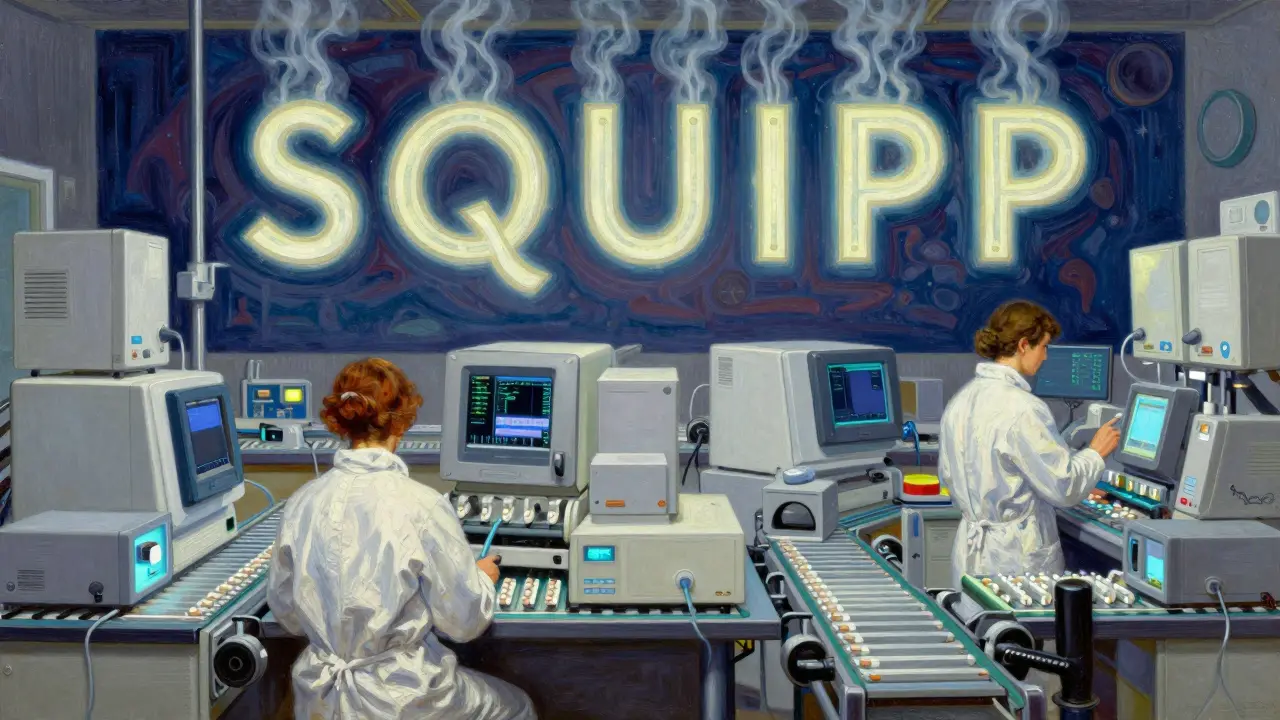
Generic drug makers don’t just follow vague guidelines. They operate under a precise framework called SQUIPP: Safety, Quality, Identity, Potency, and Purity. Each letter stands for a non-negotiable requirement.- Identity: Is this the right drug? Tests must confirm the exact chemical structure matches the brand-name version. Techniques like near-infrared spectroscopy can identify a drug with 98% accuracy just by scanning its surface.
- Potency: Does it contain the right amount of active ingredient? Too little, and it won’t work. Too much, and it could be dangerous. Dissolution testing ensures the drug releases properly in the body-typically, 80% must dissolve within 30 to 45 minutes.
- Purity: Are there harmful impurities? Even trace amounts of toxic byproducts can cause serious harm. That’s why every batch is tested for contaminants, including heavy metals and residual solvents.
- Quality: Is the drug stable? Does it last? Is it protected from moisture, heat, and light? Packaging and storage conditions are part of the standard.
- Safety: Is the manufacturing environment clean? Clean rooms must meet ISO Class 5 standards-fewer than 3,520 airborne particles per cubic meter. That’s cleaner than a hospital operating room.
These aren’t suggestions. They’re legally enforceable. A single violation can shut down a factory. And it’s not just the U.S. enforcing this. The WHO, the European Medicines Agency, and regulators in over 100 countries follow similar rules.
Tracking Every Pill: Serialization and Digital Fingerprints
Even the best manufacturing can’t stop every fake if drugs get lost in the supply chain. That’s why the U.S. passed the Drug Supply Chain Security Act in 2013. It requires every package of medicine to have a unique serial number-a digital fingerprint.This isn’t just a barcode. It’s a 2D data matrix that links to a secure database. When a pharmacy receives a shipment, scanners check each package against the database. If the number doesn’t match, or if it’s been used before, the system flags it immediately. The accuracy? 99.99%. That’s why counterfeit drugs are now rare in pharmacies and hospitals in countries with full systems in place.
By 2023, 92% of the top 50 generic drug makers had implemented this system. Smaller companies lag behind, but even they’re catching up. The cost? Up to $3.5 million per facility to install scanners, software, and integrate with national databases. But the payoff? Preventing billions in losses and saving lives.
What Happens When the System Fails?
No system is perfect. In 2018, a batch of valsartan-a common blood pressure drug-was recalled because of a hidden impurity. Standard tests didn’t catch it because the chemical was new and hadn’t been on the radar. The problem? The drug’s crystal structure was wrong. It wasn’t fake-it was made by a legitimate company, but the process had changed slightly, and the new form didn’t dissolve properly in the body.This exposed a blind spot: current tests can’t always detect polymorphs-different molecular arrangements of the same drug. That’s why the European system requires a Qualified Person (QP) to personally sign off on every batch. That person must have deep expertise and legal responsibility. The U.S. relies more on process validation, which works well… until something unexpected happens.
That’s why audits matter. In 2023, the FDA inspected 1,242 U.S. generic drug facilities. Only 76 were flagged for serious issues. That’s 94% compliance. But for facilities in India and China, compliance dropped to 78% and 65% respectively. That’s why the FDA sends inspectors overseas. And why many U.S. pharmacies only buy from manufacturers with U.S.-approved facilities.
Technology Is Making It Even Harder to Fake Drugs
The fight against counterfeits is going digital. Companies are now using AI to spot anomalies in production data. Sensors collect readings every 5 seconds during manufacturing. Algorithms compare each batch to thousands of past runs. If something’s off-even a tiny fluctuation in temperature or pressure-the system alerts engineers before the batch is even finished.Some are testing molecular taggants-tiny, safe chemical markers added to drugs that can be scanned with a smartphone app. Others are exploring blockchain to create tamper-proof records of every step from factory to pharmacy. The WHO is already using blockchain to track antimalarial drugs in Africa, where counterfeit rates can hit 30%.
By 2027, experts predict AI-driven quality control will cut counterfeit drugs by 40%. IBM and Siemens have invested over $1.2 billion in these technologies. And it’s not just for big companies. Cloud-based Quality Management Systems (eQMS) now cost less than $100,000 a year to run, making them accessible to smaller manufacturers.

Why This Matters to You
Generic drugs make up 90% of all prescriptions in the U.S. But they cost only 23% of what brand-name drugs do. That’s why they’re essential. Without them, millions couldn’t afford their medicine.But if quality control fails, those savings vanish. A fake heart medication doesn’t just waste money-it can kill. A fake antibiotic might not cure an infection, leading to worse illness and antibiotic resistance.
The system works. When properly enforced, generic drugs have a 0.02% adverse event rate-lower than brand-name drugs at 0.03%. That’s not luck. It’s the result of thousands of checks, hundreds of trained workers, and millions in technology investment.
When you buy a generic drug, you’re not just saving money. You’re relying on a global network of scientists, inspectors, engineers, and regulators who’ve built a wall of standards around your health. And that wall is holding.
What You Can Do
You don’t need to be an expert to protect yourself. Here’s what helps:- Buy from licensed pharmacies. Avoid websites that sell drugs without a prescription.
- Check your pills. If the color, shape, or taste changes suddenly, ask your pharmacist.
- Use the FDA’s Drug Shortage Database or the MedWatch system to report suspicious products.
- Support policies that fund global drug safety efforts. Counterfeits in one country can end up in another.
Generic drugs are safe. But only if the system works. And right now, it’s working better than ever.



Steph Carr
So let me get this straight-we’re trusting our lives to a system that requires workers to wash their hands a certain way, but the FDA didn’t catch a deadly impurity in valsartan because it was a *new* polymorph? That’s not a system. That’s a game of whack-a-mole with a microscope.
And don’t get me started on the ‘94% compliance’ stat. That’s like saying 94% of your car’s parts are made in the U.S.-until you find out the brakes were forged in a basement in Hyderabad and shipped with a fake certificate.
Generic drugs are cheaper because someone’s cutting corners. The system’s not holding. It’s just really good at looking like it is.
Brenda K. Wolfgram Moore
This is actually one of the most reassuring things I’ve read in a long time. The level of precision in manufacturing-down to airborne particles and dissolution rates-is mind-blowing. We take for granted that our pills work, but this is science at its most meticulous. No fluff, no guesswork. Just cold, hard, repeatable standards. That’s what keeps us safe.
Linda Franchock
I love how they call it SQUIPP. Sounds like a cereal. ‘SQUIPP: It’s got identity! And potency! And purity! And safety! And quality!’
Anyway-real talk: the fact that a Qualified Person has to sign off on every batch in Europe? That’s the only thing that gives me peace of mind. The U.S. system is like a self-driving car that still needs a human to nod and say ‘yep, that looks fine.’
Haley DeWitt
I'm so glad we have all these checks!!! Seriously, it's such a relief to know that someone is watching every single step!!! I used to be terrified of generics until I read this!!! Now I feel like I can trust them!!!
Also, blockchain? AI? That's next-level!!! I'm so proud of science!!!
John Haberstroh
The whole thing feels like a sci-fi movie where the AI is the hero. Sensors every five seconds? Digital fingerprints on pills? They’re not just making drugs-they’re building a surveillance state for medicine. And honestly? I’m here for it. If I’m gonna swallow something, I want it tracked like a package from Amazon. No exceptions.
Logan Hawker
The cGMP framework, while ostensibly robust, is fundamentally a regulatory artifact of post-1938 industrial trauma-its epistemological foundations are rooted in mid-20th-century pharmacokinetic paradigms that fail to account for dynamic polymorphic behavior, microstructural heterogeneity, and bioavailability variance under real-world physiological conditions.
Moreover, the SQUIPP taxonomy is a reductive heuristic that conflates process control with therapeutic equivalence. Potency, for instance, is not merely a function of dissolution kinetics-it is mediated by enterohepatic recirculation, CYP450 metabolism, and gut microbiome modulation, none of which are captured in the current regulatory model.
Thus, the claim that ‘the system works’ is not just optimistic-it is epistemologically naïve.
James Lloyd
The FDA’s inspection compliance rate of 94% for U.S. facilities is impressive, but the real story is in the details: 76 serious violations out of 1,242 inspections means roughly one major issue every 16 facilities. That’s not ‘working well’-that’s ‘working despite the odds.’
And the fact that India and China have lower compliance? It’s not about corruption. It’s about scale. You can’t enforce ISO Class 5 clean rooms in a factory that produces 20 million pills a day with 300 workers and no real-time data logging. The tech exists. The funding doesn’t always follow.
Digital Raju Yadav
You Americans act like your drug system is some holy grail. Meanwhile, your so-called ‘FDA-approved’ generics are imported from factories that use child labor and dump waste into rivers. You think your scanners and blockchain fix that? Nah. You just pay more so you can feel better about poisoning people 8,000 miles away. The real counterfeiters? The ones with white coats and U.S. passports.
Carrie Schluckbier
This whole thing is a psyop. The FDA doesn’t inspect 1,242 facilities-they inspect 12 and then clone the report 100 times. The ‘serial numbers’? They’re just QR codes that link to a database that gets hacked every 3 months. And don’t get me started on the ‘AI detecting anomalies’-it’s trained on data from the same factories that make the fakes. It’s like a dog catching its own tail.
They’re selling you a fairy tale so you’ll keep buying generics instead of demanding real medicine. Wake up.
guy greenfeld
I’ve been thinking about this all day. The fact that we’ve turned medicine into a precision engineering problem is both beautiful and terrifying. We’ve taken something sacred-health-and turned it into a manufacturing line with sensors, algorithms, and compliance checklists.
But what happens when the system fails? Not because someone’s lazy, but because the math changed? Because a new polymorph emerged that no algorithm has ever seen?
We’re not protecting people. We’re just building a more elegant cage.
Adam Short
I’m British. We’ve had the MHRA since 1963. We don’t need blockchain or AI. We have a Qualified Person who signs off with a fountain pen and a sense of duty. You Americans turn everything into a tech demo. Meanwhile, your ‘99.99% accurate’ serial numbers still can’t stop a guy in Ohio from ordering fake Adderall off Instagram.
Stop overengineering. Just make people responsible.
Sam Pearlman
I love how everyone acts like this is some miracle of science. But let’s be real-generic drugs are cheap because the companies are making pennies per pill. If you think they’re not cutting corners, you’ve never met a CFO.
The system ‘works’ because we don’t have the money to pay for anything else. This isn’t safety. It’s economic coercion dressed up as innovation.