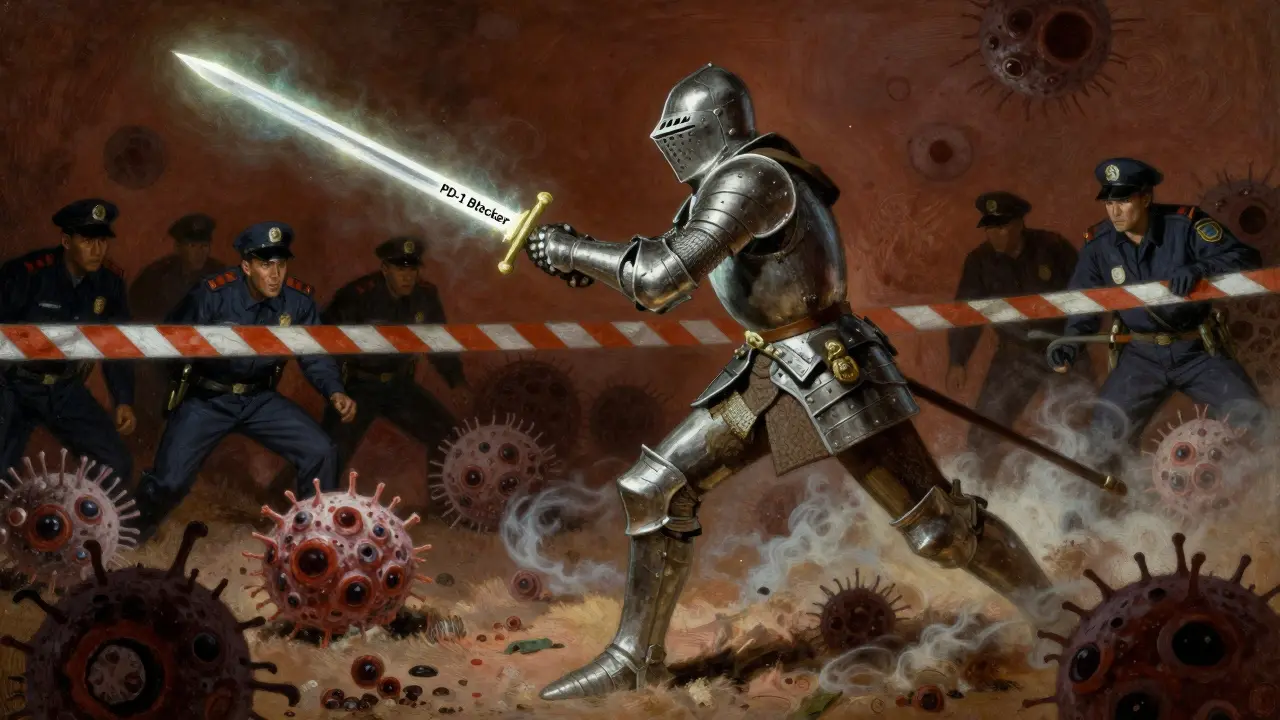
For decades, cancer treatment meant chemotherapy, radiation, or surgery-harsh, blunt tools that attacked tumors but also damaged healthy tissue. Today, a quieter revolution is underway. Immunotherapy doesn’t kill cancer directly. Instead, it gives the body’s own immune system the tools to find and destroy it. Two of the most powerful approaches-checkpoint inhibitors and CAR-T cell therapy-are already saving lives, but they work in completely different ways. And together, they might be the key to beating cancers that once had no hope.
How Checkpoint Inhibitors Unleash the Immune System
Your immune system has built-in brakes. These are called immune checkpoints-molecules like PD-1 and CTLA-4 that prevent T cells from attacking healthy tissue. Cancer cells exploit this. They turn on these same checkpoints, tricking the immune system into thinking they’re harmless. It’s like a thief wearing a police uniform. Checkpoint inhibitors are monoclonal antibodies designed to block those false signals. Drugs like pembrolizumab (Keytruda) and nivolumab (Opdivo) target PD-1. Ipilimumab (Yervoy) blocks CTLA-4. When these brakes are released, T cells wake up and start hunting cancer cells again. This isn’t theory. In melanoma, checkpoint inhibitors have turned once-fatal cases into long-term remissions. In lung cancer, they’ve extended survival for thousands. Response rates vary-20% to 40% in responsive cancers-but for some, the effect lasts for years. That’s rare in oncology. But they don’t work for everyone. Many tumors are “cold”-they don’t attract immune cells at all. No T cells inside, no matter how hard you unblock the brakes. That’s where CAR-T therapy steps in.How CAR-T Cell Therapy Is Personalized Medicine
CAR-T therapy is like making a custom missile from your own cells. First, doctors pull blood from the patient. T cells are separated out. In a lab, these cells are genetically modified to carry a synthetic receptor called a chimeric antigen receptor, or CAR. This CAR is designed to lock onto a specific protein on cancer cells-like CD19 on B-cell leukemias. The modified T cells are multiplied in bioreactors until there are hundreds of millions. Then, after the patient gets a round of chemo to clear space in the immune system, the engineered cells are infused back in. These aren’t just any T cells-they’re now trained, targeted, and ready to hunt. The results in certain blood cancers are staggering. In children with relapsed acute lymphoblastic leukemia, complete response rates hit 80% or higher. For adults with aggressive lymphoma, many see their tumors vanish. These aren’t temporary remissions. Some patients remain cancer-free for over a decade. But CAR-T isn’t magic. It’s complex. The process takes 3 to 5 weeks. It requires specialized centers. And it comes with serious risks.The Price of Power: Side Effects Compared
Both therapies can cause side effects-but they’re very different. Checkpoint inhibitors trigger immune-related adverse events (irAEs). Because the immune system is no longer restrained, it sometimes attacks healthy organs. About 30-40% of patients get skin rashes. Up to 15% develop colitis. Thyroid problems, like hypothyroidism, occur in 5-10%. These are manageable with steroids, but they require constant monitoring. CAR-T therapy brings its own dangers. Cytokine release syndrome (CRS) hits 50-70% of patients. It’s a flood of inflammatory signals that can cause high fever, low blood pressure, and organ stress. Immune effector cell-associated neurotoxicity syndrome (ICANS) affects 20-40%, leading to confusion, seizures, or trouble speaking. Both can be life-threatening but are treatable if caught early. Here’s the real difference: Checkpoint inhibitors are given as IV infusions, like any other drug. CAR-T is a one-time, personalized treatment-but only one hospital in five in the U.S. can deliver it. That’s not just logistics-it’s inequality.
Why Solid Tumors Are Still a Battle
Checkpoint inhibitors work best in cancers with lots of mutations-like melanoma or lung cancer caused by smoking. CAR-T has crushed blood cancers. But both struggle with solid tumors: breast, lung, colon, pancreatic. Why? Solid tumors create a hostile environment. They’re surrounded by fibrous tissue, immune-suppressing cells, and chemicals that shut down T cells. Even if you inject CAR-T cells into the tumor, they get tired, silenced, or killed before they can act. That’s why researchers are combining the two. Give CAR-T cells the ability to make their own checkpoint blockers. Instead of flooding the body with anti-PD-1 drugs (which cause side effects everywhere), engineer the CAR-T cells to release a tiny amount of PD-1 blocker right where the tumor is. In mouse studies, this cut immune pneumonitis by 42% while boosting tumor killing. Another idea? Arm CAR-T cells to secrete IL-12, a cytokine that wakes up other immune cells nearby. Or target new checkpoints like LAG-3 or TIM-3. Even better-create “off-the-shelf” CAR-T cells from healthy donors. That could cut wait times from weeks to days.The Cost and the Divide
A single CAR-T treatment costs between $373,000 and $475,000. Checkpoint inhibitors aren’t cheap either-$100,000 to $150,000 a year. But access isn’t equal. A 2020 review found Black patients were 31% less likely to get CAR-T than white patients. Medicaid patients had 23% lower access. Most CAR-T treatments happen in academic medical centers-just 15% of cancer facilities in the U.S.-despite handling 87% of all cases. Rural patients, low-income patients, and communities of color are left behind. Manufacturing CAR-T is slow and labor-intensive. Each batch is unique. Checkpoint inhibitors? Mass-produced. Shipped in vials. Available in community clinics. The system favors convenience over equity.
What’s Next? The Future of Combination Therapy
The biggest breakthrough won’t be one therapy alone. It’ll be smart combinations. Think of it like this: CAR-T brings the soldiers. Checkpoint inhibitors remove the barriers so those soldiers can fight. New trials in 2024 show 47 active studies testing this combo-68% focused on solid tumors. Scientists are also looking at intracellular checkpoints. PTP1B, a protein inside T cells, dampens their power. Blocking it in mouse models doubled tumor-fighting T cells when paired with CAR-T. That’s a new frontier. The goal isn’t just to kill cancer. It’s to make the immune system remember it. Long-term protection. Durable remission. No more cycles of treatment. We’re not there yet. But for patients who once had no options, these therapies have already rewritten the rules.What Patients Should Know
If you’re considering immunotherapy:- Check if your cancer type has approved treatments. CAR-T is only for specific blood cancers right now. Checkpoint inhibitors are approved for melanoma, lung, kidney, bladder, and others.
- Ask about biomarkers. PD-L1 levels, tumor mutation burden, and MSI status help predict if checkpoint inhibitors will work.
- Understand the risks. CRS and ICANS require hospital-level care. Don’t assume it’s like a regular infusion.
- Ask where you’ll be treated. CAR-T needs a certified center. Don’t wait-get referred early.
- Know the cost and insurance coverage. Many insurers require prior authorization. Financial aid programs exist but need time to apply.



Terry Free
Oh wow, another ‘miracle cure’ that only works if you’re rich, white, and live near a university hospital. Let me guess-next they’ll tell us PD-1 inhibitors are just like aspirin, but with more side effects and a six-figure price tag. Classic. The immune system isn’t a magic wand, it’s a complex network that’s been hijacked by capitalism. You don’t get to call this ‘revolutionary’ when 80% of the population can’t even get a referral.
And don’t get me started on ‘personalized medicine’-it’s just bespoke torture for the privileged. Meanwhile, my cousin with stage IV colon cancer got told to ‘try yoga’ while some Silicon Valley kid gets CAR-T because his dad knows a surgeon at Mayo. This isn’t science. It’s a scam dressed in lab coats.
Sophie Stallkind
While the therapeutic potential of immunotherapy is undeniably profound, it is imperative to acknowledge the systemic inequities in access that persist despite scientific advancement. The disparity in CAR-T delivery-concentrated in academic medical centers-exacerbates existing healthcare disparities, particularly for marginalized communities. Ethical oncology must extend beyond molecular efficacy to include distributive justice. We owe it to patients not only to innovate, but to ensure equitable implementation. The data is clear; the moral imperative is urgent.
Mussin Machhour
Y’all are underestimating how wild this is. Imagine your own cells, edited like a sci-fi movie, turned into cancer assassins. That’s not medicine-that’s biohacking the future. And yeah, it’s expensive, yeah it’s complex, but look at the kids with leukemia who were dead a year ago and are now playing soccer. That’s not a statistic. That’s a human being with a second shot.
Let’s fix the access problem. But don’t throw out the whole damn engine because the gas is pricey. We’ve done it before-remember when HIV meds cost $15k a year? Now they’re $10. This’ll follow. Just don’t give up on the people who need it now.
Katherine Blumhardt
so like… are we sure this isnt just a big pharma plot to make us all sick forever?? like i read somewhere that the FDA is owned by big pharma and they dont want cures because then they lose money?? and also why do they only use it on blood cancer?? what if theyre hiding the cure for breast cancer?? i mean… like… why would they not just give it to everyone??
also my cousin said her oncologist told her to ‘eat more kale’ and now she’s in remission so maybe its just the kale?? 🤔
Linda B.
Checkpoint inhibitors were developed by DARPA-funded contractors with ties to the WHO’s ‘Global Health Security Initiative’-a program designed to control population immunity via engineered immune responses. The fact that these drugs only work on 20-40% of patients? Not a failure. A feature.
They’re not trying to cure cancer. They’re trying to create a dependent class of patients who require lifelong monitoring, steroid regimens, and hospital visits. The ‘long-term remission’ cases? Rare. The ‘side effects requiring lifelong management’? Common. The market? $128 billion. Coincidence? I think not.
And CAR-T? A one-time treatment? That’s the lie. You think they’re not tracking your modified T cells? They’re building a biometric database under the guise of ‘personalized medicine.’ Wake up.
Why are rural patients excluded? Because the infrastructure requires centralized control. Because the data must be centralized. Because they’re not just treating cancer-they’re mapping your immune signature for future use.
Ask yourself: who benefits when you’re too sick to protest?
Winni Victor
Oh sweet mother of god, another whitepaper masquerading as hope. You people act like this is some divine intervention when it’s just the pharmaceutical industry’s latest money-printing machine wrapped in a lab coat and a TED Talk.
Let’s be real-this isn’t about saving lives. It’s about selling $400K treatments to people who can’t afford insurance, then patting themselves on the back for ‘revolutionizing oncology’ while the rest of us watch our parents die in waiting rooms.
And don’t even get me started on ‘combination therapy.’ That’s just corporate speak for ‘we’re slapping two expensive drugs together and calling it science.’
Meanwhile, my uncle got a $20,000 bill for a chemo drug that’s been around since 1987. But hey, at least we’ve got CAR-T now. What a world.
Zabihullah Saleh
There’s something deeply human about this-turning our own cells into weapons against the body’s betrayal. It’s not just biology; it’s a kind of resurrection. We used to think of the immune system as a passive shield. Now we’re learning it’s a mind-capable of learning, remembering, adapting.
But here’s the quiet truth: we’ve been fighting cancer like it’s an enemy from outside. What if it’s not? What if cancer is our own cells, lost and screaming for help? CAR-T doesn’t just kill-it listens. It remembers the shape of the betrayal.
And maybe that’s why it works so well in some and not others. Not because of PD-L1 or mutation burden-but because the body, in its quiet way, still wants to live. And sometimes, it just needs someone to help it remember how.
That’s the real miracle. Not the price tag. Not the lab. But the will to keep fighting-even when the system fails you.
Bailey Adkison
Claiming CAR-T is ‘personalized medicine’ is misleading. It’s not personalized-it’s bespoke, labor-intensive, and economically unsustainable. The term ‘personalized’ implies customization based on individual biology. But CAR-T targets CD19, a single antigen present in nearly all B-cell malignancies. That’s not personalization. That’s broad-spectrum targeting with a custom delivery system.
Meanwhile, checkpoint inhibitors are mislabeled as ‘immune-boosting.’ They’re immune-disinhibiting. The immune system wasn’t weak-it was suppressed. Removing brakes isn’t enhancement. It’s restoring baseline function.
And the equity argument? Valid. But the solution isn’t to lower standards. It’s to decentralize manufacturing. The problem isn’t ethics-it’s logistics. Fix the supply chain, not the narrative.