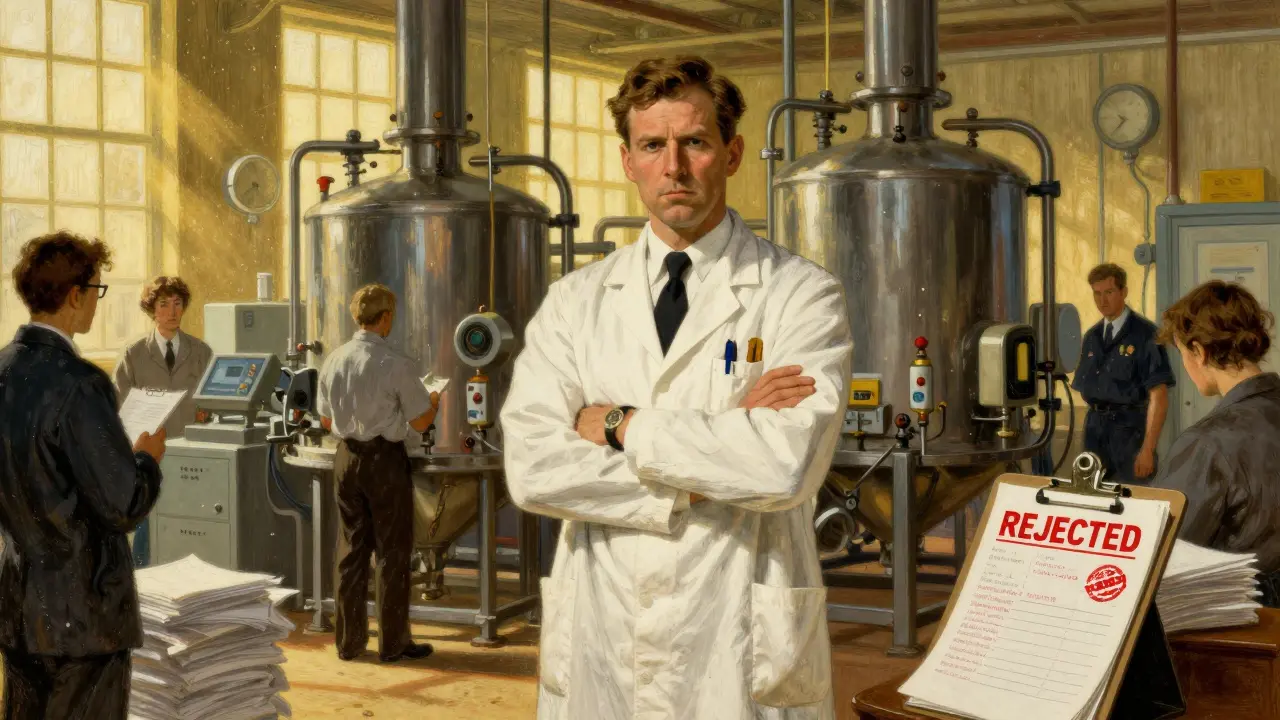
When you pick up a generic pill at the pharmacy, you expect it to work just like the brand-name version. That’s not luck. It’s the result of strict CGMP rules enforced by the FDA. These aren’t suggestions-they’re legal requirements. Every generic drug sold in the U.S. must be made under the same quality standards as the original. If a factory skips a step, fails a test, or doesn’t document properly, the FDA can shut it down. No exceptions.
What CGMP Actually Means for Generic Drug Factories
CGMP stands for Current Good Manufacturing Practices. The "current" part is critical. It means manufacturers can’t rely on old methods. They must use up-to-date technology, equipment, and procedures. The FDA doesn’t just check if a drug works-it checks how it’s made. Every step, from mixing raw ingredients to sealing the final bottle, must be controlled, documented, and repeatable. The rules are laid out in 21 CFR Parts 210 and 211. They cover everything from who’s allowed to touch the product to how the air in the cleanroom is filtered. There’s no room for guesswork. Every procedure must be written down. Every employee must be trained. Every piece of equipment must be calibrated and cleaned according to a schedule. If you can’t prove it happened, it didn’t happen.Who Runs the Show? The Quality Unit
One of the most powerful parts of CGMP is the Quality Unit. This isn’t just a department that does paperwork. It has real authority. It can stop production. It can reject a batch of active ingredient. It can prevent a drug from shipping-even if management wants it to go out. The Quality Unit answers only to top leadership, not to production or sales teams. That’s by design. The FDA wants someone with no incentive to cut corners to have the final say. This unit must be staffed with qualified people who understand chemistry, microbiology, and regulatory requirements. They’re not hired to be nice. They’re hired to be tough. And they’re the ones who sign off on every batch before it leaves the facility.What Happens in the Lab? Testing and Validation
Generic drugs must be identical to their brand-name counterparts in strength, purity, and how they work in the body. That means every batch of active pharmaceutical ingredient (API) must be tested before use. No exceptions. If a supplier sends you a batch of metformin, you can’t just trust their certificate of analysis. You must test it yourself. Production process validation is another big one. You can’t just say, "We’ve been making this pill this way for five years." You have to prove, with data, that your process consistently produces a product that meets specs. Most companies use three consecutive batches for initial validation. But the FDA doesn’t require a specific number-it requires proof. If you change the mixer, the temperature, or the drying time, you have to revalidate. Laboratory controls are where many factories fail. In 2022, 41% of all FDA CGMP violations were related to lab testing and data integrity. That means: missing audit trails, backdated records, or data that doesn’t match what was actually measured. The FDA now expects full electronic records with secure, time-stamped logs. The ALCOA+ principles-Attributable, Legible, Contemporaneous, Original, Accurate, plus Complete, Consistent, Enduring, and Available-are now the gold standard.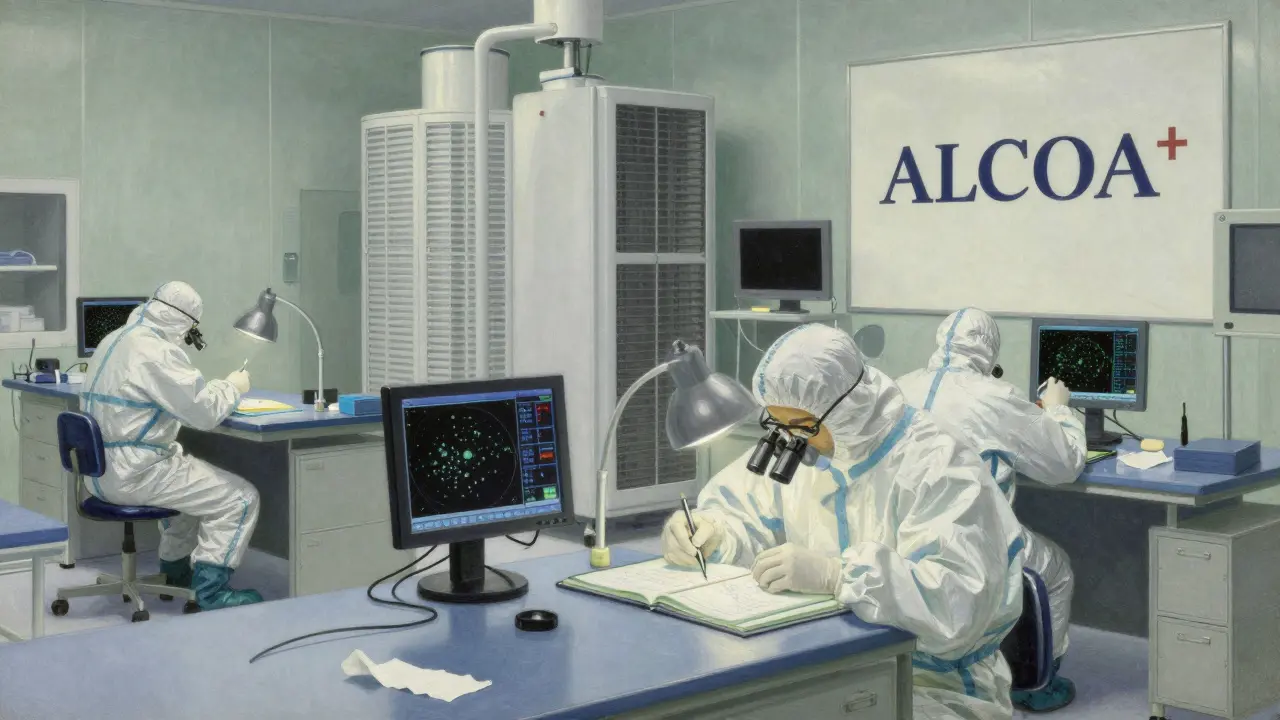
Equipment, Cleanliness, and Contamination Control
Your equipment isn’t just a machine-it’s part of the product. If a blender isn’t cleaned properly between batches, you risk cross-contamination. That’s why cleaning validation is mandatory. You can’t just rinse it out. You have to swab surfaces, test rinse water, and prove that no more than 100 colony-forming units (CFU) of microbes remain per swab. For sterile products, the standards are even tighter. Facilities must have controlled environments. Airflow, humidity, and temperature are monitored constantly. If you’re making a tablet, the air in the mixing room must be filtered to remove particles. If you’re making an injectable, the room must be sterile. And all of this has to be documented. A single temperature spike during storage can invalidate an entire shipment.Documentation: The Paper Trail That Keeps You in Business
In CGMP, paperwork isn’t bureaucracy-it’s your legal defense. Every step must be recorded. Who did it? When? What was the result? Was it within limits? If not, why? Records must be kept for at least one year after the product’s expiration date. For some drugs, that’s 10 years or more. Electronic records are now the norm. But they come with their own risks. 78% of generic manufacturers struggle with Part 11 compliance-ensuring electronic signatures are secure, audit trails are intact, and data can’t be altered. One company on Reddit said it took them 14 months and $1.2 million to get their electronic batch records right. That’s not unusual.
Foreign Factories and Enforcement Gaps
Over 80% of generic drugs sold in the U.S. are made outside the country-mostly in India and China. The FDA inspects foreign facilities less often than domestic ones. In 2020-2022, foreign sites received 43% fewer warning letters per inspection. That’s not because they’re cleaner. It’s because inspections are harder to schedule, and resources are limited. But the FDA is changing that. Its 2023-2027 plan includes a 25% increase in foreign inspections. The agency is also using more risk-based targeting-focusing on factories with past violations or those supplying high-risk ingredients like metformin or heparin. The 2022 metformin recalls, linked to NDMA contamination, showed what happens when oversight slips. The FDA traced it back to inadequate cleaning validation and poor process controls at a foreign supplier. That’s why the FDA issued its May 2023 guidance requiring testing for diethylene glycol and ethylene glycol in high-risk ingredients-after a batch of fake metformin in Pakistan caused deaths.Costs, Challenges, and Who Can Afford It
Complying with CGMP isn’t cheap. For a mid-sized generic manufacturer, annual compliance costs average $2.3 million. That’s 12-15% of total manufacturing costs. Small companies struggle. A 2022 ISPE survey found 68% of firms had trouble with documentation. Many can’t afford the software, the training, or the full-time quality staff the FDA demands. Large companies like Teva have invested in advanced manufacturing. One Teva facility switched to continuous production for a cardiovascular drug. Batch failures dropped from 4.2% to 0.7%. But that kind of upgrade requires millions in capital. Most small firms still rely on batch processing, which is easier to audit but harder to scale.What’s Next? The Future of Generic Drug Manufacturing
The FDA is pushing toward real-time quality control. Instead of testing each batch after it’s made, manufacturers will use sensors and AI to monitor the process as it happens. Predictive analytics will flag problems before they happen. That’s the goal of the Emerging Technology Program. Data integrity will get even stricter. Expect more audits, more electronic record checks, and fewer tolerances for human error. The Drug Supply Chain Security Act is also forcing companies to track every package from raw material to pharmacy. The bottom line? CGMP isn’t going away. It’s getting harder. But it’s also what keeps you safe. Every time you take a generic drug, you’re relying on thousands of documented steps, trained workers, calibrated machines, and a quality unit that said "no" to a bad batch. That’s not just regulation. That’s protection.Are generic drugs held to the same manufacturing standards as brand-name drugs?
Yes. The FDA requires generic drugs to be manufactured under the exact same CGMP rules as brand-name drugs. There is no separate or lower standard. The only difference is the price. The quality, testing, and production controls are identical.
What happens if a generic drug factory fails an FDA inspection?
If a factory fails an inspection, the FDA issues a Warning Letter. The company must fix the problems within a set time or face more serious consequences: import alerts (blocking shipments), product recalls, or even a ban on selling the drug. In extreme cases, the FDA can pursue criminal charges against the company or individuals.
Why do some generic drugs get recalled?
Recalls happen when manufacturing problems are found after the drug is on the market. Common causes include contamination (like NDMA in metformin), incorrect labeling, failure to validate cleaning procedures, or unstable ingredients. Most recalls are linked to CGMP violations-often in foreign facilities where oversight is harder to enforce.
Do all generic drug manufacturers have to use electronic records?
Not all, but the FDA strongly encourages it. Paper records are still allowed, but they’re harder to audit and more prone to errors. Since 2023, most large manufacturers have switched to electronic quality management systems (eQMS) to meet Part 11 requirements for data integrity and audit trails. Smaller firms are catching up, but the trend is clear: paper is becoming obsolete.
How often does the FDA inspect generic drug factories?
Domestic facilities are inspected about every 1.3 years on average. Foreign facilities are inspected less frequently-roughly every 3 to 5 years-but the FDA is increasing foreign inspections by 25% through 2027. High-risk facilities or those with past violations may be inspected more often. The FDA uses risk-based targeting, so a factory with a clean record may wait longer.


Chris Buchanan
So let me get this straight - we’re trusting our lives to pills made in a factory where someone might’ve skipped cleaning the blender because they were running late? And we call this 'quality control'? 🤡
Meanwhile, my cousin’s dog got a better audit trail last year when it got its rabies shot.
Wilton Holliday
Honestly? I’m glad this stuff exists. 🙌
I used to think generics were just cheap knockoffs - until my dad’s blood pressure meds switched and he didn’t crash. Turns out, the science is legit. The FDA doesn’t play. If your lab’s got backdated logs, you’re gonna get a visit from a very serious-looking inspector with a clipboard and zero chill.
Big props to the Quality Unit - they’re the unsung heroes keeping us from swallowing toxic soup.
Raja P
From India here - we make a lot of these generics, and yeah, the pressure is real.
Most factories here try hard, but small players? They’re drowning in paperwork and cost. The FDA rules aren’t wrong - they’re just hard to scale without investment.
Also, the 'ALCOA+' thing? We call it 'record or get fired' in our shop. 😅
Joseph Manuel
It is imperative to underscore that the regulatory framework governing CGMP compliance is not merely a procedural formality but a non-negotiable pillar of public health infrastructure. The statistical prevalence of data integrity violations - particularly in foreign manufacturing sites - constitutes a systemic risk vector requiring immediate structural intervention. The current inspection frequency differential between domestic and international facilities is statistically indefensible and represents a critical vulnerability in the pharmaceutical supply chain.
Furthermore, the assertion that small manufacturers cannot afford compliance is a fallacy of resource allocation, not regulatory overreach. Capital investment in quality systems is not an expense - it is a prerequisite for market access.
Andy Grace
Interesting read. I’ve worked in pharma QA for 12 years. The part about cleaning validation? Spot on.
One time, we had a batch rejected because a technician used the same spatula for two APIs without swabbing. Didn’t even realize it until the HPLC showed traces of the previous drug.
They shut down the line for two weeks. Cost us $200K. But we didn’t ship a single bad pill. Worth it.
Delilah Rose
I just want to say how deeply moved I am by the sheer dedication of the people working in these labs - the ones who stay late to revalidate a process because the temperature in the drying oven spiked by 0.5 degrees, the ones who double-check every batch even when no one’s watching, the ones who get yelled at by production for being 'too slow' but still say no to a bad batch because they know someone’s kid might be taking it next week.
It’s not glamorous. It’s not talked about. But it’s the quiet, meticulous, exhausting work of thousands of people who care enough to do it right - even when no one’s looking - that’s literally keeping us alive. I’m not just talking about the drugs. I’m talking about the humanity behind them.
And if you think it’s expensive? Try paying for the hospital bills when it all goes wrong because someone cut a corner. That’s the real cost.
Lindsey Kidd
So… we’re basically trusting our health to people who have to fill out 17 forms just to change a lightbulb in the cleanroom? 😅
But honestly? I’d rather have the paperwork than the panic. 🤞
Also, shoutout to the Quality Unit - you’re the OG gatekeepers. No cap. 🙏
Austin LeBlanc
Wow, this post is basically a love letter to bureaucracy. Congrats.
Let’s be real - most of these rules exist because someone got rich off a scandal. NDMA? Metformin recalls? Yeah, that’s when the FDA got its power trip.
And don’t even get me started on 'electronic records.' I’ve seen systems that crash and erase audit trails. So now we’re trusting software written by interns who didn’t sleep in 36 hours? That’s not safety - that’s a new kind of gamble.
Also, why are we still letting India and China make 80% of our meds? We’re outsourcing our health to countries with different laws. That’s not innovation - it’s negligence dressed up as cost-cutting.
niharika hardikar
It is a matter of profound concern that the current regulatory paradigm, while ostensibly robust, remains fundamentally reactive rather than proactive. The ALCOA+ framework, though laudable, is insufficiently enforced in jurisdictions where jurisdictional sovereignty impedes harmonized oversight. The persistent prevalence of non-compliance in foreign establishments - particularly those manufacturing high-risk APIs such as metformin - constitutes a violation of the fiduciary duty owed to the U.S. patient population. Regulatory arbitrage is not a business model; it is a public health threat. The FDA’s 25% increase in foreign inspections is a necessary but insufficient step. What is required is mandatory third-party certification, blockchain-based traceability, and the criminalization of data falsification at the executive level. Anything less is complicity.
Blow Job
Man, I’ve seen factories where the QA guy had a 10-year-old laptop and a printer that jammed every time he tried to print a batch record.
And yet - somehow - they still didn’t ship a single bad pill.
People think compliance is about software and audits. Nah. It’s about people who show up every day and say ‘no’ when it’s easier to say ‘yes.’
Respect.
Christine Détraz
My dad used to work at a generic drug plant in Ohio. He told me once that the most important person on the floor wasn’t the CEO or the engineer - it was the woman who ran the final inspection. She’d stare at each bottle for a full minute before signing off. Said she was looking for the one that looked ‘off.’
Never found one. But she still checked.
That’s CGMP. Not the forms. Not the software. Just someone who cares enough to look.
Thank you, anonymous quality inspector. You’re the reason I trust my pills.