
When you hear that the U.S. pays the highest drug prices in the world, it’s easy to assume that means generic drugs are more expensive too. But that’s not the whole story. In fact, when it comes to unbranded generics-the pills most Americans actually take-the U.S. is often cheaper than most other developed countries. The confusion comes from mixing up brand-name drugs with generics. And the difference? It’s massive.
Generics Make Up 90% of U.S. Prescriptions-And They’re Cheaper
Here’s the real breakdown: 9 out of every 10 prescriptions filled in the U.S. are for generic drugs. That’s not a small fraction-it’s the norm. And according to a 2022 study by the RAND Corporation, the average price of these generics in the U.S. is 33% lower than in 33 other wealthy nations, including Canada, Germany, France, and Japan.
Why? Three big reasons. First, the U.S. market has way more generic manufacturers competing. When three or more companies make the same drug, prices drop to just 15-20% of what the original brand charged. The FDA found that in 2019, once four generic makers entered the market, prices fell by 70-80% from the original brand price. Compare that to countries like France or Japan, where fewer companies make generics, and prices stay higher.
Second, public programs like Medicare Part D and Medicaid have serious buying power. They don’t pay list prices. They negotiate. And because they buy in bulk-hundreds of millions of pills a year-they get discounts most other countries can’t match. A 2024 study from the University of Chicago found that after rebates and discounts, the U.S. actually pays 18% less for public-sector prescriptions than peer countries.
Third, the cost to patients reflects this. The average generic copay in the U.S. is $6.16. For brand-name drugs? $56.12. Nearly nine times more. And 93% of generic prescriptions cost under $20. Only 59% of brand-name ones do.
Brand-Name Drugs Are the Real Problem
So if generics are cheaper, why does the U.S. spend so much more on drugs overall? The answer is simple: brand-name drugs. While they make up only 10% of prescriptions, they account for nearly 80% of total spending.
U.S. brand-name drug prices are 308% higher than in other OECD countries. For some drugs, it’s even worse. Take Jardiance, a diabetes pill. Medicare negotiated a price of $204 per prescription. In Japan? $52. In Australia? $48. That’s almost four times higher. Stelara, used for autoimmune diseases, costs $4,490 in the U.S. under Medicare. The average in other countries? $2,822.
Why? Because the U.S. doesn’t regulate drug prices. Other countries set price caps. Canada negotiates directly. The U.K. and France use centralized agencies to decide what’s worth paying for. The U.S. lets drugmakers set their own prices-and then relies on insurers and pharmacies to negotiate discounts behind closed doors. That system works for some, but leaves many patients paying full list price before insurance kicks in.
How Other Countries Keep Prices Low
France and Japan consistently have the lowest drug prices in the OECD. How? They use strict price controls. France’s government sets a maximum price for every drug based on its medical value. Japan does something similar, with prices reviewed every two years. Both countries also limit how many new drugs enter the market at high prices.
Germany and the U.K. use a mix of negotiation and volume-based pricing. If a drug is expensive, they’ll negotiate discounts based on how many patients will use it. If the company won’t agree, they restrict access. The U.S. doesn’t do that. Even when Medicare negotiates, its prices are still 2.8 times higher than the average in 11 other countries.
Even when the U.S. tries to catch up, it falls short. The 2022 Inflation Reduction Act allowed Medicare to negotiate prices for 10 drugs. The results? In nine out of ten cases, every other country paid less. Only one-Stelara in Germany-had a price close to the U.S. negotiated rate.
Why the U.S. Can Still Afford Cheaper Generics
It sounds contradictory: how can the U.S. pay more for brand drugs but less for generics? The answer lies in scale and competition.
The U.S. market for generics is enormous. More than 4 billion prescriptions are filled each year. That volume attracts manufacturers. A small company in India or China can make a profit selling a generic pill for 20 cents if they’re producing millions of them. In countries with smaller markets, that math doesn’t work. So fewer companies enter, and prices stay high.
Also, U.S. pharmacies and insurers have built systems to push generics. If you have a prescription for a drug with a generic version, your pharmacy will automatically substitute it unless your doctor says no. That’s not common in many other countries. In France, for example, doctors often prescribe by brand name, and pharmacists can’t switch without permission.
The Hidden Risk: When Generics Disappear
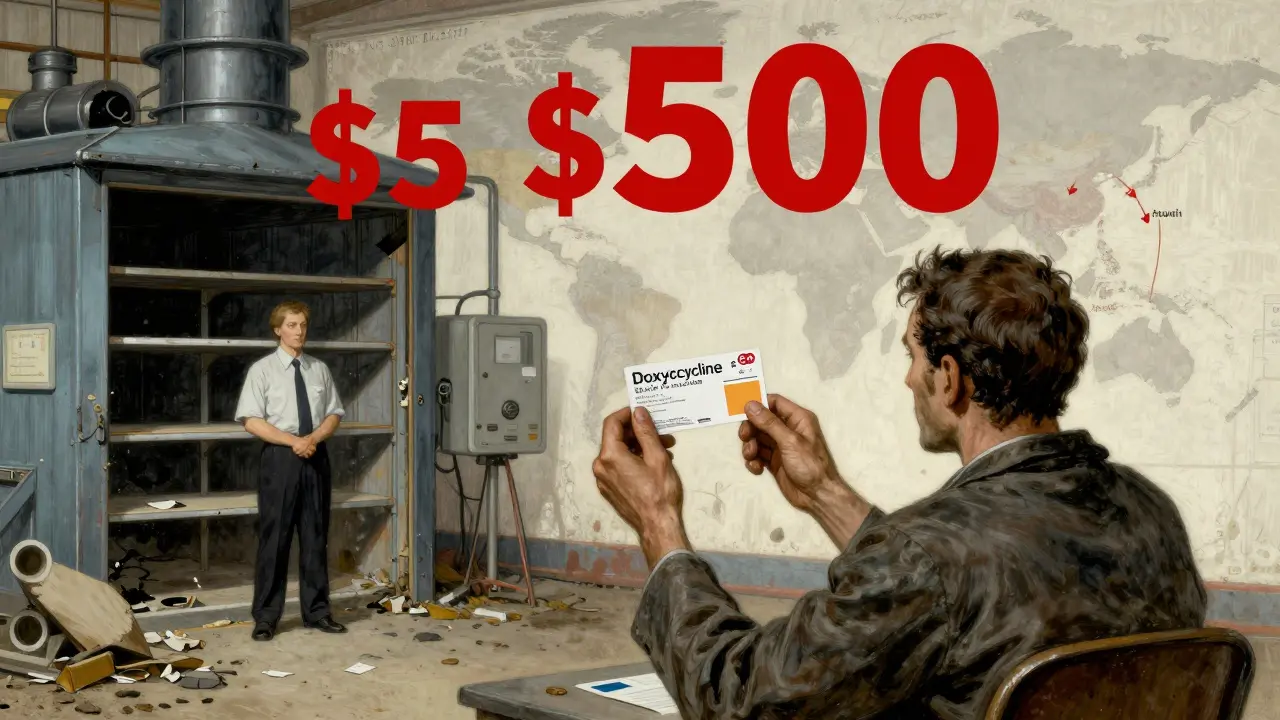
There’s a dark side to all this competition. When too many companies make the same generic, profits shrink. Some manufacturers quit. That’s what happened with the antibiotic doxycycline. At one point, 12 companies made it. Then, after years of price wars, only two remained. Prices jumped 1,000% overnight.
The FDA has documented this pattern. When competition drops to one or two makers, prices spike. It’s not common-but it happens often enough to cause real harm. Patients with chronic conditions end up paying hundreds of dollars for a drug that used to cost $5.
That’s why the FDA now tracks generic supply chains closely. They watch for shortages and step in when a single company controls a market. But they can’t prevent every collapse. And when it happens, it’s the patients who suffer.
What This Means for You
If you’re on generic meds, you’re probably getting a good deal. You’re paying less than people in most other rich countries. But if you’re on a brand-name drug-especially one without a generic alternative-you’re likely paying far more than you should.
Here’s what you can do:
- Always ask your doctor if a generic version exists
- Check your pharmacy’s mail-order or discount programs (like GoodRx or Blink Health)
- If you’re on Medicare, look up your drug’s negotiated price on Medicare.gov
- For expensive brand drugs, ask about patient assistance programs-many drugmakers offer them
And if you’re one of the 90% who rely on generics? You’re benefiting from a system that works better than most people realize. The U.S. isn’t perfect-but when it comes to generics, it’s one of the best places in the world to get them.
What’s Next?
The next round of Medicare negotiations is due out in early 2026. It could include 15 more drugs. If history holds, those prices will still be higher than international benchmarks-but they’ll be lower than what they were before. Meanwhile, the FDA is approving more generics every year. In 2023 alone, 773 new generic drugs hit the market. That’s an estimated $13.5 billion in savings.
The real question isn’t whether the U.S. pays too much for generics. It’s whether we’ll keep letting brand-name prices run wild. Because if we don’t fix that, the savings from generics won’t matter.
Why are generic drugs cheaper in the U.S. than in other countries?
Generic drugs are cheaper in the U.S. because of intense competition-often 10 or more manufacturers make the same drug. This drives prices down to 15-20% of the brand-name cost. The U.S. also has massive prescription volumes, which attract global manufacturers. Public programs like Medicare negotiate bulk discounts, and pharmacies automatically substitute generics unless blocked by a doctor. In contrast, countries like France and Japan limit the number of generic makers and set price caps that keep costs higher.
Do Americans pay more for all prescription drugs?
No-only for brand-name drugs. The U.S. pays 308% more for brand-name drugs than other wealthy nations. But for generics, prices are 33% lower than the OECD average. Overall drug spending is high because brand-name drugs account for 80% of total costs, even though they make up only 10% of prescriptions. So while most Americans pay little for their meds, those on expensive brands face sky-high bills.
Why do Medicare’s negotiated prices still exceed international prices?
Medicare’s negotiated prices are still higher because the law doesn’t let them use international prices as a benchmark. They negotiate based on what’s “fair” under U.S. law, not what other countries pay. Even so, in nine out of ten cases, every other OECD country paid less than Medicare’s negotiated rate. Japan and Australia consistently have the lowest prices, often less than half of what Medicare pays.
Can I get cheaper generics by ordering from Canada or other countries?
Legally, importing prescription drugs from other countries is not allowed in the U.S., though enforcement is rare for personal use. Many generics sold abroad are the same as U.S. versions-made by the same factories. But quality control and shipping risks exist. Instead, use U.S.-based discount services like GoodRx, which often show prices lower than what you’d pay at a Canadian pharmacy.
Why do some generic drugs suddenly become very expensive?
When too many manufacturers compete, some go out of business. If only one or two companies remain, they can raise prices sharply. This happened with doxycycline and minoxidil. The FDA tracks these markets and tries to prevent shortages, but it can’t stop every collapse. These price spikes are rare but dangerous-they hit patients with chronic conditions hardest.


tatiana verdesoto
So I've been on a generic for years and honestly never realized how much I was saving. My copay is like $5, and I thought that was just how it was everywhere. Turns out I'm basically getting a steal compared to folks in Canada or Germany. Makes me feel kinda lucky, honestly.
Also, my pharmacist automatically swaps it out every time. No questions asked. I didn't even know that wasn't normal until I read this. Wild.
Ethan Zeeb
Let's cut the crap. The system is rigged. Generics are cheap because we let foreign manufacturers flood the market with low-quality pills while U.S. companies sit on their hands. And don't get me started on Medicare's 'negotiations'-they're just PR stunts. The real issue is that Big Pharma still owns the whole damn game. We're just rearranging deck chairs on the Titanic.
Darren Torpey
Yo, this whole thing is like a rollercoaster made of pills. One minute you're paying $6 for your blood pressure med, next thing you know, some dude in Ohio stops making it because the profit margin is thinner than a dollar bill in 2024. Then bam-$200 for a 30-day supply. It’s not a system, it’s a gamble.
But hey, at least we’ve got GoodRx. That app is my personal superhero. Capes optional, savings mandatory.
Jane Ryan Ryder
U.S. is the only country that makes generics cheaper. Funny how that works. We can't afford healthcare but we can afford to undercut every other nation on earth. Must be the magic of capitalism. Or maybe it's just that we're too lazy to care about people who aren't us.
Meanwhile, my cousin in Australia pays $4 for the same pill. And she doesn't even have a damn app for it.
Chris Beckman
ok so i read this whole thing and honestly the only thing that matters is that if u have a generic u r fine. if u dont u r screwed. period. the rest is just noise. why are we even debating this? people on brand names are getting robbed. end of story.
also why is everyone acting like this is news? i've been saying this since 2018. no one listens.
Richard Elric5111
One must consider the ontological underpinnings of pharmaceutical commodification within the neoliberal paradigm. The United States, as a hegemonic actor in global capital markets, has structurally incentivized the proliferation of generic manufacturing through economies of scale and deregulatory frameworks that subordinate patient welfare to market efficiency.
Consequently, the 33% price differential observed is not an accident of policy, but rather an emergent property of competitive saturation within an unregulated, volume-driven pharmaceutical supply chain. The irony, of course, is that this very efficiency renders the system vulnerable to monopolistic collapse-a phenomenon we have witnessed in the doxycycline crisis of 2021.
Betsy Silverman
I love how this post breaks it down without being preachy. I work in a pharmacy in rural Ohio, and I see this every day. People are shocked when I tell them their $6 generic is cheaper than what their neighbor in Germany pays. We’re not perfect, but we’ve got this one thing right.
Also, shoutout to pharmacists who catch shortages before they hit the shelves. We’re the unsung heroes here.
Ivan Viktor
Australia’s prices are half of what Medicare pays. That’s not a coincidence. It’s because they say ‘no’ to drug companies. We say ‘yes’ and then pretend we’re negotiating. We’re not even trying. Just admit it-we’re the suckers of the developed world.
Zacharia Reda
So if generics are so cheap, why do I still have to choose between my med and groceries every month? Because my insurance doesn’t cover it until I hit my deductible. And my deductible is $7,000. So yeah, $6 copay sounds great… until you’re the one paying $600 out of pocket because your plan ‘doesn’t count’ the first $6,000.
Stop acting like affordability = accessibility. They’re not the same thing.
John Cyrus
Everyone keeps talking about generics like they’re some miracle. But what about the people who need brand names because generics don’t work for them? You think that’s fair? You think it’s right that someone with epilepsy has to pay $1,200 a month because the FDA says their generic isn’t ‘bioequivalent’ enough? Nah. This whole system is broken. And you’re all just dancing around it.
John Smith
Let me get this straight-we let 12 companies make a drug, they fight until only 2 are left, then those 2 jack up prices 10x and we act surprised? That’s not capitalism. That’s a rigged game. And the FDA? They’re just watching like it’s a reality show.
Meanwhile, I’m paying $180 for a 30-day supply of a drug that used to cost $12. And no one cares. Just another Tuesday in America.