
Most people with fatty liver don’t know they have it-until it’s too late. No pain. No symptoms. Just a routine blood test that says your ALT is high, and suddenly you’re staring at terms like NAFLD and NASH, wondering what’s really going on in your liver. The truth? These aren’t just buzzwords. They’re stages of a silent disease that affects 1 in 4 adults worldwide, and the difference between them could mean the difference between a normal life and liver failure.
What’s the real difference between NAFLD and NASH?
NAFLD stands for Non-Alcoholic Fatty Liver Disease. It’s an umbrella term covering everything from harmless fat buildup to serious liver damage. But not all fatty liver is the same. The key split is between two conditions: NAFL and NASH.
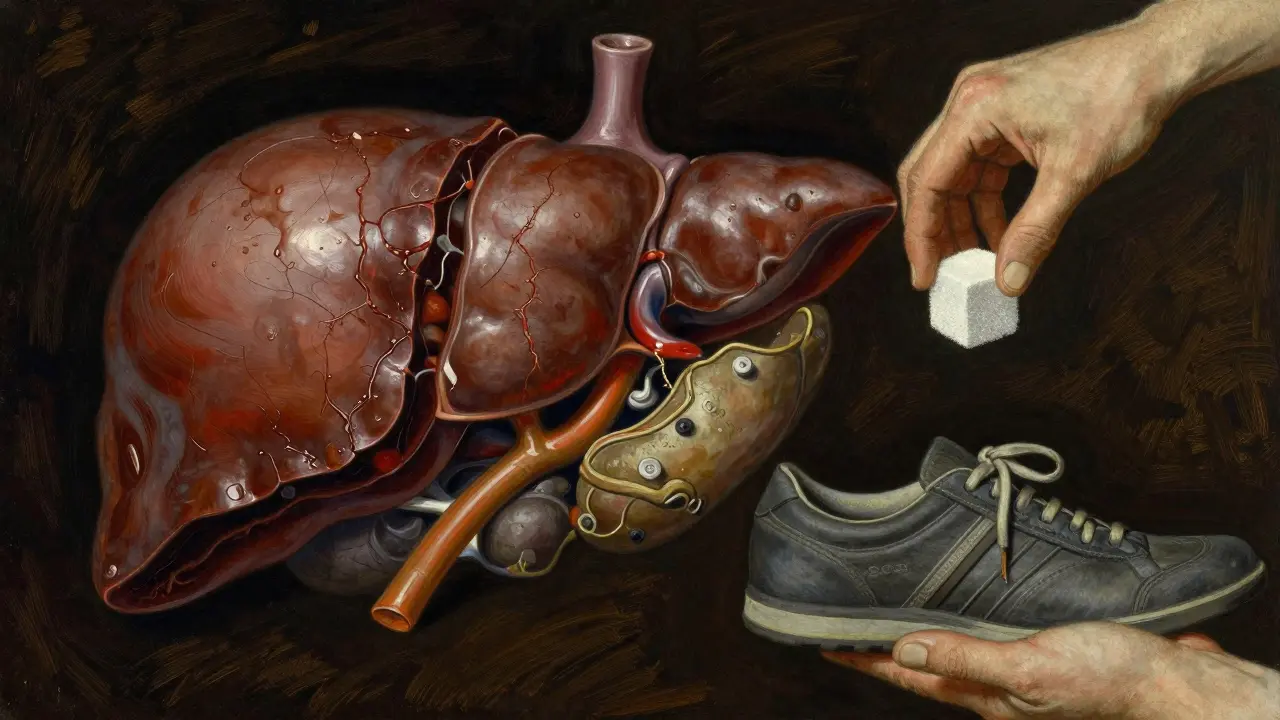
NAFL means you have fat in your liver-5% or more-but no inflammation or cell damage. Think of it like oil pooling in a car engine. It’s not ideal, but if you don’t drive it hard, it won’t break anything. Many people live with NAFL for decades without any problems.
NASH, on the other hand, is when that fat starts to hurt. It’s not just fat anymore-it’s fat plus inflammation, plus ballooned liver cells. This is where the damage begins. Your liver isn’t just storing fat; it’s fighting it. And over time, that fight scars the tissue. That’s fibrosis. And fibrosis can turn into cirrhosis. And cirrhosis can lead to liver cancer or the need for a transplant.
The 2023 update from major liver societies now calls these conditions MASLD (Metabolic Dysfunction-Associated Steatotic Liver Disease) and MASH (Metabolic Dysfunction-Associated Steatohepatitis). The change isn’t just semantics-it’s a shift in understanding. These aren’t ‘non-alcoholic’ diseases. They’re metabolic diseases. They’re tied to insulin resistance, belly fat, high blood sugar, and high triglycerides. If you have metabolic syndrome, you’re at risk.
How do you know if you’re at risk for NASH?
You won’t feel it. That’s the problem. In a 2023 British Liver Trust survey of over 1,200 people with fatty liver, 68% had no symptoms when diagnosed. The rest reported vague things: tiredness, mild belly discomfort, or unexplained weight loss. No jaundice. No swelling. No vomiting. Just silent damage.
So how do you find out? Blood tests are the first clue. ALT and AST are liver enzymes. Normal ALT is 7-55 U/L. If yours is 68, like one Reddit user found after years of ignoring it, that’s a red flag. But normal enzymes don’t rule it out. Some people with advanced fibrosis have perfectly normal liver tests.
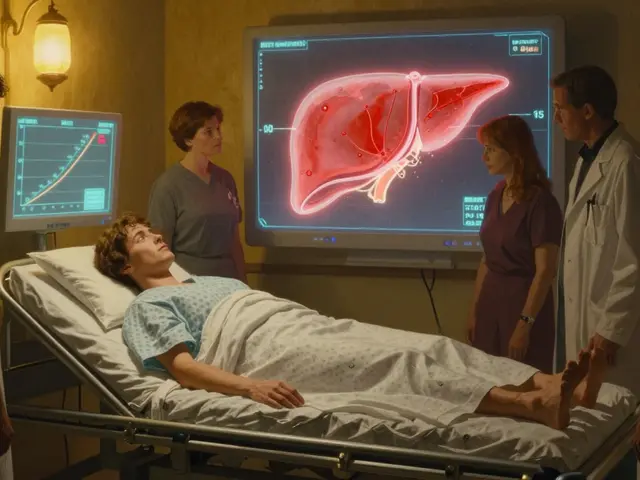
Imaging helps. An ultrasound can spot fat when it hits 20-30% of the liver. But it can’t tell if there’s inflammation or scarring. That’s where FibroScan comes in. It measures liver stiffness. A reading above 7.1 kPa suggests significant fibrosis. Above 10 kPa? That’s a strong sign you’re in the danger zone.
But the only way to confirm NASH is a liver biopsy. It’s invasive. It carries a tiny risk of bleeding. And it’s not perfect-sampling error can miss damaged areas in up to 30% of cases. But it’s still the gold standard. If your doctor says you have NASH based on blood tests and scans alone, ask: Is this confirmed? Because up to 30% of those diagnoses aren’t backed by tissue evidence.
Fibrosis is the real threat-not just NASH
Here’s what most people don’t realize: It’s not whether you have NASH. It’s how far the scarring has gone.
Fibrosis is staged from 0 to 4:
- Stage 0: No scarring
- Stage 1: Minor scarring around veins
- Stage 2: Scarring spreading
- Stage 3: Bridging fibrosis-scars start connecting
- Stage 4: Cirrhosis-liver is permanently scarred
Dr. Arun Sanyal, one of the world’s leading fatty liver experts, says it plainly: ‘The fibrosis stage, not the NASH diagnosis itself, is the strongest predictor of outcomes.’
Patients with stage F3 or F4 fibrosis have a 10-year liver-related death rate of 12-25%. Those with F0-F2? Just 0.5-2%. That’s a 12-fold difference.
And here’s the kicker: You can have NASH with no fibrosis (F0-F1), and you can have fibrosis without NASH (from other causes). But if you have both-NASH plus F3-F4 fibrosis-you’re in the highest risk group.

What makes NASH worse?
Not everyone with fatty liver progresses. Why do some people stay at NAFL, while others spiral into NASH and fibrosis?
It’s not just weight. It’s metabolic health.
- Obesity (BMI ≥30): Present in 70-90% of NASH cases
- Type 2 diabetes: Affects 50-70% of NASH patients, compared to 20-30% of NAFL
- High blood pressure: Seen in 60-75% of NASH cases
- Obstructive sleep apnea: 30-50% of NASH patients have it
These aren’t random associations. They’re part of the same system. Insulin resistance drives fat storage in the liver. Fat causes inflammation. Inflammation causes scarring. And scarring changes how your liver works forever.
One study followed 1,245 people for 15 years. Only 12% of those with NAFL developed serious fibrosis. But 42% of those with NASH did. That’s a 3.5x higher risk.
And even if you don’t get cirrhosis, your risk of heart disease is still higher. In fact, 42% of deaths in NAFLD patients are from heart attacks or strokes-not liver failure. Your liver is warning you about your whole body.
Can you reverse it?
Yes. But only if you act early.
The 2023 International NASH Registry found that patients who lost 7-10% of their body weight had a 90% chance of reversing NASH back to simple fatty liver. And 85% saw improvement in fibrosis.
That’s not a miracle. That’s biology. Lose weight, and your liver stops being flooded with fat. Inflammation drops. Scarring halts. Sometimes, it even reverses.
One user on the Fatty Liver Alliance forum wrote: ‘Lost 10% body weight in 18 months. My biopsy went from NASH with stage 2 fibrosis to just NAFL. No meds. Just diet and walking.’
That’s the power of lifestyle. No pill can match it. Not yet.
What about drugs?
For decades, there were none. That changed in March 2023, when the FDA approved resmetirom (brand name Rezdiffra). It’s the first drug specifically for NASH patients with moderate to advanced fibrosis.
In the MAESTRO-NASH trial, 26% of patients taking resmetirom saw fibrosis improve by at least one stage, compared to 10% on placebo. It’s not a cure. But it’s a breakthrough.
Three other drugs-cenicriviroc, lanifibranor, and others-are in phase 3 trials. But none are approved yet. And none replace weight loss. They’re meant to help those who can’t lose weight or whose disease is already advanced.
And here’s the catch: Insurance won’t cover them yet. They’re expensive. And you still need to lose weight. The drug doesn’t work without lifestyle change.
What should you do if you’re diagnosed?
Step 1: Don’t panic. But don’t ignore it.
Step 2: Get your fibrosis stage checked. If you’re in stage 0-2, focus on weight loss. Aim for 5-10% of your body weight. Cut sugar. Cut processed carbs. Move every day-even 30 minutes of walking helps.
Step 3: If you’re stage 3 or higher, see a hepatologist. Ask about FibroScan. Ask about resmetirom. Ask about clinical trials.
Step 4: Get screened for diabetes, high blood pressure, and sleep apnea. Treat them. They’re part of the same problem.
Step 5: Avoid alcohol-even small amounts can speed up damage. And don’t take supplements like vitamin E without medical advice. Some can hurt more than help.
Primary care doctors are getting better at spotting this. But many still don’t know how to manage it. If your doctor says, ‘Just lose weight and come back in a year,’ push for a referral. You don’t have to wait 6-24 months like 41% of patients do.
What’s next for fatty liver?
The world is waking up. In the U.S., 100 million people have NAFLD. The cost? Over $100 billion a year. By 2030, NASH could be the top reason for liver transplants in the U.S.-up from 10% to 25%.
But here’s the hopeful part: This disease is preventable. Reversible. In most cases, it doesn’t have to be a death sentence. The tools are already here: blood tests, FibroScan, weight loss, and now, medication.
The real question isn’t whether you have NAFLD or NASH. It’s whether you’re ready to act before your liver can’t fix itself anymore.


Shanna Sung
They’re lying about resmetirom. It’s just a cover-up for Big Pharma’s real agenda-glyphosate in your corn syrup is what’s killing your liver, not sugar. The FDA’s in their pocket. You think they’d let a real cure exist? Nah. They’d rather you keep buying meds forever.
John Ross
Let’s be precise here-the shift from NAFLD/NASH to MASLD/MASH isn’t semantic, it’s epistemological. The metabolic syndrome triad-insulin resistance, visceral adiposity, and dyslipidemia-creates a pro-inflammatory hepatic microenvironment via TNF-alpha and IL-6 upregulation, driving hepatocyte ballooning and stellate cell activation. Fibrosis progression is linearly correlated with HOMA-IR scores, not BMI. You can be lean and still have MASH.
Clint Moser
wait i just checked my bloodwork and my alt was 58 but i dont eat sugar?? i think my liver is being poisoned by 5g maybe its the wifi routers?? i read on a forum that 5g changes liver enzymes??
Mandy Kowitz
Oh great, another ‘just lose weight’ lecture. Like I haven’t tried. My doctor gave me a pamphlet and a pat on the back. Meanwhile, my insurance won’t cover a FibroScan unless I’m already in cirrhosis. Thanks, capitalism.
Rory Corrigan
It’s wild how we treat the liver like a disposable battery. We stuff it full of carbs, then act shocked when it catches fire. Maybe we need to stop seeing our bodies as machines and start seeing them as sacred ecosystems. 🌿
melissa cucic
I appreciate the thoroughness of this post-it’s rare to see such a nuanced breakdown of fibrosis staging and metabolic drivers. The shift to MASLD/MASH terminology is indeed critical; it moves the paradigm from ‘what you didn’t do’ to ‘what your body is struggling with.’ The data on fibrosis as the true prognostic marker, not NASH diagnosis, is underappreciated in primary care. I’ve seen patients dismissed for ‘normal enzymes’ while their FibroScan readings were alarming. Early intervention, even before symptoms arise, is the only ethical path forward.
Vikram Sujay
Respectfully, the emphasis on weight loss as the primary intervention, while biologically sound, overlooks systemic determinants of metabolic health-food deserts, chronic stress, sleep deprivation, and socioeconomic barriers. In India, where I practice, many patients with advanced fibrosis are lean, urban professionals consuming ‘healthy’ processed foods with hidden fructose. The solution cannot rest solely on individual willpower. Policy-level changes in food labeling and sugar taxation are equally vital.
josh plum
Anyone else notice how the article says ‘no pill can match weight loss’ but then spends half the post talking about a $10,000 drug? Classic bait-and-switch. They want you to feel guilty, then sell you a miracle. The real cure? Stop eating anything with a label. Real food. No exceptions. And quit scrolling on your phone before bed-stress is the real villain.
Connor Hale
I’ve had NAFLD for 8 years. Diagnosed after a routine check-up. I lost 15% of my body weight over two years. No keto, no fasting. Just cutting soda, walking after dinner, and sleeping 7+ hours. My FibroScan dropped from 9.2 to 5.8. It’s not magic. It’s consistency. I’m not proud of my past habits. But I’m proud of the change. You can do this.
Roshan Aryal
Western medicine is a scam. In India, we’ve had turmeric, neem, and bitter gourd for centuries. You think some FDA-approved pill is better than Ayurveda? You’re brainwashed by Big Pharma. Your liver doesn’t need drugs-it needs truth, discipline, and ancestral wisdom. Stop swallowing pills. Start chewing neem leaves.
Charlotte N
Wait so if you have normal ALT but high FibroScan… you still have fibrosis even if your liver enzymes look fine? That’s terrifying. I had a normal blood test last year. Should I get a FibroScan? I’m scared to ask my doctor because they’ll just say ‘lose weight’ again…
Catherine HARDY
They’re hiding the truth. The real cause of fatty liver? The government added fluoride to the water. It’s in your toothpaste, your tea, your bottled water. It’s not sugar. It’s not carbs. It’s fluoride poisoning. The liver is detoxing. They don’t want you to know. They profit from your confusion.
mark etang
Thank you for this comprehensive, evidence-based overview. The distinction between fibrosis staging and histological diagnosis is critical for clinical decision-making. I’ve counseled patients with F3 fibrosis who were asymptomatic and dismissed by primary care. Early referral to hepatology, metabolic workup, and structured lifestyle intervention-not just vague advice-are the pillars of care. Resmetirom is not a panacea, but it is a milestone. The future of hepatology lies in personalized metabolic medicine. We must stop treating the liver in isolation. It is a mirror of systemic metabolic health.