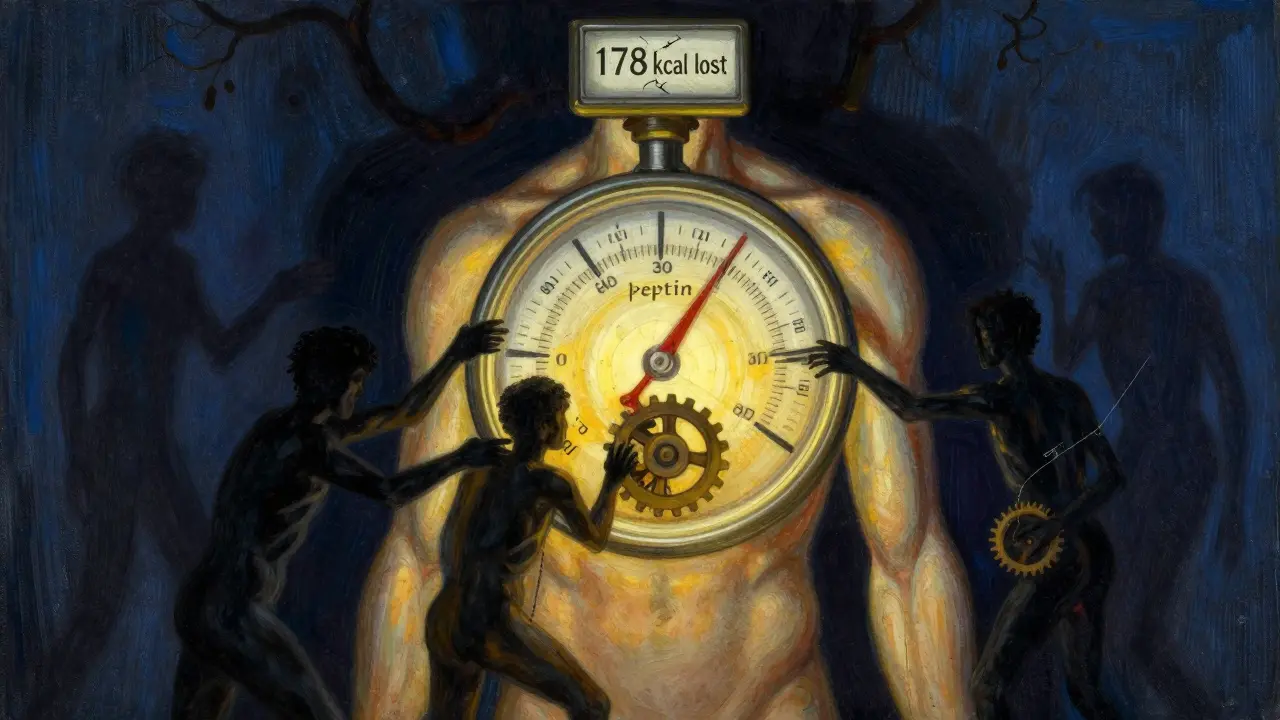
When you lose weight, your body doesn’t just let you keep it off. It fights back. And the reason isn’t laziness, lack of willpower, or eating too many carbs. It’s something deeper, biological, and measurable: adaptive thermogenesis.
Imagine your metabolism as a thermostat. When you cut calories to lose weight, your body doesn’t just burn fewer calories because you’re lighter. It actively lowers your energy expenditure-sometimes by hundreds of calories a day-beyond what your new weight should logically require. This isn’t a glitch. It’s a survival mechanism. Your body thinks you’re starving. And it does everything it can to keep you from losing more fat.
What Adaptive Thermogenesis Actually Does
Adaptive thermogenesis (AT) is the drop in your total daily energy expenditure that happens after weight loss, even when you account for changes in muscle, fat, and organ size. In plain terms: you burn fewer calories than your scale says you should.
Studies show this isn’t minor. One 2020 study tracked people after just one week of dieting and found their 24-hour energy expenditure dropped by an average of 178 kcal per day. That’s like eating a whole banana less every day-without realizing it. Over six weeks, that adds up to an 8,195 kcal deficit that never happened. Result? You lost 2 kg less than expected, mostly from fat.
And it doesn’t stop after the diet. Researchers followed participants for 44 weeks after losing weight. Their metabolism stayed suppressed. Even after they stopped losing, their bodies kept burning fewer calories than before. This is why so many people regain weight: their metabolism didn’t bounce back. It got stuck.
What’s driving this? Hormones. Leptin, insulin, thyroid hormones, and stress chemicals like cortisol all shift after weight loss. Leptin, the hormone that tells your brain you’re full, crashes. Your brain interprets that as famine. In response, it lowers your sympathetic nervous system activity. That means less heat production, less movement (even fidgeting), and less energy burned at rest.
One fascinating theory involves brown fat. That’s the kind of fat that burns calories to make heat. Dr. Michael Rosenbaum’s research showed that if just 25 grams of brown fat went from fully active to barely active after weight loss, it could explain the entire drop in resting metabolism. But here’s the catch: we still don’t know how much brown fat humans actually have, or how much it contributes. Some scientists argue the effect is exaggerated. But the data doesn’t lie: the drop in energy expenditure is real.
Why Some People Lose Weight Faster Than Others
Not everyone experiences adaptive thermogenesis the same way. One person might drop 178 kcal/day after dieting. Another might drop 379 kcal. A third might even increase their metabolism slightly. The variation? Up to ±137 kcal/day. That’s a huge gap.
Why? Genetics, age, how much weight you lost, how fast you lost it, and even your gut microbiome play roles. A 2024 study found that people with certain gut bacteria profiles showed stronger metabolic adaptation. That means your microbiome might be silently influencing whether you regain weight-or not.
Even the method of weight loss matters. People who had gastric bypass surgery lost more weight than those who dieted. But their metabolic rate didn’t drop as much. Why? Because surgery changes gut hormones, insulin sensitivity, and nutrient absorption in ways that blunt the body’s starvation signals. In contrast, people who dieted without surgery showed strong AT-even those who lost weight slowly.
And yo-yo dieting? It makes things worse. One cycle of losing and regaining weight can permanently lower your resting metabolic rate. The more times you do it, the harder it becomes to lose weight again. Your body learns to conserve energy. It becomes a better fat saver.
Reverse Dieting: The Real Science Behind It
Reverse dieting is the strategy people use to fight back. Instead of staying in calorie deficit forever, you slowly increase your food intake after weight loss-with the goal of raising your metabolism back up without gaining fat.
The typical protocol? Add 50-100 kcal per week. That’s about one extra slice of bread or half a banana. You monitor your weight. If it stays stable or increases by less than 0.5 lb per week, you keep going. If you start gaining faster, you pause and hold for a couple of weeks before trying again.
Why does this work? Because it gives your body time to adjust. If you jump from 1,200 kcal to 2,000 kcal overnight, your body doesn’t know what to do. It sees a flood of energy and assumes you’re going to overeat. So it stores fat. But if you creep up slowly, your metabolism gets a chance to adapt. Leptin levels rise. Thyroid output improves. Your nervous system wakes up.
But reverse dieting isn’t magic. A 2022 survey of 1,200 MyFitnessPal users found that 68% experienced metabolic adaptation after weight loss. Of those, 42% tried reverse dieting. Of the ones who did, 73% felt more energy. 65% reported less hunger. And 31% successfully maintained their weight without regain. That’s promising-but not a guarantee.
One Reddit user lost 100 pounds and reverse dieted for a year. He gained back 30 pounds. Why? Because he didn’t account for one thing: muscle loss. If you lose muscle during weight loss, your metabolism stays low-even if you eat more. That’s why protein and resistance training are non-negotiable.

The Role of Muscle and Movement
Lean muscle tissue burns more calories at rest than fat. Even a small amount makes a difference. Research shows preserving muscle during weight loss reduces the magnitude of adaptive thermogenesis by about 15%.
That means if you’re trying to reverse diet, you need to lift weights. At least two to three times a week. Not cardio. Not yoga. Actual resistance training-squats, deadlifts, push-ups, rows. This tells your body: “We still need muscle. Don’t burn it.”
And protein? Aim for 1.6 to 2.2 grams per kilogram of body weight. That’s about 120-165 grams for a 150-pound person. It protects muscle, keeps you full, and helps your metabolism recover faster.
Also, don’t ignore non-exercise movement. Fidgeting, standing, walking around the house-these are called NEAT (non-exercise activity thermogenesis). After weight loss, people naturally move less. They sit more. They take the elevator. That small drop adds up. Be mindful. Take stairs. Stand while on calls. Walk after meals.
What Doesn’t Work
There are a lot of myths floating around. “Metabolic reset” supplements? No evidence. “Detox” cleanses? Harmful. Doing a 3-day high-calorie refeed every week? Doesn’t help if you’re not consistent. Reverse dieting isn’t about bingeing. It’s about precision.
And don’t expect quick results. This isn’t a 4-week fix. It takes 3 to 6 months to properly reverse diet. You need patience. You need to track your weight, energy, hunger, and sleep. Some people see changes in 4 weeks. Others take 6 months. That’s normal.
Also, don’t assume your metabolism is broken. It’s not. It’s doing exactly what it evolved to do: survive. The problem isn’t your body. It’s the extreme dieting most people use to lose weight. Crash diets, 800-calorie plans, excessive cardio-they trigger a deep survival response. Reverse dieting is just undoing the damage.
What’s Next? The Future of Metabolic Health
Science is moving fast. Companies like Zoe and Levels are now using continuous glucose monitors and indirect calorimetry to measure your personal adaptive thermogenesis. Early tests show they can predict your risk of weight regain with 85% accuracy.
Researchers are also testing drugs that activate brown fat. A new beta-3 adrenergic receptor agonist reduced AT by 42% in early trials. That’s huge. But it’s still years away from the market.
Meanwhile, the NIH is running a study called RESTORE, testing whether high-protein reverse dieting (40% protein) works better than standard plans. Early results suggest it preserves metabolism 18% better. That could change how we design post-diet plans forever.
And don’t forget the gut. Gut bacteria are now linked to metabolic adaptation. Future diets might be personalized based on your microbiome-not your weight or height.
Final Takeaway: You’re Not Broken
If you’ve lost weight and regained it, it’s not your fault. Your metabolism didn’t fail. It did its job perfectly. It kept you alive.
Reverse dieting isn’t about cheating your way to a higher metabolism. It’s about giving your body time to heal. It’s about rebuilding your energy balance slowly, carefully, and with muscle, protein, and movement as your allies.
You don’t need a magic pill. You don’t need a 10-step plan. You need patience, consistency, and respect for your biology. The science is clear: adaptive thermogenesis is real. But it’s not unstoppable. With the right approach, your metabolism can recover.
Is adaptive thermogenesis the same as a slow metabolism?
No. A slow metabolism usually means you naturally burn fewer calories at rest due to genetics, age, or low muscle mass. Adaptive thermogenesis is a temporary, diet-induced drop in energy expenditure that goes beyond what your body composition should predict. It’s a physiological response to calorie restriction, not a fixed trait.
Can you reverse adaptive thermogenesis completely?
Most people can recover most of their metabolic rate with proper reverse dieting, resistance training, and high protein intake. But some degree of suppression may remain, especially after extreme or repeated weight loss. Complete reversal isn’t guaranteed, but significant improvement is very possible.
How long does reverse dieting take?
It typically takes 3 to 6 months, depending on how much weight you lost and how low your calories were. If you lost 50+ pounds on a very low-calorie diet, expect the process to take longer. Rushing it by adding too many calories too fast often leads to fat gain.
Do I need to track calories during reverse dieting?
Yes, at least at first. You need to know your starting point and how much you’re increasing. After a few weeks, you can switch to using hunger, energy, and weight trends as guides. But without tracking, you won’t know if you’re progressing or overdoing it.
Why does my weight fluctuate during reverse dieting?
Water retention is common as your body adjusts to more food, especially carbs. Glycogen stores refill, and you hold onto more water. This isn’t fat gain. Look at trends over 2-4 weeks, not daily numbers. If your weight stays stable or increases by less than 0.5 lb per week, you’re on track.





Chris Beckman
So let me get this straight-you’re telling me my body just decided to burn fewer calories because I lost weight? Like it’s some kind of stubborn old thermostat set to "survive famine"? I’ve been told for years to just eat less and move more, but this explains why my progress stalled even when I was eating 1,200 calories and walking 10k steps. I didn’t fail. My biology did.
Sharon Lammas
It’s wild to think that our bodies are built to resist change, not to support it. We’ve been sold this narrative that weight loss is about discipline, but what if it’s more about biology? The fact that leptin crashes and brown fat quiets down-it’s not laziness. It’s evolution. We’re not broken. We’re just trying to survive in a world that doesn’t match our biology anymore.
Diane Croft
If you’re trying to reverse diet, start with protein. Get your lifts in. Move more in daily life. No magic pills. No cleanses. Just consistency. It’s not sexy, but it works.
Donna Zurick
I reverse dieted for 8 months after losing 40 pounds and it changed everything. My energy went from zombie to human. My hunger stopped screaming. I didn’t gain fat. I just got my body back. It’s slow but worth it. Don’t rush it.
Alex Brad
Reverse dieting isn’t about eating more. It’s about rebuilding trust with your body. You’ve been in survival mode. Now you’re telling it: we’re safe. Give me back my metabolism. It takes time. Be patient.
Callum Duffy
One must consider the historical context of metabolic adaptation. In ancestral environments, energy conservation was not a flaw-it was a necessity. Modern diet culture pathologizes what is, in fact, a deeply adaptive physiological response. The issue is not the body, but the systems we impose upon it.
John Cyrus
Everyone’s so obsessed with reverse dieting but no one talks about how most people who do it still gain weight back because they never fixed their relationship with food. You think adding 50 calories a week is gonna fix years of restriction? Please. It’s just another diet hack. The real fix is therapy.
John Smith
Let’s be real here-this whole adaptive thermogenesis thing is just science-speak for your body being a lazy bastard that refuses to work unless you’re starving. And reverse dieting? It’s like trying to convince a toddler to eat veggies by slowly offering more candy. Eventually, they’ll just eat the whole damn jar. You’re not healing your metabolism-you’re feeding your cravings.
Deborah Dennis
So… you’re saying that after losing weight, your body literally becomes a fat-saving machine? And you need to "reverse diet" to undo it? That’s insane. And expensive. And honestly? Sounds like a scam to sell more supplements. Who even came up with this?
Shivam Pawa
From India, here. We’ve been doing something similar for generations-slowly increasing intake after fasting periods. The concept isn’t new. What’s new is the Western obsession with quantifying everything. But yes, protein, resistance, and movement matter. Gut health too. My grandmother’s dal and roti did more for my metabolism than any app ever could.
Justin Rodriguez
I lost 60 lbs on a low-carb diet. My metabolism tanked. I tried reverse dieting for 9 months. Added 75 kcal/week. Monitored weight, energy, hunger. Took 3 months before I saw any real change. But now? I’m stable. No bingeing. No cravings. Just normal. It’s not glamorous. But it works. Stick with it.
Megan Nayak
Let me ask you something-what if adaptive thermogenesis isn’t a problem to be solved? What if it’s a warning? A biological red flag screaming that you’ve been treating your body like a machine to be optimized, not a living system to be honored? Maybe the real solution isn’t reverse dieting… it’s stopping dieting altogether.
Tildi Fletes
It is imperative to note that the majority of studies on adaptive thermogenesis rely on indirect calorimetry, which carries inherent measurement error margins of approximately ±5%. Furthermore, the assumption that brown fat activity directly correlates with total energy expenditure remains speculative in human populations, given the limited sample sizes and heterogeneity of adipose tissue distribution. Therefore, while the phenomenon is likely real, its magnitude and clinical significance remain subject to interpretation.