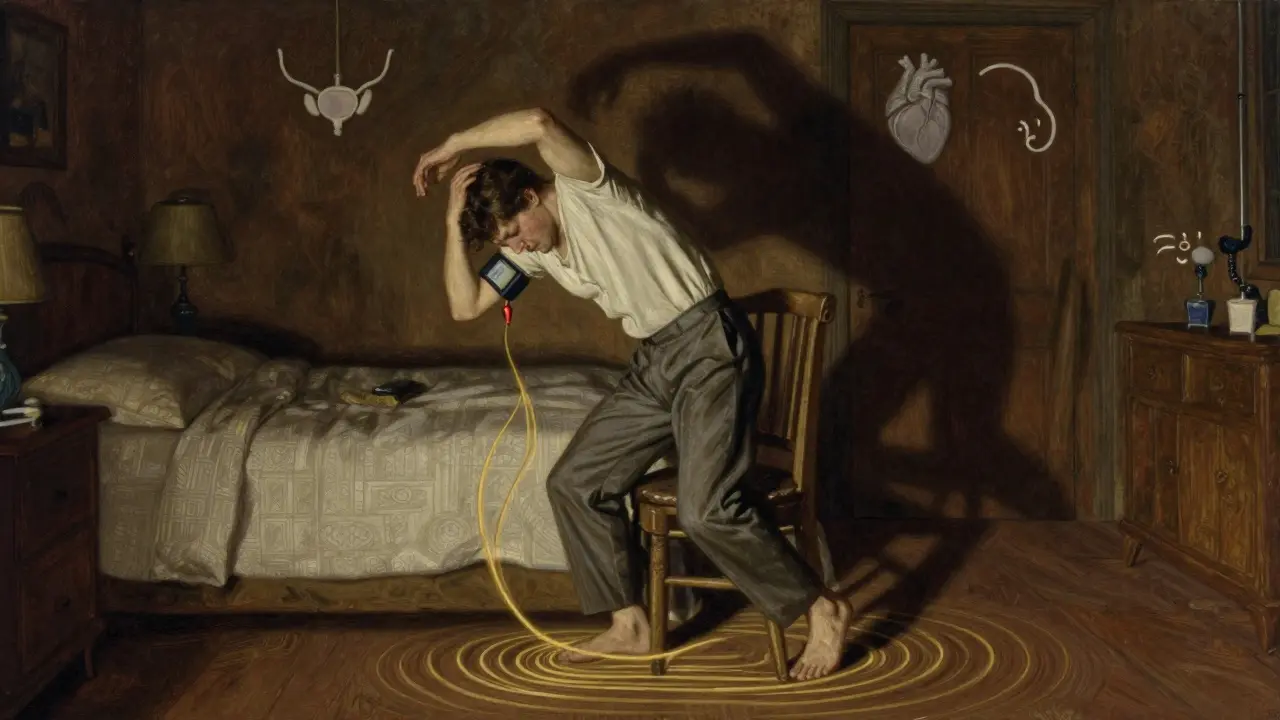
Multiple System Atrophy (MSA) is not Parkinson’s disease. Even though they share similar symptoms-slow movement, stiffness, and tremors-their causes, progression, and outcomes are drastically different. MSA is a rare, aggressive neurodegenerative disorder that attacks multiple parts of the brain at once. It doesn’t just affect movement. It cripples the body’s ability to control blood pressure, bladder function, breathing during sleep, and even body temperature. For someone diagnosed with MSA-P-the parkinsonian subtype-the road ahead is steep and fast-moving. There’s no cure. No drug can stop it. And the window for meaningful intervention is narrow.
What Makes MSA-P Different from Parkinson’s?
At first glance, MSA-P looks like Parkinson’s. People stumble. Their movements get slower. Their voice fades into a whisper. But the differences are critical-and they show up early.
Unlike Parkinson’s, which mainly damages the substantia nigra, MSA-P destroys nerve cells across the basal ganglia, brainstem, and cerebellum. This widespread damage is why symptoms hit harder and faster. A person with Parkinson’s might live 15 to 20 years after diagnosis. Someone with MSA-P? Half will lose most of their mobility within five years.
One of the biggest red flags is how poorly MSA-P responds to levodopa, the main drug used for Parkinson’s. In Parkinson’s, levodopa can dramatically improve movement for years. In MSA-P, only 15 to 30 percent of patients get any benefit-and even then, it fades within one to two years. If a person with parkinsonian symptoms doesn’t respond to high-dose levodopa after six months, MSA should be strongly suspected.
Another clue? The tremors. In Parkinson’s, tremors usually happen at rest-like when the hands are resting in the lap. In MSA-P, tremors are more likely to appear when the arms or legs are held out. They’re jerky, irregular, and often linked to posture. About 60 percent of MSA-P patients develop these tremors, but they don’t behave like classic Parkinson’s tremors.
The Silent Storm: Autonomic Failure
What makes MSA-P truly terrifying isn’t just the movement problems-it’s what’s happening beneath the surface. Autonomic failure isn’t a side effect. It’s a core feature, and it often starts years before movement issues.
Orthostatic hypotension-the sudden drop in blood pressure when standing-is present in 90 percent of MSA-P patients. Many describe feeling lightheaded, blurry vision, or even fainting when they get up from a chair. This isn’t just inconvenient. It increases fall risk dramatically. In fact, 85 percent of MSA-P patients experience falls within the first one to two years after symptoms begin.
Bladder problems are nearly universal. Eighty-five to ninety percent struggle with urgency, frequency, or complete incontinence. For men, erectile dysfunction is an early warning sign-hitting 95 percent of cases, sometimes appearing five years before any tremor or stiffness.
Sleep is another battleground. Eighty to ninety percent have REM sleep behavior disorder, meaning they physically act out their dreams-kicking, shouting, even falling out of bed. Sixty to seventy percent also suffer from sleep apnea, where breathing stops repeatedly during sleep. This isn’t just about tiredness. It’s linked to sudden death risk.
And then there’s temperature control. About half of patients lose the ability to sweat normally in certain areas, making overheating dangerous. Others experience cold hands and feet despite normal room temperatures.
How Fast Does MSA-P Progress?
Progression is brutal and predictable. The timeline isn’t measured in decades-it’s measured in years.
Within 3.5 years of symptom onset, most people need a cane or walker. By 5.3 years, they’re in a wheelchair. Within five years, half are unable to stand or walk without help. By the time they reach stage 5 on the Hoehn and Yahr scale-completely bedridden-the average time is just 5.7 years for MSA-P, compared to 8.3 years for the cerebellar subtype (MSA-C).
Survival is short. Median lifespan from symptom onset is 6 to 10 years. Only 9 to 23 percent survive beyond 10 years. The most common causes of death? Respiratory infections (45 percent), sudden cardiac events (20 percent), and aspiration pneumonia from swallowing difficulties (15 percent). These aren’t rare complications-they’re expected outcomes.
There’s a direct link between levodopa response and survival. Those with no benefit from levodopa live a median of 6.2 years. Those with even partial improvement? Around 9.8 years. That’s a huge difference in a disease where every year counts.
Why Diagnosis Takes So Long
Doctors often mistake MSA-P for Parkinson’s. Even specialists can be fooled in the first year. That’s because the early signs overlap too much. A slow shuffle, a quiet voice, a stiff arm-these are textbook Parkinson’s symptoms.
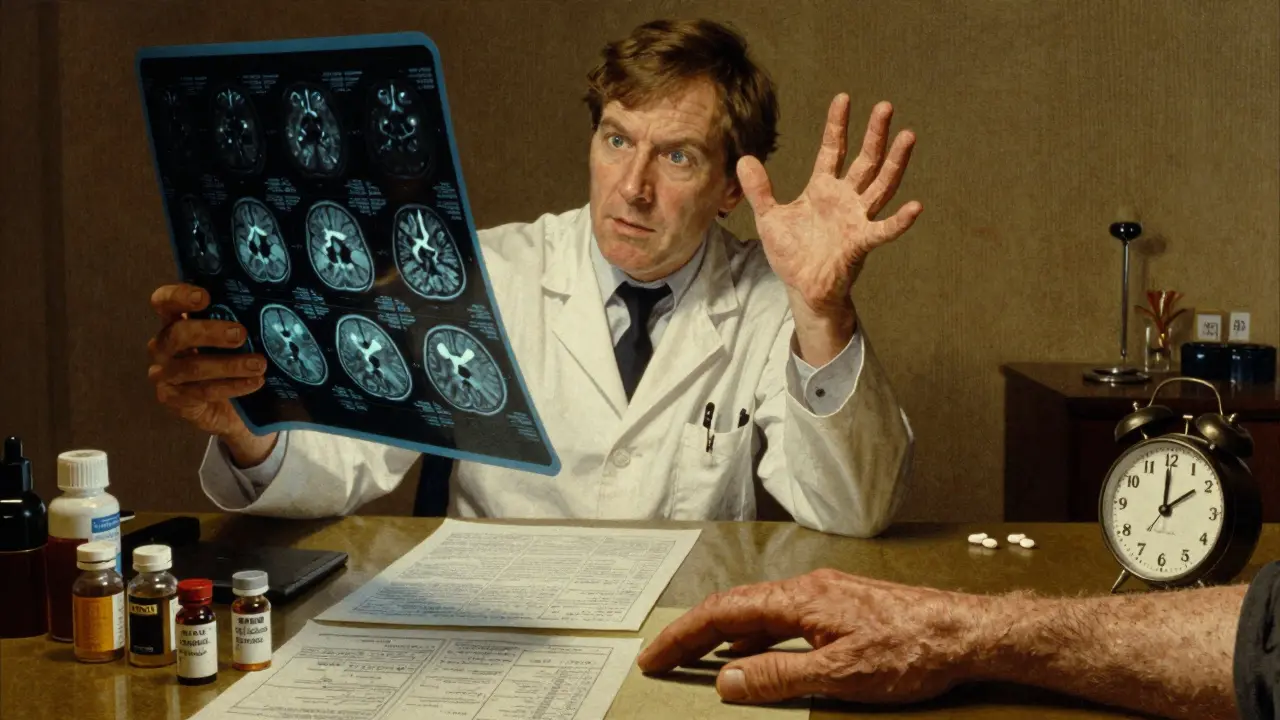
But MSA-P has clues. If autonomic symptoms like fainting, bladder issues, or sexual dysfunction appear within three years of movement problems, it’s almost certainly MSA. MRI scans can help. The "hot cross bun" sign-a distinctive pattern in the brainstem-is visible in 50 to 80 percent of MSA-C cases. Putaminal atrophy (shrinkage in a specific brain region) is common in MSA-P.
There’s also emerging blood testing. Neurofilament light chain levels, a marker of nerve damage, are three to five times higher in MSA than in Parkinson’s. Combined with MRI and autonomic testing, this new biomarker panel could cut diagnosis time to under a year. A large study tracking this is expected to publish results in mid-2024.

What Treatments Actually Help?
There’s no treatment that slows MSA. No drug halts the nerve death. So care focuses on managing symptoms and preventing complications.
For low blood pressure: fludrocortisone and midodrine are standard. Droxidopa, approved by the FDA in 2014, helps some patients stand without fainting. But these drugs don’t fix the underlying problem-they just manage the symptoms.
Bladder issues? Anticholinergics or catheterization. Sleep apnea? CPAP machines. REM sleep disorder? Melatonin or clonazepam. Speech and swallowing therapy can delay aspiration. Physical therapy helps maintain mobility as long as possible.
But even with all this, quality of life plummets. A 2021 survey of 327 MSA patients found that 78 percent rated their quality of life as "poor" or "very poor" within four years of diagnosis. That’s more than double the rate seen in Parkinson’s patients at the same stage.
The Future: Hope or Hype?
Research into MSA is painfully slow. As of late 2023, there are only three active clinical trials worldwide targeting disease modification. Most focus on clearing abnormal alpha-synuclein clumps-the protein that builds up in MSA brain cells.
The PASADENA trial, which tested an immunotherapy drug, showed only a 1.2-point slower decline on a symptom scale over 18 months-barely noticeable. Other trials have failed outright.
Experts agree: the biggest gap is early diagnosis. By the time movement symptoms appear, 50 to 70 percent of the affected neurons are already dead. If we could detect MSA before that-through blood tests or advanced imaging-we might have a chance to intervene.
For now, the prognosis remains grim. Without a breakthrough in understanding how MSA starts and spreads, median survival is unlikely to stretch beyond 10 years in the next decade. Families are left with one reality: the clock starts ticking the moment symptoms appear.
Is MSA-P the same as Parkinson’s disease?
No. While both cause slowness, stiffness, and tremors, MSA-P is a distinct disorder that damages more areas of the brain and includes severe autonomic failure. It progresses faster, responds poorly to levodopa, and has a much shorter life expectancy than Parkinson’s.
How long do people live after being diagnosed with MSA-P?
Median survival is 6 to 10 years from symptom onset. About half of patients lose most mobility within five years. Only 9 to 23 percent survive past 10 years. Death is often due to pneumonia, respiratory failure, or sudden cardiac events.
Why doesn’t levodopa work well for MSA-P?
Levodopa helps replace dopamine lost in Parkinson’s, but MSA-P damages brain areas beyond just dopamine-producing cells. The nerve pathways that respond to levodopa are already destroyed. Only 15-30 percent of MSA-P patients get any benefit, and even then, it lasts less than two years.
Can MSA-P be diagnosed early?
Currently, diagnosis is often delayed by years. But new tools are emerging. Blood tests measuring neurofilament light chain, MRI scans showing putaminal shrinkage or the "hot cross bun" sign, and autonomic function tests can now detect MSA-P within a year of symptom onset-much earlier than before.
What are the first signs of MSA-P?
Early signs often include fainting when standing, urinary incontinence, erectile dysfunction in men, or acting out dreams during sleep. Movement symptoms like stiffness or shuffling may appear months or years later. Autonomic symptoms before motor symptoms are a major red flag.
Is there any hope for new treatments?
There are no proven disease-modifying treatments yet. A few experimental drugs are being tested, but results so far are minimal. The biggest hope lies in early detection-catching MSA before too many neurons die. Research into biomarkers and imaging is active, but progress is slow.




Martin Halpin
Let me tell you something nobody else will: MSA isn't just a disease, it's a slow-motion car crash with no airbags. I've watched my uncle go from golfing to bedridden in 3 years. No one talks about the shame of needing help to pee or the way your voice just... disappears like a radio station fading out. They call it 'autonomic failure' like it's a glitch in a spreadsheet. It's not. It's your body turning on itself while you're still conscious enough to feel every second of it.
And don't get me started on levodopa. It's not just ineffective-it's cruel. Giving someone hope for six months just to yank it away when they realize their legs still won't move. It's like offering a lifeline made of wet string.
The worst part? You know you're dying, but you're not allowed to die quickly. They keep you alive with catheters and CPAP machines while your brain rots. That's not medicine. That's torture with a white coat.
Eimear Gilroy
I'm a nurse who's worked in neurology for 14 years. I've seen Parkinson's, ALS, Huntington's-but MSA-P is the one that haunts me. The autonomic symptoms come first, often years before anyone even suspects movement issues. I had a patient who kept coming in for 'dizziness' and 'bladder infections' for two years before he couldn't stand. By then, his putamen was already collapsing on MRI.
What no one tells families is that the sleep issues aren't just 'acting out dreams.' It's not REM behavior disorder-it's screaming, punching, falling out of bed while dreaming of being chased. One man broke his wife's collarbone. She still slept beside him. That's love. And tragedy.
Timothy Haroutunian
Look, I get it. MSA is bad. But let's be real-this whole post reads like a medical school lecture dressed up as a Reddit thread. You're dumping a textbook on us. I'm not a neurologist. I'm just a guy who lost his dad to this. Can we please stop pretending this is some kind of educational seminar? It's not. It's a eulogy written in bullet points.
And don't even get me started on 'emerging biomarkers.' We've been hearing that for a decade. Every 'breakthrough' turns out to be a dead end. You're not giving hope. You're just repackaging grief with citations.
Erin Pinheiro
ok so i just read this whole thing and like... wow. i had no idea msa was this bad. like, i thought parkinsons was bad but this is next level. my uncle had parkinsons and he was fine for like 12 years. this is like... a death sentence with a countdown timer. i cant even imagine having to deal with fainting every time you stand up. also, the part about men getting ed 5 years before symptoms?? that's wild. why isn't this on the news??
also why is levodopa even a thing if it doesnt work?? is it just to make people feel better??
Michael FItzpatrick
There’s a quiet horror here that no one talks about-the loneliness of the body betraying itself before the mind even catches up. You’re not just losing mobility. You’re losing dignity in increments: the inability to wipe yourself, the smell of urine that lingers despite catheters, the way your partner’s eyes flicker away when you ask for help with your shirt buttons.
And yes, the meds-fludrocortisone, midodrine, CPAP-they’re bandaids on a severed artery. They don’t cure. They don’t slow. They just buy time. Time for what? More hospital visits? More falls? More nights spent afraid to sleep because you might stop breathing?
But here’s what no one says: the people who live with MSA are the bravest on earth. They show up. They laugh at their own incontinence. They hold their grandkids even when their hands shake. That’s not just survival. That’s grace.
Brandice Valentino
ok so like... i'm just gonna say it. this whole thing feels so... dramatic? like, is this even real? i mean, i've seen people with parkinsons and they're fine. my neighbor's dad still drives. why is this so much worse? also, why do they keep saying 'median survival' like we're all gonna die tomorrow??
and like... the 'hot cross bun' thing?? is that a real medical term?? sounds like a bakery. also, i think they're just scared to admit they don't know what's going on. they're throwing big words at us to make themselves look smart.
also, why is everyone so obsessed with levodopa?? i bet it's just pharma companies pushing drugs. i'm not buying it.
Larry Zerpa
You people are delusional. This isn’t a tragedy-it’s a failure of medicine. Look at the data: 90% of MSA patients develop orthostatic hypotension. 85% fall within two years. Median survival: 6–10 years. And yet, we have three clinical trials? THREE? That’s not research. That’s a joke. It’s like sending a single firetruck to a city on fire and calling it 'progress.'
And don’t even get me started on the 'emerging biomarkers.' Neurofilament light chain? You think that’s going to change anything? It’s a marker, not a cure. You’re measuring the smoke, not putting out the fire.
Meanwhile, the pharmaceutical industry is laughing all the way to the bank. They sell you fludrocortisone at $400 a pill while knowing full well it does nothing to stop the decay. This isn’t science. It’s exploitation dressed in lab coats.
Gwen Vincent
I’ve been following MSA research for years. I lost my sister to it. I don’t want to scare anyone, but I also don’t want to sugarcoat it. The truth is brutal, yes-but there’s a quiet strength in how families adapt. They learn to bathe someone without shame. They install grab bars not as medical necessities, but as acts of love. They memorize the rhythm of their loved one’s breathing at night.
I know it sounds cliché, but the real miracle isn’t in the science. It’s in the human moments: a whispered joke during a catheter change, a hand held too tight during a fall, a grandchild who doesn’t understand why Grandpa’s voice is quiet but still hugs him anyway.
We don’t need more drugs. We need more compassion. And more funding. Always more funding.
Joseph Cantu
Here’s the real conspiracy: MSA isn’t a disease. It’s a cover-up. The same people who run Big Pharma also control the NIH. They let MSA stay rare because if they admitted how fast it spreads, how many people it kills, how easily it’s misdiagnosed-then the lawsuits would drown them.
Think about it. Why does MSA only affect 1 in 100,000? That number is too clean. Too convenient. What if it’s actually 1 in 10,000? What if every time someone gets diagnosed with Parkinson’s and doesn’t respond to levodopa, they’re being quietly reclassified to avoid liability?
And the 'hot cross bun' sign? That’s not a brain pattern. That’s a warning label. They’re telling us to look, but not to ask why.
Wake up. This isn’t science. It’s silence.
David McKie
Let me be blunt: this post reads like a eulogy written by a textbook. You've got all the numbers, all the stats, all the clinical jargon. But where’s the humanity? Where’s the person behind the MRI scan? The man who cried because he couldn’t button his own shirt? The woman who stopped going to church because she was too afraid of leaking in the pews?
MSA isn’t a paragraph in a journal. It’s a funeral you’re forced to plan while still breathing. And no, you don’t get to choose how long you live. You get to choose whether you die with dignity-or with a catheter taped to your leg and a CPAP mask glued to your face.
Stop talking about 'prognosis.' Start talking about care. Real care. Not just drugs. Not just scans. Just... presence.
Southern Indiana Paleontology Institute
So you're telling me this MSA thing is worse than parkinsons? I don't believe it. My cousin had parkinsons and he still drove his truck till he was 82. This sounds like fearmongering. Who even wrote this? Some doctor trying to scare people into donations? I'm from Indiana. We don't need your fancy science. We know what real disease looks like. This is just hype.
Martin Halpin
Reply to @7832: You think this is hype? My uncle was a mechanic. Drove a 1998 Ford F-150 every day. Last time he drove? He passed out at a stoplight. Broke his hip. Spent 14 months in a nursing home. They didn’t even tell us it was MSA until the autopsy. You think he ‘still drove till 82’? He died at 71. And no, he didn’t die of old age. He died because no one knew what was killing him until it was too late.
So no. This isn’t hype. It’s the quiet scream of a thousand families nobody listens to.