Key Takeaways for Safe Communication
- Always use read-back verification to confirm the order.
- Spell out drug names phonetically to avoid "sound-alike" confusion.
- State numbers using two different methods (e.g., "fifteen" and "one-five").
- Avoid all abbreviations like "BID" or "PO."
- Never use verbal orders for high-alert medications like chemotherapy.
The Danger of Sound-Alike Medications
One of the biggest hurdles in provider communication is the prevalence of Look-Alike, Sound-Alike (LASA) drugs. According to data from the Institute for Safe Medication Practices (ISMP), roughly 34% of verbal order errors stem from drug names that sound nearly identical. For example, a nurse might hear "Hydralazine" when the doctor actually said "Hydroxyzine." These aren't just typos; they are different medications with entirely different effects on a patient.
To fight this, the gold standard is phonetic spelling. Instead of just saying the name, the prescriber should spell it out: "Ampicillin spelled A-M-P-I-C-I-L-L-I-N." This removes the guesswork. When you combine this with the rule of avoiding abbreviations, the risk drops. Instead of saying "PO BID," which can be misread or misheard, say "by mouth twice daily." It takes a few extra seconds, but it prevents a potentially fatal mistake.
Mastering the Read-Back Process
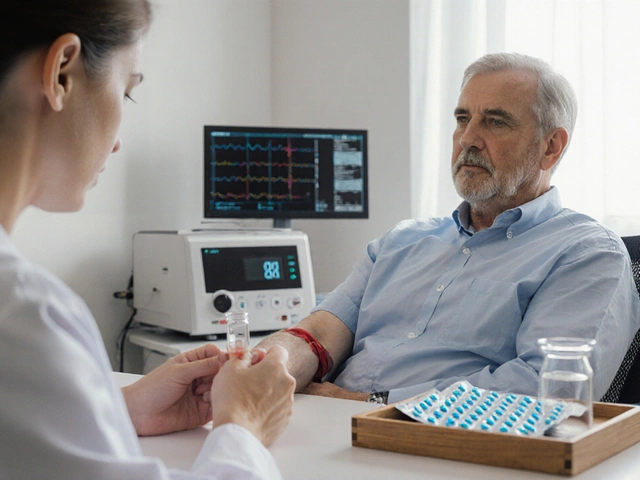
The most effective tool we have is the "read-back." This isn't just a casual "got it." A true read-back requires the receiver to repeat the entire order back to the prescriber exactly as they understood it. The Joint Commission has mandated this practice since 2006 because it can slash medication errors by up to 50%.
A proper read-back sequence looks like this:
- Prescriber: "Administer ten milligrams of Morphine IV every four hours."
- Receiver: "I have an order for ten milligrams of Morphine, given intravenously, every four hours. Is that correct?"
- Prescriber: "Correct."

Handling High-Alert Medications and Restrictions
Not all drugs are created equal. Some medications are so dangerous that the margin for error is zero. These are known as "high-alert medications." For these, verbal orders should be strictly prohibited unless it is a true life-or-death emergency. For instance, the Pennsylvania Patient Safety Authority specifically bans verbal orders for chemotherapy, except when the order is to hold or stop the treatment.
Similarly, you should be extremely cautious with insulin, heparin, and opioids. In non-emergent situations, these must be entered via a Computerized Physician Order Entry (CPOE) system. The shift toward CPOE has already helped; research from the Agency for Healthcare Research and Quality (AHRQ) shows that as electronic ordering increased, verbal order rates dropped from 22% to 10% in many hospitals, leading to a 37% decrease in miscommunication errors.
| Order Method | Estimated Accuracy | Primary Risk | Best Use Case |
|---|---|---|---|
| Electronic (CPOE) | 85-95% | System downtime/Typing errors | Standard care, Routine meds |
| Verbal (with Read-Back) | 50-70% | Auditory misinterpretation | Sterile fields, Emergencies |
| Verbal (No Read-Back) | Low/Unpredictable | High risk of LASA errors | Avoid at all costs |
Documentation and Authentication
A verbal order isn't "official" until it's in the record. The danger here is the gap between the spoken word and the written entry. If a doctor gives an order at 8:00 AM but doesn't sign off on it until the next day, that's a window for error. While CMS (Centers for Medicare & Medicaid Services) allows up to 48 hours for authentication, most top-tier hospitals demand that orders be signed off during the same shift.
When transcribing a verbal order, the record must be concrete. Don't just write "Morphine 10mg." Include these specific values:
- Patient's full name and unique identifier.
- The exact medication name (spelled out).
- The dose with clear units (e.g., "mg" not just "m").
- The route (e.g., "Intravenous").
- The frequency and the specific indication (why the patient is getting it).
- The time and date the order was received.
- The identity of the prescriber.

Overcoming Workflow Challenges
Why do we still have so many errors if the rules are clear? It usually comes down to the environment. Shift changes are a prime example; roughly 42% of verbal order errors happen during this transition. The handoff is rushed, and communication breaks down.
Another issue is "prescriber resistance." Some doctors feel that reading back an order is a waste of time or a challenge to their authority. The solution here is cultural. Organizations need to standardize scripts so that read-backs become a habit, not an interruption. For providers, managing distractions is key. If you are in the middle of prescribing, it's okay to use a verbal cue like, "Let me finish this prescription, and then I'll answer your question," to ensure your focus remains on the dosage and drug name.
Are verbal orders illegal?
No, they are not illegal. Both CMS and The Joint Commission allow them, provided they are used appropriately and authenticated promptly by the ordering practitioner. They are considered necessary tools for emergencies and sterile environments.
What is the most common cause of verbal order errors?
Sound-alike (LASA) drug names are a primary culprit, accounting for about 34% of errors. Common examples include confusing Celebrex with Celexa or Hydralazine with Hydroxyzine.
How should I communicate numbers to avoid mistakes?
Use two different methods to state numbers. For example, instead of just saying "fifteen milligrams," say "fifteen milligrams, also stated as one-five milligrams." This prevents "15" from being misheard as "50."
When is a read-back absolutely mandatory?
According to Joint Commission standards, read-back verification should be used for all verbal or telephone orders to ensure the receiver has captured the order accurately before administration.
What should I do if I'm unsure about a verbal order?
Always ask for immediate clarification. It is better to pause for ten seconds to confirm a dose than to administer the wrong medication. Experienced practitioners recommend documenting the exact time the order was received and the exact phrasing used.
Next Steps for Providers
If you're working in a fast-paced clinic or hospital, the best way to improve safety is to start small. Begin by implementing a "no-abbreviation" rule for yourself and your immediate team. If you're a manager, look at your shift-change protocols-can you create a dedicated, quiet space for order transcription to reduce the 42% error rate seen during handoffs?
For those using electronic records, leverage voice-recognition technology where available, but never let it replace the human verification step. The ultimate goal is to move toward a system where verbal orders are the exception, not the rule, and where the "read-back" is as instinctive as washing your hands before a procedure.