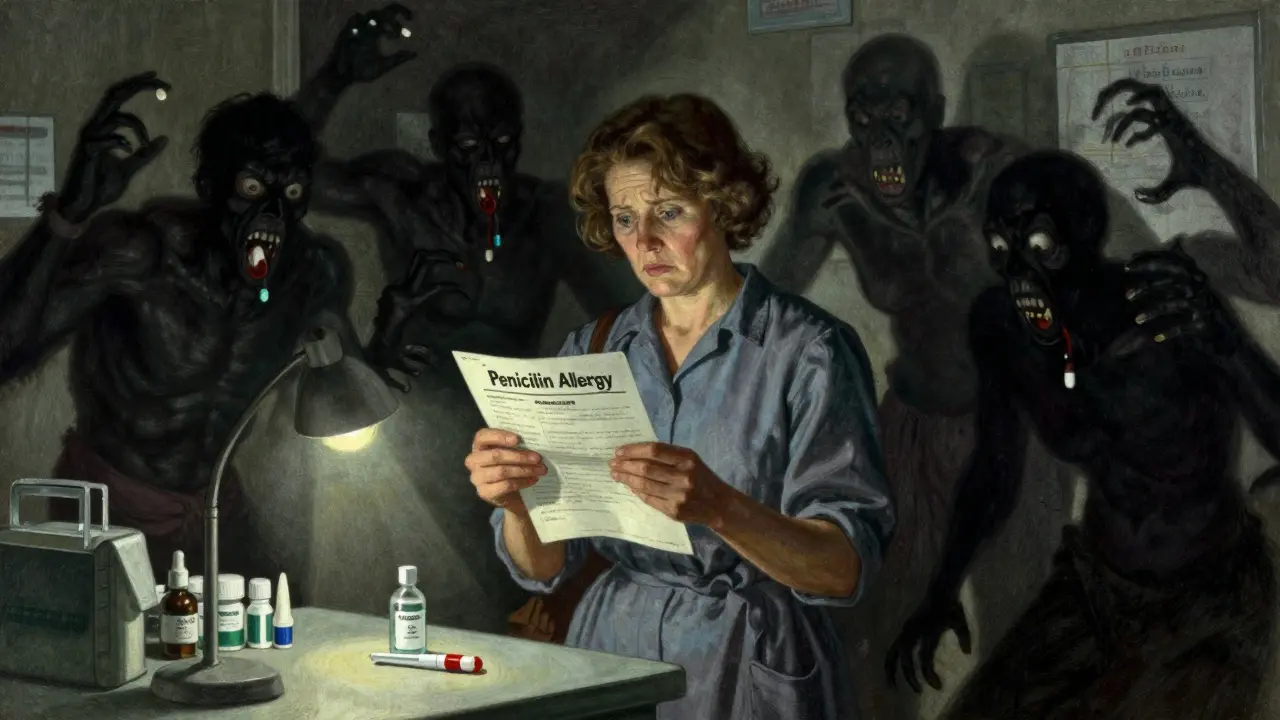
More than 10% of Americans carry a label saying they’re allergic to penicillin. But here’s the truth: over 95% of them aren’t actually allergic. That label-often from a childhood rash or a misdiagnosed stomach upset-isn’t just outdated. It’s dangerous. It’s pushing doctors toward stronger, costlier, and more resistant antibiotics. And it’s putting patients at higher risk of infections they could’ve avoided.
Why a False Allergy Label Matters More Than You Think
If you’ve been told you’re allergic to penicillin, you’ve probably been given alternatives like vancomycin, clindamycin, or fluoroquinolones. These drugs work-but they’re not better. They’re broader-spectrum, meaning they wipe out good bacteria along with bad ones. That’s why patients with false penicillin allergy labels are 30% more likely to develop Clostridioides difficile infections, a severe gut illness that can lead to hospitalization or death. The CDC estimates false penicillin labels cause 50,000 extra C. diff cases each year in the U.S. alone. That’s not a small number. It’s a public health crisis hiding in plain sight. And it’s not just about infections. Patients with these labels pay about $1,000 more per year in healthcare costs, according to JAMA Internal Medicine. Why? Because they’re often treated with more expensive drugs, longer hospital stays, and more follow-up visits. Worse yet, overuse of these alternatives fuels antibiotic resistance. Patients with penicillin labels get clindamycin 69% more often and fluoroquinolones 28% more often than those without. That’s directly linked to rising rates of MRSA and drug-resistant E. coli. Your allergy label isn’t just your problem-it’s everyone’s problem.How Do You Know If Your Allergy Label Is Wrong?
Most people get labeled allergic after a mild reaction years ago-a rash, nausea, or a headache. But true IgE-mediated penicillin allergies (the kind that cause anaphylaxis) are rare. Only 1-2% of people who think they’re allergic actually have them. The rest? Their reactions were likely side effects, viral rashes, or unrelated symptoms. The good news? You don’t have to guess. Testing can confirm it. And it’s safer than you think. There are two main ways to test:- Skin testing: A small amount of penicillin is placed on the skin (prick test) or just under it (intradermal test). If you’re truly allergic, you’ll get a raised bump within minutes. This test is highly specific-meaning if it’s negative, you’re very likely not allergic.
- Oral challenge: If skin testing is negative, you’re given a small, gradually increasing dose of penicillin (like amoxicillin) under medical supervision. You’re watched for 30 to 60 minutes. If nothing happens, you’re cleared.
Who Should Get Tested?
You don’t need to be sick to get tested. In fact, the best time is when you’re healthy. Here’s who should consider it:- Anyone told they’re allergic to penicillin or amoxicillin-especially if it happened as a child
- People who’ve had a rash (not hives or swelling) after taking penicillin
- Patients with recurring infections who keep getting broad-spectrum antibiotics
- Anyone scheduled for surgery, pregnancy, or long-term antibiotic treatment
- P - Penalty: Was the reaction severe? (Anaphylaxis, swelling, breathing trouble)
- E - Event: Was it more than 5 years ago?
- N - No: Did you take penicillin since without issue?
- FAST - Was it a fast reaction (within an hour)?
What Happens During Testing?
The process is straightforward:- History review: Your provider asks about the reaction-when, what symptoms, how long ago. They’ll use PEN-FAST to assess risk.
- Skin test (if needed): A nurse or allergist applies a drop of penicillin to your arm, then lightly pricks the skin. No needles. No pain. Just a tiny scratch. If negative, they do a second test deeper under the skin.
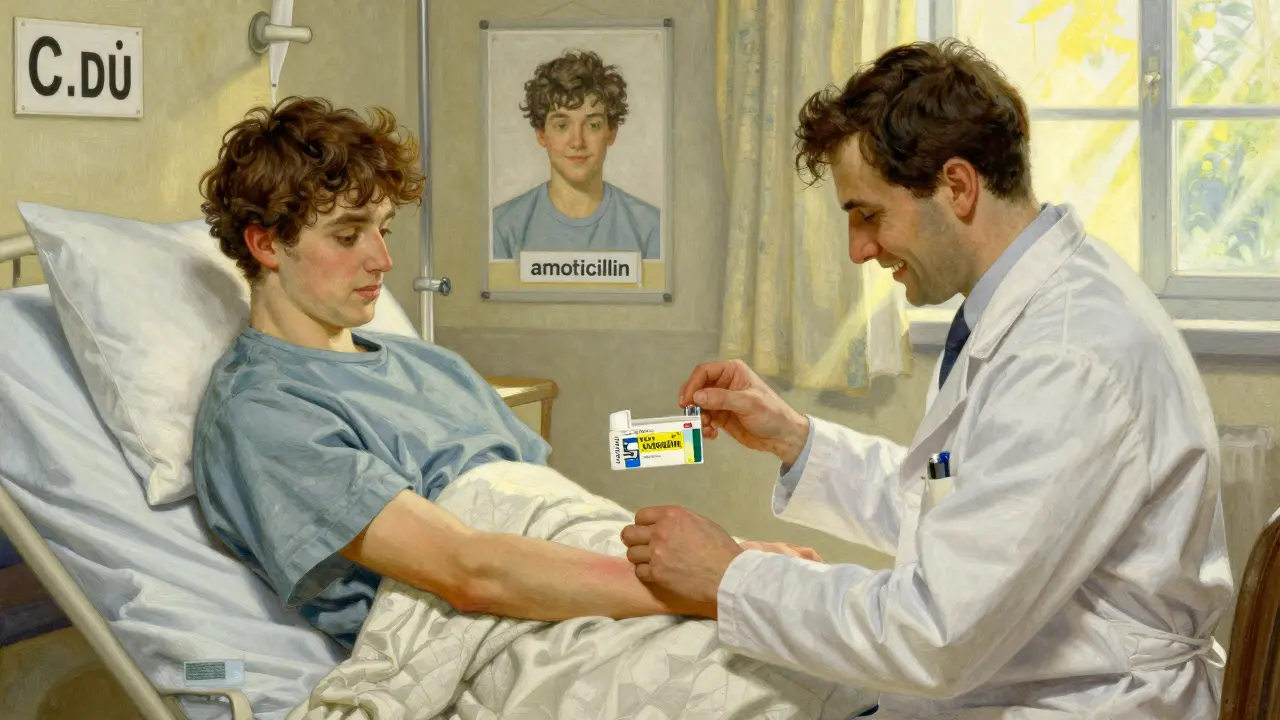
- Oral challenge: You swallow a small dose of amoxicillin (often 250mg). You wait 30 minutes. If fine, you take a full therapeutic dose (500-1000mg) and wait another 30-60 minutes.
- Result: If no reaction, your allergy label is removed. You get a letter to give your doctor. Your EHR is updated. You’re free to use penicillin antibiotics going forward.
Real Stories: What Testing Changed
One patient, 68, had a penicillin label for 40 years. Every time she got a UTI, she was given IV antibiotics. She spent weeks in and out of hospitals. After testing and de-labeling, she took a simple oral amoxicillin course. No more hospital stays. No more IV lines. She saved over $28,000 in two years. Another patient, a college student, avoided antibiotics for years because of a childhood rash. When he got strep throat, he was prescribed azithromycin. He got terrible stomach cramps. He thought it was the antibiotic. Turns out, it was the drug itself-he was never allergic to penicillin. After testing, he took amoxicillin for his next infection. No side effects. No anxiety. Just relief. On Reddit, someone wrote: “I thought I was allergic. Turns out I just had a virus when I was five. Now I can take amoxicillin instead of Z-Pak-which always made me nauseous.”Why Isn’t Everyone Getting Tested?
If it’s this safe and this effective, why aren’t more people doing it? The answer is systemic. Fewer than 40% of eligible patients get tested. Why?- Lack of access: Most hospitals don’t have allergists on staff. Rural areas have one allergist per 500,000 people.
- Provider hesitation: Many doctors don’t know the guidelines or fear liability.
- Patient fear: People are scared of testing. They’ve heard horror stories.
- Electronic health record problems: Even when you’re cleared, your allergy status doesn’t always update in the system.

What You Can Do Right Now
You don’t need to wait for your doctor to bring it up. Here’s what to do:- Check your records: Look at your medical chart. Does it say “penicillin allergy” without details? That’s a red flag.
- Ask your doctor: “I was told I’m allergic to penicillin as a kid. Can we test to confirm?”
- Request PEN-FAST: Ask if they use the PEN-FAST tool to assess your risk.
- Push for de-labeling: If you’re low-risk, ask for a direct oral challenge. It’s faster, cheaper, and just as safe.
- Update your records: After testing, get a written note and make sure your EHR is updated. Don’t assume it happened automatically.
What If You Test Positive?
If you do have a true allergy? That’s important too. You’ll get a clear, accurate label-like “allergic to amoxicillin, not penicillin” or “allergic to cefazolin.” That’s better than a blanket “penicillin allergy.” Cross-reactivity isn’t guaranteed. You might still be able to take other beta-lactams safely. The goal isn’t to remove all labels. It’s to remove the false ones. Accurate labels help doctors choose the right drug-and keep you safe.Final Thought: Your Label Isn’t Permanent
Allergy labels stick like scars. But unlike scars, they can be erased-with science, not time. You don’t need to live with a misdiagnosis from childhood. You don’t need to risk antibiotic resistance or pay more for care. You don’t need to avoid the best, safest, cheapest antibiotics just because of a label that might be wrong. Testing is safe. It’s quick. It’s covered by most insurance. And it changes everything. If you’ve ever been told you’re allergic to penicillin-ask for a test. Your future self will thank you.Can I just take penicillin without testing to see if I’m allergic?
No. Never try to test yourself at home. Even if your reaction years ago was mild, a true allergic reaction can become more severe with repeated exposure. Always get tested under medical supervision with proper emergency equipment available.
Is skin testing painful?
Skin testing feels like a tiny scratch or a quick pinch. It’s not painful. Some people feel a little itch if they’re allergic, but most feel nothing at all. The test is designed to be safe and minimally invasive.
How long does the whole process take?
Most testing takes 2 to 3 hours total. Skin testing takes about 20 minutes, followed by a 30- to 60-minute observation after each oral dose. You can usually go home the same day.
Will my insurance cover this?
Yes. Most insurance plans, including Medicare and Medicaid, cover allergy testing for drug allergies when medically indicated. The cost is far less than the long-term costs of inappropriate antibiotic use.
Can I be allergic to one penicillin but not another?
Yes. Penicillin is a class of drugs. Being allergic to amoxicillin doesn’t mean you’re allergic to ampicillin or cefdinir. Cross-reactivity is lower than most people think. That’s why accurate labeling-down to the specific drug-is so important.
What if I had anaphylaxis years ago? Can I still be tested?
If you had a true anaphylactic reaction, you should avoid penicillin. But many people misremember or mislabel severe reactions. If you’re unsure, consult an allergist. They can review your history and determine if testing is appropriate-even after a severe reaction.
Can my primary care doctor do this, or do I need an allergist?
For low-risk patients, primary care doctors can safely perform direct oral challenges using validated protocols. Many hospitals now train non-allergists to do this. For moderate- or high-risk patients, referral to an allergist is recommended.



Gregory Parschauer
Let’s be real-this isn’t just about penicillin. It’s about systemic medical negligence. We’ve been conditioned to treat labels as gospel, not as outdated, poorly documented anecdotes. That 95% statistic? It’s not a fluke-it’s a indictment of how lazy our EHRs are. And don’t even get me started on how providers still reflexively default to vancomycin like it’s some kind of holy grail. We’re not just overprescribing-we’re weaponizing resistance through bureaucratic inertia. This isn’t patient care. It’s algorithmic malpractice wrapped in a white coat.
Kimberly Mitchell
I’ve had this label since I was six. Got a rash from amoxicillin after a cold. No anaphylaxis. No hives. Just a red spot. But my chart says ‘penicillin allergy’ like it’s carved in stone. No doctor has ever questioned it. Not one. And now I’m 42, on clindamycin every time I get a sinus infection, and I’m tired of feeling like a medical liability. This article finally gave me the courage to ask for testing. I’m scheduling it next week.
Angel Molano
False labels kill. Period. Stop wasting time and get tested.
Vinaypriy Wane
As someone who’s watched my brother suffer through multiple C. diff infections because of unnecessary broad-spectrum antibiotics-this hits hard. I’ve been pushing our family to get tested for years. We’re all low-risk, but no one listens. The fear is irrational. The science? Rock-solid. Please, if you’re reading this and you have a label-don’t wait until you’re hospitalized. Do it now. Your gut will thank you.
jefferson fernandes
I work in primary care. I’ve started implementing PEN-FAST with every patient who has a penicillin label. It’s changed how we approach antibiotics. We’ve done 87 oral challenges this year-zero serious reactions. We’ve saved over $150K in drug costs and reduced C. diff cases by 40%. The barrier isn’t safety-it’s workflow. Most clinics don’t have the time, training, or support to do this right. We need systemic investment, not just individual courage. This isn’t a niche issue-it’s a population health imperative.
mike swinchoski
So you’re telling me I can just swallow a pill and not die? Wild. I thought my mom’s ‘allergy’ was some kind of sacred family curse. Guess I’m getting tested. Also, why is this not on every doctor’s homepage? This is like finding out your car has a spare tire you never knew about.
Lethabo Phalafala
I’m from South Africa-we don’t have the same access to allergists here, but I’ve seen what happens when people get treated with the wrong antibiotics. One neighbor died from C. diff after being given clindamycin for a tooth infection. She had a penicillin label from age seven. No one ever checked. I cried when I read this. It’s not just American. It’s global. We need mobile testing units. We need community nurses trained in this. This isn’t just medicine-it’s justice.
Lance Nickie
penicilin? i think i had it once and got a tummy ache. so yeah, i’m allergic. lol. who cares?
Milla Masliy
As a nurse who’s seen patients get sicker because of mislabeled allergies, I’m so glad this is getting attention. But I want to add something: it’s not just about testing-it’s about updating records. I’ve had patients cleared in clinic, only to have the hospital system flag them as allergic again because the EHR didn’t sync. That’s a failure of infrastructure, not patient compliance. If you get tested-get the paperwork. Email it to your PCP. Call the hospital’s medical records department. Don’t assume it’s done. Your life depends on it.