Living with chronic obstructive pulmonary disease means getting used to a "new normal" when it comes to breathing. But there is a massive difference between a day where you're feeling a bit winded and a full-blown COPD exacerbations. When your symptoms suddenly spike, it isn't just a bad day; it's a medical event that can leave permanent scars on your lungs if not handled quickly. Understanding how to spot the shift from a daily struggle to an emergency is the only way to stop a flare-up from becoming a life-threatening crisis.
| Feature | Typical COPD Day | Exacerbation (Flare-up) |
|---|---|---|
| Shortness of Breath | Manageable with rest | Severe, happens even at rest |
| Phlegm/Sputum | Consistent amount/color | More volume, change in color (yellow/green) |
| Coughing | Chronic, predictable | Increased frequency and intensity |
| Energy Levels | Usual fatigue | Extreme exhaustion, unable to sleep |
What exactly is a COPD exacerbation?
In simple terms, an exacerbation is a sudden worsening of your respiratory symptoms. While COPD is a chronic inflammatory lung disease that causes obstructed airflow from the lungs, an exacerbation is an acute event. It happens when your airways-which are already narrowed-become even more inflamed and clogged with mucus.
This isn't just a temporary dip in mood or energy. It's a physiological shift where your body struggles to move air in and out. This often leads to dynamic hyperinflation, which is a fancy way of saying your lungs trap too much air, making it nearly impossible to take a full breath. This is why the shortness of breath feels so much more panicked during a flare-up than on a normal day.
The triggers: What sets off a flare-up?
Most flare-ups don't happen for no reason. Usually, something triggers the inflammation. About 75% of these events are caused by infections. When a virus or bacteria hits your lungs, your immune system kicks into overdrive, creating more mucus and swelling in the airways.
Bacteria like Haemophilus influenzae or Streptococcus pneumoniae are common culprits. On the other hand, viruses such as the rhinovirus (the common cold) or influenza can just as easily trigger a crisis. Interestingly, recent data suggests that the inhaled medications used for COPD might actually help dampen the severity of some viral infections, including COVID-19.
Beyond germs, your environment plays a huge role. Have you ever noticed your breathing get tighter on a freezing winter morning or in a room filled with strong perfume? These are environmental triggers. Common ones include:
- Heavy air pollution or smog
- Cigarette smoke or chemical fumes
- Very cold or very humid air
- Strong odors like bleach or pungent perfumes

Spotting the warning signs
The danger of a COPD flare-up is that it can sneak up on you. You might think you're just tired, but your body is actually signaling for help. The most reliable indicator is a change in your sputum. If your phlegm becomes thicker, increases in volume, or changes color to yellow or green, your lungs are likely fighting an infection.
You should also watch for a "coughing fit" that won't stop. If you find yourself unable to sleep because you're gasping for air or coughing throughout the night, you've moved past your baseline. Other red flags include fever, chills, and a feeling of extreme weakness that makes simple tasks, like walking to the bathroom, feel like running a marathon.
Emergency treatment: When to act fast
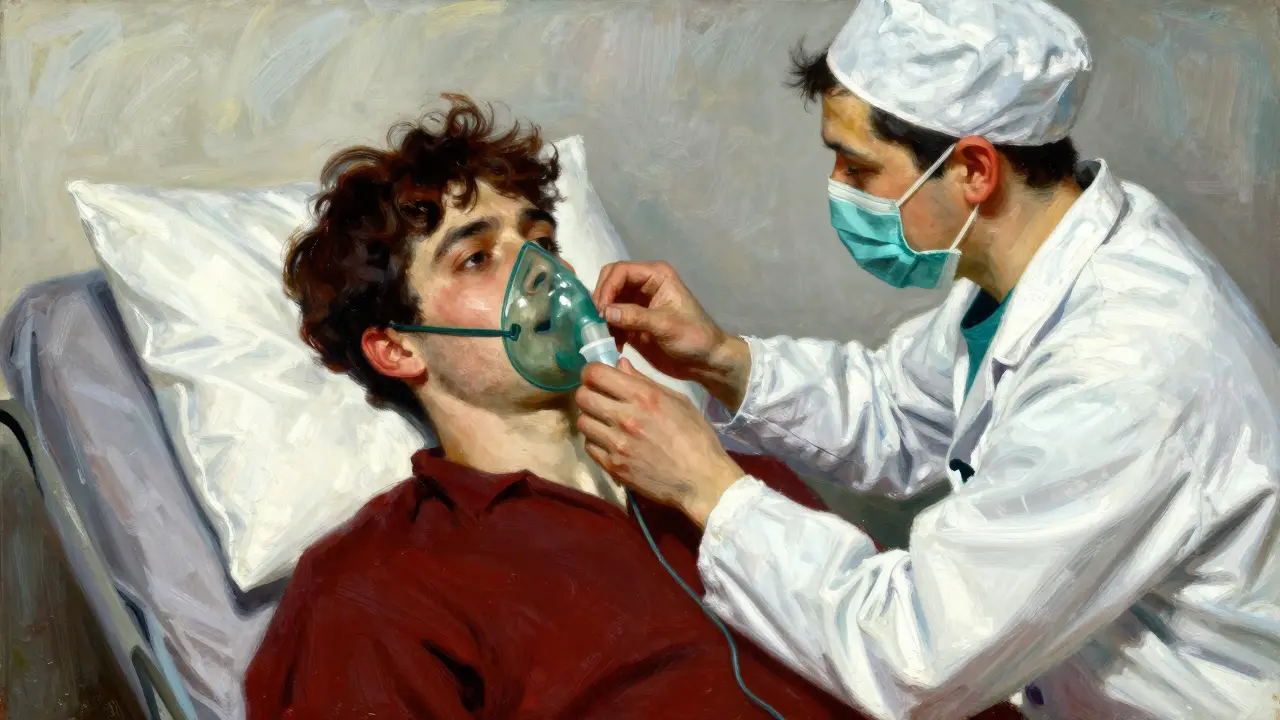
When an exacerbation hits a critical point, the primary goal is to get oxygen back into your blood and reduce the swelling in your lungs. If you experience a sudden drop in oxygen levels-which can be measured with a pulse oximeter-it is a life-threatening emergency. Do not wait; get to an emergency room.
In a clinical setting, doctors typically use a three-pronged attack to stabilize you:
- Bronchodilators: These open up the airways quickly to allow more air to flow.
- Corticosteroids: Oral or intravenous steroids are used to bring down the massive inflammation in the lung tissue.
- Antibiotics: If a bacterial infection is suspected, antibiotics are administered to kill the pathogen.
In severe cases, you might need Supplemental Oxygen to prevent organ damage caused by low oxygen (hypoxemia). Some patients may even require non-invasive ventilation to help push air into the lungs and clear out the trapped carbon dioxide.
The long-term cost of a flare-up
Here is the hard truth: not every exacerbation is a "clean" recovery. Each major flare-up can cause irreversible damage to the lung tissue. Think of it like a scar on your skin; once that lung tissue is damaged by intense inflammation, it doesn't just bounce back. This creates a vicious cycle: the more flare-ups you have, the weaker your lungs become, which in turn makes you more susceptible to the next flare-up.
Research shows that some people don't fully return to their pre-flare lung function even eight weeks after the event. This is why prevention isn't just a suggestion-it's a necessity for survival.
How to prevent the next crisis
You can't cure COPD, but you can stop the cycle of exacerbations. The most effective tool you have is a personalized COPD Action Plan. This is a written guide from your doctor that tells you exactly what to do when symptoms start to dip-like when to increase your rescue inhaler use or when to call the clinic.
Stay on top of your vaccinations. Annual flu shots and pneumonia vaccines are non-negotiable for people with chronic lung disease. Because your lungs are already compromised, a simple flu shot can be the difference between staying home and spending a week in the hospital.
Finally, stick to your maintenance medications. Many people stop using their long-term inhalers when they feel "good," but those medications are what keep the inflammation low and your airways open. Consistency is your best defense against a sudden crash.
How long does a COPD exacerbation typically last?
Most exacerbations last between 7 to 14 days, though some can persist for several weeks. It's important to realize that while you may feel better after two weeks, your actual lung function may take two months or longer to recover, if it recovers fully at all.
Can a COPD flare-up be fatal?
Yes, severe exacerbations can be life-threatening. The primary danger is a drastic drop in blood oxygen levels (hypoxemia), which can lead to respiratory failure or put immense strain on the heart, potentially causing cardiac events.
What is the difference between a "bad day" and an exacerbation?
A "bad day" involves symptoms that are slightly worse than usual but still manageable with your current routine. An exacerbation is a significant shift-more coughing, a change in the color or amount of mucus, and shortness of breath that doesn't improve with rest or standard rescue medication.
Why do I get more flare-ups in the winter?
Winter brings two major triggers: cold, dry air, which irritates the airways and causes them to tighten (bronchospasm), and a peak in respiratory viral infections like the flu and common cold, which trigger inflammation in the lungs.
Do antibiotics always help during a flare-up?
Only if the exacerbation is caused by bacteria. Since about 25% of flare-ups are purely viral and another 25% are purely bacterial, doctors usually look for signs like yellow or green sputum or a fever before prescribing antibiotics. They won't work for a virus.

Dale Kensok
The discourse here fails to adequately address the systemic failure of the pulmonary parenchyma during these events. We are talking about a profound disruption of the ventilation-perfusion ratio, not some "bad day." The clinical nomenclature of "dynamic hyperinflation" is merely a surface-level observation of a much more complex hemodynamic collapse that occurs when the thoracic cavity becomes a pressurized chamber of stale carbon dioxide. It is frankly pedestrian to reduce this to a "flare-up" when we are discussing a cascading failure of homeostatic respiratory regulation. The sheer inefficiency of the alveolar gas exchange during these episodes is an exercise in biological futility. One must analyze the epigenetic predispositions that render certain cohorts more susceptible to these triggers. The insistence on basic "action plans" ignores the nuanced pharmacological synergy required to manage the systemic inflammatory response. It is the height of cognitive dissonance to assume a standardized protocol can mitigate the idiosyncratic nature of pulmonary distress. We should be discussing the molecular signaling of cytokines rather than whether the sputum is yellow or green. The obsession with visible markers over biochemical indicators is exactly why modern outpatient care is stagnating. Only a superficial understanding of pathophysiology would suggest that a simple antibiotic course is a panacea for a complex inflammatory storm. The systemic burden of repeated exacerbations is not just a "scar" but a total reconfiguration of the patient's physiological baseline. It is an existential descent into respiratory insufficiency that no amount of casual advice can fully encapsulate.
Nigel Gosling
Absolutely tragic that we've reached a point where people need a "guide" to not die from breathing air. The moral bankruptcy of the industrial age has left us with smog-filled cities and ruined lungs, yet we treat the symptoms like a minor inconvenience. It's an absolute farce!
Ryan Wilson
Looking at the way people just ignore their maintenance meds is like watching a slow-motion train wreck in a fireworks factory. Pure, unadulterated stupidity to think you're "cured" just because you can walk to the fridge without wheezing for ten minutes.
lalit adesara
Western medicine is a failure. Purely chemical. Try pranayama and ancient wisdom instead of these toxic steroids. Pathetic.
Abhishek Charan
Actually!!! I think the winter triggers are overrated!!! 🙄 Most people just forget their scarves and blame the disease!!! ❄️❄️
Sharon Mathew
Oh please! As if a little bit of "yellow phlegm" is the only way to know you're dying! Some of us feel the crisis in our very souls long before the mucus changes color! The drama of a flare-up is completely ignored here!
Aubrey Johnson
The previous comment regarding ancient wisdom is profoundly ignorant. Clinical data is the only metric that matters here.
Kali Murray
just stay hydrated and keep the humidifier going guys ✌️✨
Steve Grayson
I agree with the point about the Action Plan. Having everything written down really takes the panic out of the situation when you can't breathe well enough to think clearly.
Kat G
The information provided about vaccinations is correct and very important.
Angela Cook
This is why American healthcare is the best in the world! We have the best meds and the best ERs to handle these crises while other countries are still using leeches!