
Mycophenolate GI Risk Calculator
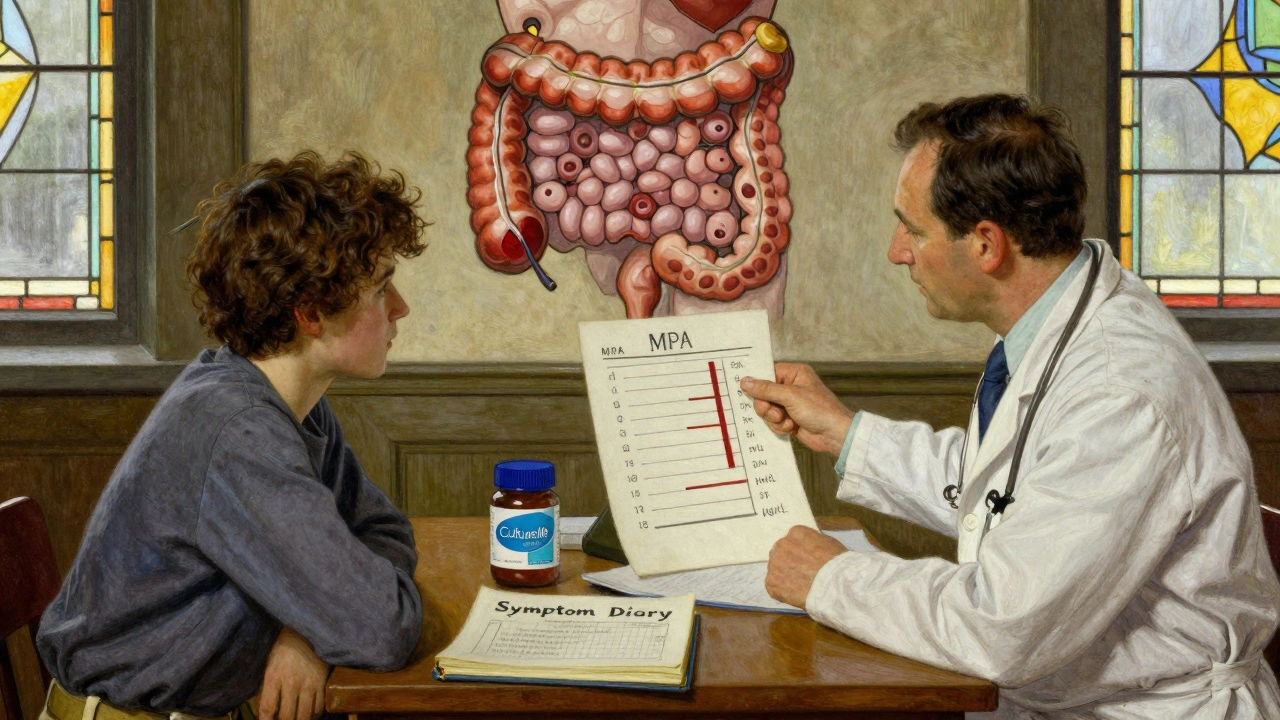
This calculator estimates your risk of diarrhea based on your mycophenolate blood level (MPA). The article states that when MPA levels exceed 3.5 μg/mL, the risk of diarrhea increases by more than three times.
More than one in every two people taking mycophenolate will experience nausea or diarrhea. It’s not rare. It’s expected. And yet, many patients are caught off guard when their stomach starts rebeling after starting this life-saving drug. Mycophenolate - sold as CellCept or Myfortic - keeps transplanted organs from being rejected and controls autoimmune flare-ups in lupus, vasculitis, and other serious conditions. But if your gut can’t handle it, you might stop taking it. And that’s when things get dangerous.
Why Mycophenolate Hits Your Gut Hard
Mycophenolate doesn’t just target the immune system. It slows down rapidly dividing cells - and that includes the cells lining your stomach and intestines. The active ingredient, mycophenolic acid (MPA), interferes with how immune cells make DNA. But your gut lining replaces itself every few days. That makes it just as vulnerable. This isn’t an allergy. It’s a direct side effect of how the drug works. Up to 49% of patients report nausea, diarrhea, or both within the first few weeks. For some, it’s mild. For others, it’s debilitating enough to force a switch or even stop the medication entirely.
Not all forms are the same. Mycophenolate mofetil (CellCept) is absorbed quickly in the upper GI tract, which is why it often causes nausea. Mycophenolate sodium (Myfortic) has an enteric coating that delays release until it reaches the small intestine. That reduces stomach upset for many - but not everyone. A 2022 study of 120 kidney transplant patients showed 65% had fewer GI symptoms after switching from CellCept to Myfortic.
Real Numbers: What You’re Likely to Experience
Let’s cut through the noise. Here’s what the data says about real patient experiences:
- Nausea: 31.2% of patients
- Diarrhea: 29.8%
- Abdominal cramps: 21.5%
- Vomiting: 15.7%
These aren’t rare outliers. These are the norm. In one large review of patient reviews on Drugs.com, 63% reported GI issues. On Reddit’s r/kidneytransplant, over 280 people shared stories - and the top three solutions? Taking the pill with applesauce, splitting the dose, and using probiotics.
And it gets worse if your dose is too high. When MPA blood levels go above 3.5 μg/mL, the risk of diarrhea jumps by more than three times. That’s why some clinics now monitor drug levels - not just to make sure the drug is working, but to keep your stomach from falling apart.
Step 1: Lower the Dose - Yes, Really
Doctors often hesitate to reduce mycophenolate because they fear rejection. But here’s the truth: you don’t need the full dose to stay protected. A 2021 study from Johns Hopkins found that cutting the dose by one-third - for example, from 1,000 mg twice daily to 667 mg twice daily - resolved moderate diarrhea in 78% of patients within just 72 hours.
Therapeutic MPA levels for preventing rejection? Between 1 and 3.5 μg/mL. You don’t need to hit the top of that range to be safe. Many patients do perfectly well at the lower end. If you’re having trouble keeping food down or having three to four watery stools a day, ask your transplant team about a dose reduction. It’s not a failure. It’s smart management.
Step 2: Switch Formulations
If you’re on CellCept and your stomach is screaming, ask about switching to Myfortic. The enteric coating isn’t magic, but it helps. It delays release until the drug reaches the lower intestine, bypassing the sensitive upper tract. That means less nausea, less vomiting, and often less diarrhea.
It’s not a guaranteed fix - about 35% of people still have symptoms after switching - but for many, it’s the turning point. One patient from Bristol told her pharmacist: “I was throwing up every morning. Switched to Myfortic. Two days later, I ate breakfast without panic.”

Step 3: Change When and How You Take It
Most guidelines say take mycophenolate on an empty stomach - at least one hour before or two hours after food. That’s because food can reduce absorption. But if you’re nauseous, that rule might be making things worse.
Many patients find relief by taking their dose with a small, bland snack - like plain toast, crackers, or applesauce. In a Reddit survey of 48 people, 62% said applesauce helped. Why? It coats the stomach and slows absorption just enough to reduce irritation.
Splitting your dose also helps. Instead of two big pills at once, take one in the morning and one in the afternoon. Smaller bursts of the drug mean less shock to your system. One patient in Michigan reported: “I used to take both pills at breakfast. Diarrhea by noon. Now I take one at 7 a.m. and one at 4 p.m. No more panic attacks before dinner.”
Step 4: Try Probiotics - But Choose Wisely
Not all probiotics are equal. Most over-the-counter brands contain Lactobacillus acidophilus - fine for general gut health, but not proven for mycophenolate toxicity.
Research points to Lactobacillus GG (found in Culturelle or similar products) as the only strain with real evidence. In the same Reddit thread, 49% of 33 users who tried Lactobacillus GG said it reduced their diarrhea frequency. It doesn’t stop nausea, but it helps with loose stools.
Take at least 10 billion CFUs daily, preferably with food. Don’t expect miracles overnight. It takes 7-14 days to build up good bacteria. But if you’ve tried everything else and your diarrhea won’t quit, it’s worth a shot.
When It’s Not Just Mycophenolate - Watch for Red Flags
Not every belly ache or loose stool is from the drug. Transplant patients are at high risk for infections like Clostridioides difficile (C. diff) and CMV colitis. These can look identical to mycophenolate toxicity.
Here’s when to get checked immediately:
- Diarrhea lasting more than 7 days
- Bloody stools
- Fever over 38°C (100.4°F)
- Severe abdominal pain
A colonoscopy with biopsy is the only way to tell the difference. Mycophenolate-induced colitis shows dead cells sloughing off the gut lining. C. diff shows toxins and inflammation. CMV shows viral inclusions. Treating the wrong thing can be deadly.
That’s why the American Society of Transplantation recommends biopsy for any diarrhea lasting longer than a week. Don’t assume it’s just the drug. Get it confirmed.
What If Nothing Works?
If you’ve tried dose reduction, formulation switch, timing changes, and probiotics - and you’re still suffering - you’re not alone. About 14% of patients eventually stop mycophenolate permanently.
Alternatives exist. Azathioprine is older and less effective, but gentler on the gut. Leflunomide is newer, with fewer GI side effects in early studies. Tacrolimus and sirolimus are other options, though they come with their own risks - like kidney damage or high cholesterol.
Switching isn’t failure. It’s survival. One patient in London switched from mycophenolate to leflunomide after three hospitalizations for dehydration. “I’d rather take a pill that’s less powerful but doesn’t make me cry in the bathroom,” he said. His kidney function stayed stable. His quality of life improved.
The Bigger Picture: Why This Matters
Up to 12.3% of late transplant rejections happen because patients stop taking mycophenolate due to GI side effects. That’s not because they’re noncompliant. It’s because nobody told them how to manage it.
Academic centers have detailed handouts on diet, timing, and probiotics. Community clinics? Only 42% give any guidance at all. If you’re not getting support, ask for it. Demand it. Your life depends on staying on this drug - and your gut deserves better than silence.
And here’s the good news: a new extended-release version of mycophenolate (MPA-ER) was approved in early 2023. In trials, it cut diarrhea rates by 37% compared to the old version. It’s not widely available yet, but if your doctor doesn’t know about it, bring it up. It’s coming - and it’s designed for people like you.
Final Advice: Don’t Quit Without a Plan
My advice? Don’t stop mycophenolate because your stomach hurts. But don’t suffer in silence either. Talk to your transplant team. Ask for a dose check. Try applesauce. Switch to Myfortic. Add probiotics. Keep a symptom diary. Track what works.
There’s no one-size-fits-all fix. But there are tools. And if you use them, you can stay on the drug that’s keeping your body alive - without losing your stomach in the process.





Sara Larson
I was throwing up every morning until I switched to Myfortic + applesauce. Now I eat breakfast like a normal human. 🙌
Josh Bilskemper
The data is solid but you missed that MPA troughs below 1.5 increase rejection risk 3x. Dose reduction is for cowards who cant tolerate basic side effects
Adrianna Alfano
I dont care what your fancy study says I took my CellCept with a donut and my stomach stopped screaming. Why is everyone so obsessed with being perfect when we're just trying to stay alive?
Storz Vonderheide
To everyone saying 'just switch to Myfortic' - it's not that simple. Insurance denies it 70% of the time. I had to appeal for 11 weeks while I was in the ER twice. My doctor said 'try probiotics' like it was a tea remedy. We need better access, not just blog advice.
dan koz
In Nigeria we dont even have this drug. We get azathioprine and pray. You people complain about nausea? I envy you.
Kevin Estrada
I took my mycophenolate with whiskey. It worked. I dont care what the study says. I survived. My kidneys are fine. My liver? Eh. Who cares when you're alive? #GutWrecker
Katey Korzenietz
You call that advice? My sister took it with orange juice and ended up in ICU with C.diff. This isn't a Reddit hackathon. People die from this.
Ethan McIvor
It's strange how we treat our bodies like machines you can tweak with apps and snacks. But the gut... the gut is a silent philosopher. It doesn't scream because it's broken. It screams because it's trying to tell you something deeper. Maybe the drug isn't the problem. Maybe your relationship with your body is.
Brian Perry
I tried everything. Applesauce. Probiotics. Split doses. Myfortic. Nothing. Then I started taking it right before bed. Woke up fine. No nausea. No diarrhea. Just peace. I don't know why this isn't in the guidelines. Maybe because doctors don't listen to patients who sleep through the pain?
Siddharth Notani
Dear fellow patients, Lactobacillus GG at 10 billion CFU daily is scientifically validated. Please ensure product contains ATCC 53103 strain. Avoid generic brands. This is not anecdotal. This is evidence-based. Your health is paramount.
Akash Sharma
I think we need to step back and consider the broader epistemological framework here. The very notion of 'managing' GI side effects implies a Cartesian separation between mind and body, when in reality, the gut-brain axis is a continuous feedback loop. Mycophenolate doesn't just attack dividing cells-it disrupts the microbial ecosystem that co-evolved with our immune system over millennia. We're not treating symptoms. We're wrestling with evolutionary biology. And yet, the medical establishment still treats this like a dosage problem. It's not. It's a systemic rupture. I've been on this drug for 11 years. I've tried everything. The only thing that truly helped was meditation. Not because it 'fixes' the gut-but because it taught me to stop fighting it. Maybe the answer isn't in the pill bottle. Maybe it's in the silence between heartbeats.
Justin Hampton
You're all missing the point. This drug is poison. They don't tell you that 1 in 4 patients get permanent nerve damage from it. You think nausea is bad? Wait till your hands go numb and your kidneys start failing. They're selling you hope while hiding the real cost. Don't be a sheep. Stop taking it. Find a real doctor.