
You might have noticed those red, scaly patches on your elbows or knees. You’ve been told it’s just psoriasis, a common skin condition that affects millions of people worldwide. But what if I told you that this skin issue could be the tip of an iceberg? For about one in three people with psoriasis, the inflammation doesn’t stay on the surface. It travels deeper, attacking the joints and causing a painful condition known as psoriatic arthritis (PsA).
This isn’t just a cosmetic problem or simple wear-and-tear on your body. It is a systemic autoimmune disease. Your immune system, which is supposed to protect you from viruses and bacteria, mistakenly attacks healthy tissues. This leads to chronic inflammation that can damage joints, cause severe fatigue, and even impact your heart health. Understanding the link between your skin and your joints is the first step toward managing this complex condition effectively.
The Connection Between Skin and Joints
To understand why these two conditions are linked, we need to look at how they start. Both psoriasis and psoriatic arthritis stem from the same root cause: an overactive immune response. In psoriasis, immune cells called T-cells trigger inflammation in the skin, causing skin cells to multiply too quickly. Instead of shedding naturally, these cells build up on the surface, forming the characteristic silvery scales and red plaques.
In psoriatic arthritis, this same inflammatory process targets the joints, tendons, and ligaments. The connection is so strong that medical experts view them as part of the same disease spectrum. According to data from the Spondylitis Association of America, approximately 30% of people with psoriasis will develop PsA. In most cases-about 85%-the skin symptoms appear before the joint pain starts. However, for 5-10% of patients, the arthritis strikes first, sometimes years before any skin issues become visible.
This timeline matters because many people suffer with joint pain for years before getting a correct diagnosis. They might see a dermatologist for their skin but never mention their stiff knees, or they see a general practitioner for back pain and don’t connect it to their scalp rash. Recognizing that these symptoms often travel together is crucial for early intervention.
Recognizing the Symptoms Beyond the Skin
If you only look at the skin, you’ll miss half the picture. Psoriatic arthritis presents with a unique set of symptoms that distinguish it from other forms of arthritis, like rheumatoid arthritis. Here is what you need to watch out for:
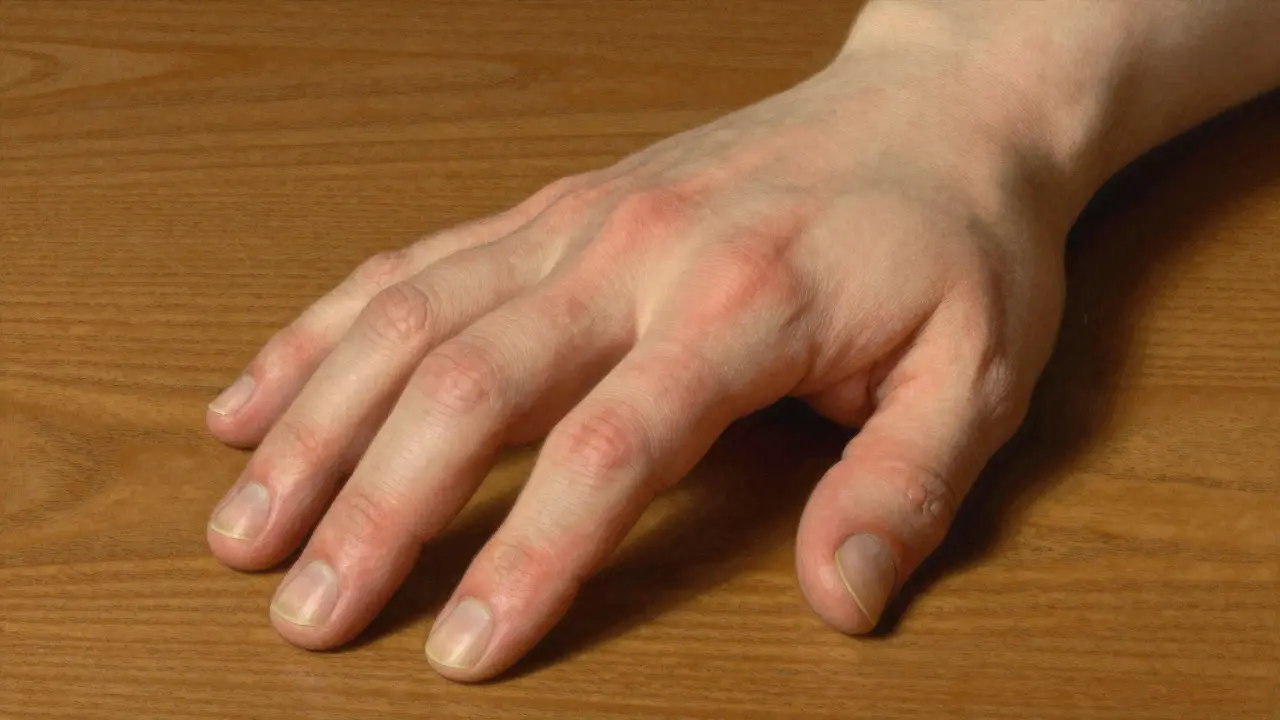
- Dactylitis: Often called "sausage digits," this is when an entire finger or toe swells up uniformly. It occurs in about 40% of PsA patients and is a hallmark sign of the disease.
- Enthesitis: This is inflammation where tendons and ligaments attach to bones. You might feel sharp pain at the bottom of your foot (plantar fasciitis) or along the back of your heel (Achilles tendonitis). It affects roughly 35-50% of people with PsA.
- Asymmetric Joint Pain: Unlike rheumatoid arthritis, which usually affects both sides of the body equally, PsA often hits joints on one side more than the other. You might have a swollen left knee but a fine right knee.
- Morning Stiffness: If you wake up feeling like your joints are locked in concrete, especially in the lower back or neck, this axial involvement is common in PsA.
- Nail Changes: Look closely at your fingernails and toenails. Pitting (small dents), thickening, or separation from the nail bed (onycholysis) occurs in up to 80% of PsA patients. Nail damage is a strong predictor of joint disease.
These symptoms aren’t static. They come in flares and remissions. One day you might feel fine; the next, your hands might swell so much you can’t button your shirt. This unpredictability makes life planning difficult and adds a layer of mental stress that goes beyond physical pain.
How Doctors Diagnose Psoriatic Arthritis
Diagnosing PsA can be tricky because there is no single blood test that says "yes" or "no." Rheumatologists use a combination of clinical signs, imaging, and exclusion criteria. The gold standard for classification is the CASPAR criteria (Classification Criteria for Psoriatic Arthritis), established in 2006.
To meet the CASPAR criteria, you must have inflammatory joint disease plus at least three points from the following features:
| Feature | Points |
|---|---|
| Current psoriasis | 2 points |
| History of psoriasis (if current is absent) | 1 point |
| Psoriatic nail dystrophy | 1 point |
| Negative rheumatoid factor (RF) | 1 point |
| Radiographic evidence of new bone formation near joints | 1 point |
A score of 3 or higher confirms the diagnosis. Doctors will also order blood tests to check for markers of inflammation, such as C-reactive protein (CRP) and erythrocyte sedimentation rate (ESR). While these don’t diagnose PsA specifically, high levels indicate active inflammation in the body. Imaging studies like X-rays, ultrasounds, or MRIs help visualize joint damage or erosion that isn’t visible to the naked eye. Early detection through these methods is vital because once bone erosion sets in, it is often irreversible.
Treatment Options: From Pills to Biologics
The goal of treatment is not just to reduce pain but to prevent permanent joint damage and achieve "minimal disease activity." Treatment plans are highly individualized based on which parts of your body are affected and how severe the symptoms are.
For mild cases, doctors may start with nonsteroidal anti-inflammatory drugs (NSAIDs) like ibuprofen or naproxen to manage pain and swelling. If the disease persists, they might prescribe conventional disease-modifying antirheumatic drugs (DMARDs) such as methotrexate. Methotrexate slows down the immune system’s attack on joints and is often the first line of defense for moderate disease.
However, for many patients, especially those with significant skin involvement or spinal pain, stronger medications are needed. This is where biologic agents come in. These are targeted therapies that block specific proteins involved in the inflammatory process.
- TNF inhibitors: Drugs like adalimumab, etanercept, and infliximab block tumor necrosis factor-alpha (TNF-α), a key driver of inflammation. They are effective for both joint and skin symptoms.
- IL-17 inhibitors: Medications like secukinumab and ixekizumab target interleukin-17. These are particularly powerful for clearing skin plaques and treating enthesitis.
- IL-12/23 inhibitors: Ustekinumab blocks interleukins 12 and 23, offering another pathway to control the immune response.
- JAK inhibitors: Oral medications like tofacitinib work inside the cells to stop inflammatory signals. They offer a pill-based alternative to injections.
The American College of Rheumatology guidelines updated in 2022 recommend tailoring these treatments to the predominant symptom. If your main issue is back pain, TNF inhibitors might be preferred. If your skin is severely affected, IL-17 inhibitors could be the better choice. The landscape of treatment is evolving rapidly, with new drugs targeting IL-23 and TYK2 pathways showing promise in recent trials.

Living with PsA: Comorbidities and Lifestyle
Psoriatic arthritis is more than just joint pain. It is a systemic condition that increases the risk of other health problems, known as comorbidities. Studies show that people with PsA have a 43% higher risk of heart attack compared to the general population. Metabolic syndrome-a cluster of conditions including high blood pressure, high blood sugar, and excess body fat-is also more common, affecting 40-50% of PsA patients.
Mental health is another critical aspect. The chronic pain, visible skin lesions, and uncertainty of the disease take a toll. Depression and anxiety affect up to 30% of patients. Addressing these issues is part of comprehensive care. Don’t hesitate to seek support groups or counseling; you are not alone in this struggle.
Lifestyle changes play a supportive role in management. While diet won’t cure PsA, reducing inflammation through an anti-inflammatory diet rich in fruits, vegetables, whole grains, and omega-3 fatty acids can help. Maintaining a healthy weight reduces stress on weight-bearing joints like knees and hips. Regular, low-impact exercise such as swimming, walking, or yoga keeps joints flexible and muscles strong without exacerbating pain.
Smoking cessation is crucial. Smoking has been linked to more severe psoriasis and reduced effectiveness of certain biologic treatments. Quitting smoking is one of the most impactful steps you can take for your overall health and disease management.
Future Directions and Hope
Research into psoriatic arthritis is advancing quickly. Scientists are exploring the gut-skin-joint axis, discovering that differences in gut microbiome composition may influence disease severity. This opens doors for future treatments involving probiotics or dietary interventions tailored to individual microbiomes.
Biomarkers are also being developed to predict who will respond best to which medication. Currently, finding the right drug can involve trial and error, leading to months of unnecessary suffering. Future tests measuring levels of matrix metalloproteinase-3 (MMP-3) or calprotectin could help doctors choose the right therapy faster.
Advanced imaging techniques, such as high-resolution ultrasound and MRI with diffusion-weighted imaging, are improving early detection. By spotting subclinical inflammation before it causes visible damage, doctors can intervene earlier and preserve joint function longer.
The prognosis for PsA has improved dramatically over the last decade. With early diagnosis and access to targeted biologics, most people with PsA can lead active, fulfilling lives. The key is vigilance. Listen to your body, communicate openly with your healthcare team, and don’t ignore new symptoms. Knowledge is your best weapon against this autoimmune disease.
Can psoriasis turn into psoriatic arthritis?
Yes, approximately 30% of people with psoriasis develop psoriatic arthritis. It is not that psoriasis "turns into" arthritis, but rather that both conditions share the same underlying autoimmune mechanism. If you have psoriasis, you should monitor for joint pain, stiffness, or swelling, especially in the fingers, toes, or lower back.
What is the difference between rheumatoid arthritis and psoriatic arthritis?
Rheumatoid arthritis (RA) typically affects joints symmetrically (both hands, both knees) and is associated with positive rheumatoid factor (RF) in blood tests. Psoriatic arthritis (PsA) often affects joints asymmetrically, involves the spine and entheses (where tendons attach to bone), and is RF-negative. PsA is also strongly linked to skin psoriasis and nail changes, which are not features of RA.
Is psoriatic arthritis curable?
Currently, there is no cure for psoriatic arthritis. However, it is highly manageable. With modern treatments, including biologics and targeted synthetic DMARDs, many patients achieve remission or minimal disease activity, meaning they have little to no symptoms and can maintain normal daily activities.
Does psoriatic arthritis affect the heart?
Yes, PsA is associated with an increased risk of cardiovascular disease, including heart attack and stroke. Chronic inflammation plays a role in hardening the arteries. Managing PsA effectively with medication and maintaining a heart-healthy lifestyle (diet, exercise, not smoking) is essential to mitigate this risk.
What foods should I avoid with psoriatic arthritis?
While no specific diet cures PsA, some foods can increase inflammation. It is generally recommended to limit processed foods, sugary drinks, refined carbohydrates, and excessive alcohol. Red meat and dairy products may also trigger flares in some individuals. An anti-inflammatory diet rich in omega-3s, fruits, vegetables, and whole grains is beneficial.





Tad Cronn
What's your BMI? You're probably just overweight and inflaming your joints. Stop eating processed garbage.
Kevin Burke
It is truly fascinating how the human body, in its infinite complexity, chooses to betray us. One must wonder if this 'autoimmune' narrative is merely a construct of modern medicine to sell pills, or if there is a deeper philosophical truth about the self attacking the self. I suspect the latter. We are our own worst enemies.
neal vince
The article states that 30% of psoriasis patients develop PsA. However, it fails to mention that many general practitioners ignore these symptoms until significant damage occurs. I have seen patients wait years for a referral. The system is broken. Also, does anyone know if methotrexate interacts with alcohol? I need to know for my own records.
Sinead Doyle
Its not real arthritis. The big pharma companies are pushing biologics because they want to keep people dependent on injections. The gut-skin-joint axis is a lie designed to distract from the fact that vaccines disrupt your microbiome. Wake up sheeple. They dont want you to know that natural remedies work better but they cant patent nature.
Samuel Friday
Oh, look at you, reading an article written by someone who likely has never experienced true suffering. Biologics are for the weak who cannot handle the pain. Real men endure. But I suppose you need your little injections to feel valid. How quaint. :(
Angie Lara
I wish more people understood that this is a systemic issue. In my experience, joining support groups helped me cope with the mental health aspects mentioned here. It’s not just about pills; it’s about community. Please be kind to yourselves and others dealing with chronic conditions. We are all fighting different battles.
ANINDA GHOSH
In India, we often see Ayurvedic approaches alongside modern medicine. The concept of balance is key. While I respect the scientific data presented, one must also consider the holistic view. Stress management through yoga and meditation can significantly reduce inflammation. It is a beautiful synergy of mind and body. :)
MiMi Stanley
I’ve been following this topic closely. The part about nail changes being a predictor of joint disease is something I hadn’t considered before. It makes sense when you think about it. Has anyone else noticed this correlation in their own lives? I’m curious to hear more personal anecdotes.
Najmunisa Govender
This is incredibly informative!; I had no idea that smoking could reduce the effectiveness of biologic treatments.; It really highlights the importance of lifestyle choices.; Thank you for sharing this detailed breakdown.; It helps so much to understand what is happening inside the body.
Megan Crossland
People need to take responsibility for their health. If you eat clean and exercise you wouldn't have autoimmune issues. It's a moral failing to let your body degrade like this. Stop blaming genetics and start fixing your diet.
Jairam Prasad
How ironic that the immune system, designed to protect, becomes the aggressor. Perhaps it is a metaphor for societal structures we build to protect ourselves, only to find them oppressive. Anyway, the medical advice seems sound, though I doubt many will actually follow the dietary restrictions. Human nature being what it is.
John Anderson
Why are you hiding your weight? Are you obese? That causes inflammation. Go to the gym. Stop making excuses about genetics. It's simple biology. Eat less move more.
Patrick Plummer
Everyone says biologics are amazing!!! But what about the side effects??? Nobody talks about those!!! It’s just a band-aid solution!!! And don’t get me started on the cost!!! It’s outrageous!!! Why should healthy people subsidize lazy ones??? It’s a scam!!!
Kieran Healy
It’s great to see such detailed information available. I know someone who struggled with diagnosis for years. Early detection is key. If you have any symptoms, please speak to a doctor. Don’t suffer in silence. We’re all in this together. :)