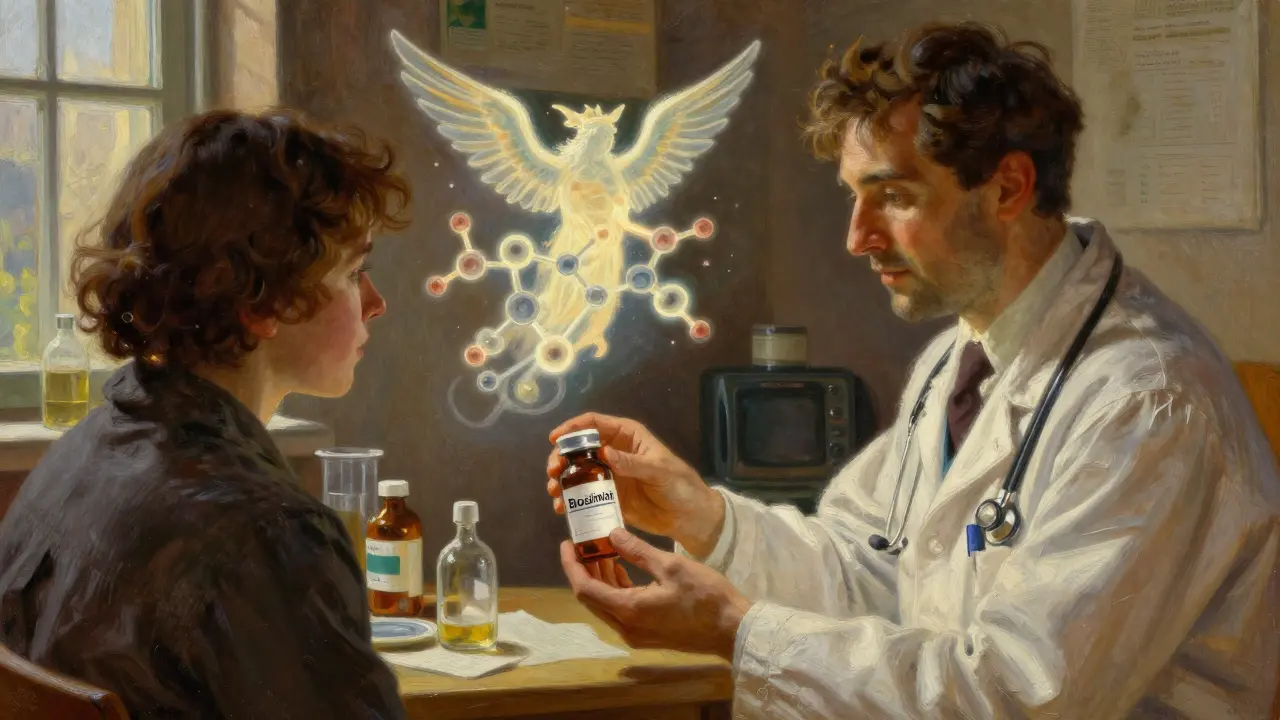
When a doctor prescribes a biologic drug for rheumatoid arthritis, Crohn’s disease, or cancer, patients often assume they’re getting the only version that works. But that’s not true anymore. Biosimilars are now a standard part of treatment plans across the U.S. and Europe, and the data shows they work just as well. Not almost as well. Not sometimes as well. Exactly as well. And they cost significantly less.
Biosimilars aren’t generics. That’s the first thing to understand. Generics are exact chemical copies of small-molecule drugs like aspirin or metformin. Biosimilars, on the other hand, are copies of complex biological drugs made from living cells-proteins, antibodies, or other molecules that can’t be replicated exactly like a pill. Think of it like cloning a tree: you can grow a new tree from a cutting, and it will look and behave almost identically, but it’s not the same exact tree. That’s biosimilars. They’re not identical, but they’re so close that any differences don’t matter in practice.
How Do We Know They Work the Same?
The answer is in the science. Before a biosimilar gets approved by the FDA or EMA, it goes through a rigorous process. Manufacturers run over 200 lab tests comparing the biosimilar’s structure, shape, and function to the original biologic. They test how it behaves in the body-how fast it’s absorbed, how long it lasts, how it binds to targets. Then, they test it in patients. Not thousands. Not tens of thousands. Sometimes as few as 50 to 100 people per group. But those studies are designed to catch even tiny differences.
Take the NOR-SWITCH trial, a randomized, double-blind study of 480 patients with various cancers. Half got the original rituximab; half got the biosimilar RTXM83. After 52 weeks, the response rates were nearly identical: 72.9% vs. 69.3%. The difference? Statistically meaningless. Same for bevacizumab in lung cancer, trastuzumab in breast cancer, and adalimumab in rheumatoid arthritis. A 2022 meta-analysis of 1,711 patients across six cancers showed response rates within 1% of the original drug in every case. The confidence intervals? All crossed 1.0-the mark for perfect equivalence.
And here’s something most people don’t realize: 84% of biosimilar trials were double-blinded. That’s higher than the 17% of original biologic trials. Meaning, the evidence for biosimilars is actually more tightly controlled than the original drugs.
Real Patients, Real Results
Lab numbers matter, but real people tell the real story. In the UK’s NHS, over 12,000 patients switched from the original rituximab to its biosimilar, Rixathon. No spike in side effects. No drop in effectiveness. Same for Canada’s 1,200-patient study on infliximab biosimilars for inflammatory bowel disease. After two years, patients on the biosimilar stayed on treatment just as long, had the same flare rates, and reported the same quality of life.
On PatientsLikeMe, 1,245 users compared their experience with the original Humira versus the biosimilar Amjevita. 87% said their symptom control was the same. 89% said the same about the original. The difference? Not statistically significant. A 2022 Arthritis Foundation survey of 2,100 patients switching from infliximab to Inflectra found 92% saw no change in disease control. Six percent even felt better. Only 2% felt worse.
Reddit threads from r/rheumatology are full of similar stories. One user wrote: “Switched from Humira to Hyrimoz 18 months ago. Zero difference in my ankylosing spondylitis.” Another said: “My psoriasis flared after switching-but my dermatologist said it’s likely stress, not the drug.” That’s the pattern. Most feel nothing. A few feel worse. But when doctors investigate, it’s rarely the biosimilar’s fault.
Why Do Some Doctors Still Hesitate?
Despite the data, a 2021 survey found 38% of U.S. physicians still had concerns about biosimilar efficacy. Why? Misinformation. Lack of familiarity. Fear of liability. Some think switching means “downgrading” care. Others worry about immunogenicity-the risk that the body might react to the biosimilar differently than the original.
But the data on immunogenicity doesn’t support that fear. The EMA and FDA have tracked over 500,000 patient-years of biosimilar use. No increased rate of antibodies or adverse immune reactions compared to the original drugs. Dr. G. Caleb Alexander from Johns Hopkins put it plainly: “The totality of evidence from over 100 biosimilars shows no clinically meaningful differences.”
Still, some experts, like Dr. Paul Kim at UCLA, urge caution. He points out that long-term data beyond five years is limited for most biosimilars. That’s fair. These drugs haven’t been around that long. But we’ve had enough time to see patterns. And so far, nothing has emerged that wasn’t already seen with the original biologics.

Cost Savings Are Real-and Massive
Biologics are expensive. Humira costs $7,000 a month in the U.S. without insurance. The biosimilar Amjevita? Around $5,000. That’s a 30% drop. In Europe, the savings are even steeper-up to 85% in some markets. The Congressional Budget Office estimates biosimilars will save the U.S. healthcare system $169 billion over the next decade. Medicare Part B alone saved $1.3 billion in one year thanks to biosimilar competition.
These savings aren’t theoretical. Hospitals and clinics are using them to expand access. A 2023 study in 15 U.S. health systems showed that with proper education and electronic alerts, 98% of them achieved over 75% biosimilar use within a year. Patients who were worried? Once they got clear information, refusal rates dropped from 22% to 5%.
What About Switching? Is It Safe?
One of the biggest myths is that switching from a biologic to a biosimilar is risky. It’s not. The FDA requires interchangeability-meaning a pharmacist can switch you without asking the doctor-if the biosimilar meets extra standards. Only a few biosimilars have that status so far, but even non-interchangeable ones are routinely switched with no issues.
A 2023 study in Clinical Rheumatology looked at patients who switched between different biosimilars of adalimumab. Some switched once. Others switched twice. The drug survival rate-the percentage still on treatment after a year-was 84.2% for those who switched multiple times. For those who stayed on one biosimilar? 85.7%. No difference. That means switching between biosimilars is as safe as staying on one.

What’s Next?
The FDA is moving toward approving biosimilars without requiring full clinical trials-when analytical and pharmacokinetic data are strong enough. The EMA is doing the same. That means more biosimilars will come to market faster, driving prices down further. Companies like Sandoz, Samsung Bioepis, and Amgen are racing to bring new versions online. Over 120 biosimilar candidates are in development worldwide.
And soon, we may see biosimilars of biosimilars. The science supports it. The data confirms it. The cost savings demand it.
Bottom Line
Biosimilars work. They’re safe. They’re effective. And they’re saving lives by making life-changing treatments affordable. The fear around them isn’t based on science-it’s based on unfamiliarity. If your doctor suggests switching, ask for the data. You’ll find it’s overwhelming: thousands of patients, hundreds of studies, and no meaningful difference in outcomes. You’re not getting a lesser drug. You’re getting the same drug at a fair price.
Are biosimilars the same as generics?
No. Generics are exact chemical copies of small-molecule drugs, like ibuprofen or metformin. Biosimilars are highly similar versions of complex biologic drugs made from living cells-like antibodies or proteins. They can’t be identical, but they’re proven to have no clinically meaningful differences in safety or effectiveness.
Do biosimilars cause more side effects than the original biologics?
No. Studies involving over 500,000 patients show no increase in side effects, including immune reactions, with biosimilars. Regulatory agencies like the FDA and EMA have monitored safety for over 15 years and found no pattern of increased risk.
Can I switch from a biologic to a biosimilar safely?
Yes. Multiple studies, including the NOR-SWITCH trial and real-world data from the NHS and Canada, show switching is safe and effective. Patients report the same symptom control, disease management, and safety profile after switching. Doctors typically monitor for a few weeks after the switch, but serious issues are extremely rare.
Why are biosimilars cheaper if they’re just as good?
Because they don’t need to repeat the original expensive clinical trials. Biosimilar manufacturers use the existing safety and efficacy data from the reference drug. They focus on proving similarity through lab tests and smaller patient studies. That cuts development costs dramatically, which translates to lower prices-typically 15-85% less, depending on the market.
Are biosimilars approved in the U.S. and Europe?
Yes. The FDA has approved 46 biosimilars as of November 2023, with 37 currently on the market. The EMA has approved 104 as of December 2023. They’re used in oncology, rheumatology, gastroenterology, endocrinology, and more. Both agencies require the same high standards for approval.
Will my insurance cover a biosimilar?
Most do-and many push for them. Insurance plans often lower copays for biosimilars to encourage use. Some even require switching from the original biologic to the biosimilar to maintain coverage. Always check your plan’s formulary, but in most cases, biosimilars are the preferred option.
Can I switch between different biosimilars?
Yes. A 2023 study showed patients who switched between different adalimumab biosimilars had the same treatment success rates as those who stayed on one. There’s no evidence that switching between biosimilars increases risk. This is becoming more common as more options enter the market.
How long have biosimilars been available?
The first biosimilar was approved in the EU in 2006 (Omnitrope). The U.S. approved its first in 2015 (Zarxio). Since then, over 140 biosimilars have been approved globally. Long-term data now spans 15+ years in Europe and 8+ years in the U.S., with no unexpected safety issues.
What to Do Next
If you’re on a biologic and your doctor suggests switching to a biosimilar, ask for the evidence. Request the study data. Ask about your specific condition. Most patients who switch don’t notice a difference-and many save hundreds or thousands a year.
If you’re a provider, consider updating your protocols. Use the FDA’s Purple Book to identify approved biosimilars. Offer patient education materials. Track outcomes. You’ll find that the switch isn’t a risk-it’s a responsibility. Better access. Lower costs. Same results.
The science is clear. The patients are speaking. The savings are real. Biosimilars aren’t the future of medicine. They’re the present-and they’re working.



Linda Caldwell
Biosimilars are a game changer. No more bankruptcy just to stay alive. Same results, way cheaper. Let’s get real.
Nishant Desae
I've been following this topic for years, and honestly, the data is just so overwhelming in favor of biosimilars. I work with patients in rural India where biologics are completely out of reach, and seeing biosimilars come in has been life-changing. The science is solid, and the human impact? Unbelievable. I’ve seen people who couldn’t afford treatment now walking into clinics with hope in their eyes. It’s not just about cost-it’s about dignity.
Sam Clark
The methodological rigor applied to biosimilar approval protocols is, in many respects, more stringent than that of the originator biologics. The regulatory frameworks established by both the FDA and EMA demand exhaustive analytical characterization, comparative pharmacokinetic and pharmacodynamic studies, and well-powered clinical trials demonstrating equivalence within predefined margins. To assert otherwise is to misunderstand the evidentiary standard.
Raven C
I suppose one must be terribly uneducated to still harbor doubts about biosimilars... after all, we’re not talking about aspirin here-we’re talking about protein folding, glycosylation patterns, and immunogenicity profiles that have been scrutinized with more precision than most PhD theses. Honestly, if your doctor suggests a switch, and you hesitate, perhaps you should ask yourself: Who are you trusting more-the entire body of modern immunology, or your fear?
Salome Perez
As someone who’s worked in global health for over two decades, I’ve watched the stigma around biosimilars shift from fear to acceptance-and it’s been one of the most beautiful transformations in modern medicine. In countries where biologics were once a luxury, biosimilars have become the quiet revolution that lets children with juvenile arthritis run again, and grandparents with Crohn’s return to family dinners. The data doesn’t lie. The human stories? Even more powerful.
Chris Van Horn
You people are naive. Biosimilars are a corporate scam. Big Pharma doesn’t want you to know that the original drugs were the ONLY ones that worked. I’ve seen patients crash after switching-rashes, fatigue, flares. They’re hiding it. The FDA is compromised. The EMA? Same thing. Don’t be fooled. This is about profit, not patients.
Jessica Salgado
I switched from Humira to Amjevita last year. I was terrified. I cried before the first injection. But... nothing changed. Not one bit. I still have my flare-ups, but they’re the same as before. I didn’t get worse. I didn’t get better. I just saved $4,200 this year. And honestly? That’s the real miracle.
Naomi Lopez
The notion that biosimilars are 'lesser' is not only scientifically baseless-it’s ethically indefensible. To withhold access to effective, lower-cost therapies based on perception rather than evidence is a form of medical elitism. The data is not merely suggestive; it is conclusive. The resistance is cultural, not clinical.
Evelyn Vélez Mejía
There is a deeper philosophical question here: if a drug performs identically in every measurable biological, immunological, and clinical dimension, and its cost is a fraction, then what does 'sameness' even mean? Is it the molecular origin that matters-or the outcome? If two trees, grown from different cuttings, produce identical fruit, bloom at the same time, and withstand the same storms-do we call one inferior? Or do we simply call them both trees?
Virginia Seitz
Biosimilars = win 🌟💸❤️
Steven Lavoie
I’ve been a rheumatology nurse for 18 years. I’ve seen patients cry because they couldn’t afford their meds. Then biosimilars came in. The first time I watched a patient who hadn’t worked in three years go back to their job because they could finally afford treatment? That’s the moment I knew this wasn’t just science-it was justice. The data backs it. The patients feel it. The system is catching up.
amanda s
This is why America is falling behind. We let Europe lead on this, and now we’re playing catch-up. Why are we letting foreign companies profit off our patients’ suffering? We should ban all biosimilars made outside the U.S. and make every single one here. No exceptions. This isn’t about science-it’s about sovereignty.