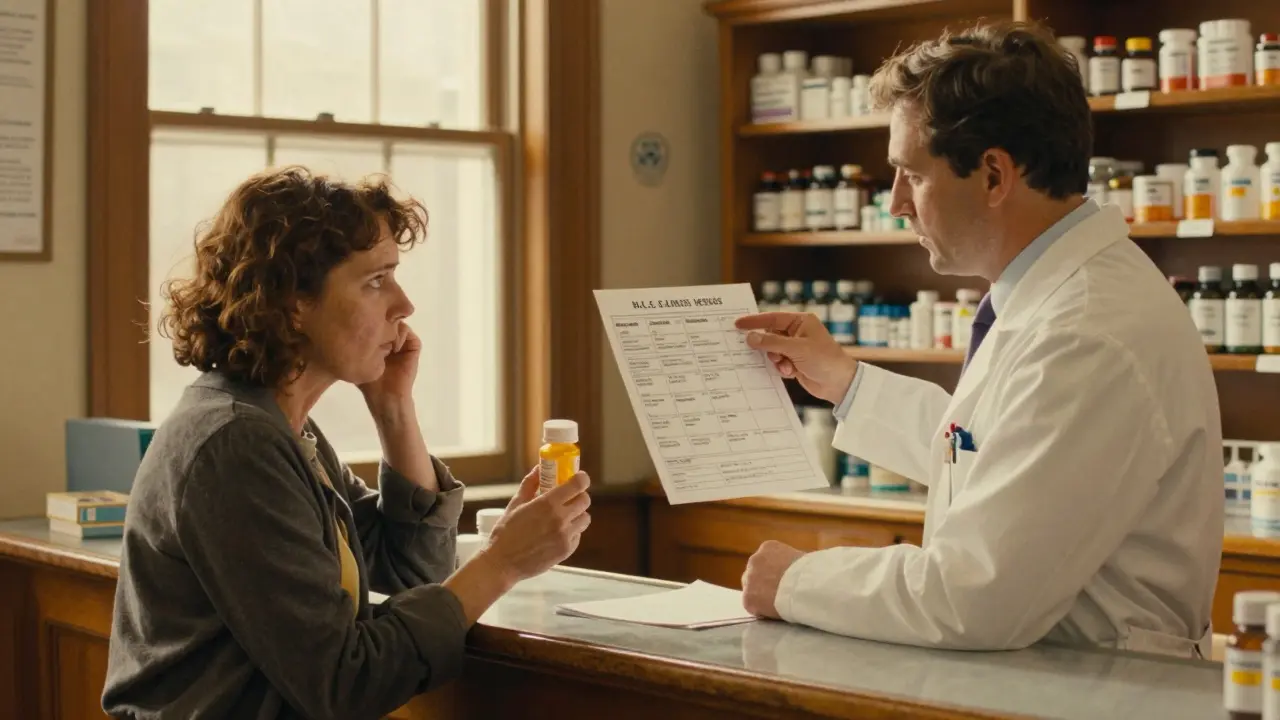
When your brand-name medication switches to a generic version, it’s not just a label change. It’s a moment that can affect how you feel, how much you pay, and even whether your treatment works as expected. You might not think much about it until you pick up your pill bottle and notice it looks different-smaller, white instead of blue, or with a strange imprint. That’s when questions start: Is this the same? Will it work? Should I be worried?
The truth is, most generic drugs work just as well as their brand-name counterparts. The FDA requires them to deliver the same active ingredient, in the same strength, at the same rate into your bloodstream. But that doesn’t mean every switch goes smoothly. Some people notice side effects. Others see their condition worsen. And many just feel confused. The key to avoiding problems isn’t just understanding the science-it’s knowing how to talk to your pharmacy.
Why Generic Switches Happen
Generic drugs become available when a brand-name drug’s patent expires. This isn’t rare-it’s standard. In 2023, about 90% of all prescriptions filled in the U.S. were for generics. That’s not because doctors prefer them-it’s because they save money. Generics cost, on average, 80% less than brand-name drugs. For Medicare beneficiaries, switching to a generic can save $265 per medication each year. Insurance companies push for generics because they cut costs. Pharmacies stock them because they’re cheaper to keep on shelves. And the government encourages it: the FDA estimates generic drugs saved the U.S. healthcare system $373 billion in 2023 alone.
But savings don’t always mean smooth transitions. When your prescription switches from, say, Lipitor to atorvastatin, or from Keppra to levetiracetam, your pharmacy doesn’t just swap the bottle. They have to check your insurance, verify if the switch is allowed, confirm your doctor didn’t write "do not substitute," and make sure you’re aware of the change. If any of those steps get missed, you could end up with the wrong drug, a gap in your supply, or worse-side effects you weren’t prepared for.
What’s Really in a Generic Drug?
Generics must contain the same active ingredient as the brand name. That’s non-negotiable. But everything else? That’s flexible. Color, shape, size, flavor, and inactive ingredients like fillers, dyes, or preservatives can-and often do-change. These differences are usually harmless. But for some people, they’re not.
Take levothyroxine, used to treat hypothyroidism. Even tiny changes in how the body absorbs the drug can throw off thyroid levels. A 2021 study in JAMA Internal Medicine found that 9.4% of patients switching from brand to generic antiepileptic drugs had a seizure within six months. That’s nearly double the rate of those who stayed on brand. The same pattern shows up with blood thinners like warfarin and seizure medications like phenytoin. These are called narrow therapeutic index drugs-where small changes in dosage or absorption can lead to big health consequences.
That’s why it’s not enough to just accept the switch. You need to know if your medication is one of them. Ask your pharmacist: "Is this a narrow therapeutic index drug?" If the answer is yes, you have more leverage to stay on brand-or at least to be extra careful about monitoring your response.
What to Say to Your Pharmacist
Pharmacists are your best ally during a generic transition. They’re trained to spot potential problems. But they can’t help if you don’t speak up. Here’s exactly what to ask:
- "Is this generic approved as bioequivalent to my brand?" The FDA requires this, but not all pharmacies confirm it. Request the FDA’s AB rating (like AB1 or AB2) to be sure.
- "Are there any differences in inactive ingredients?" Especially if you have allergies or sensitivities (like lactose, gluten, or dyes).
- "Has anyone else had trouble with this switch?" Pharmacists hear patient stories every day. They’ll know if this particular generic has a pattern of complaints.
- "Can I get a sample of the generic before my full prescription fills?" Many pharmacies will give you a few pills to test how you feel before committing to a full refill.
- "Will my insurance cover the brand if the generic doesn’t work?" Some plans allow exceptions if you document side effects or lack of effectiveness.
Don’t wait until you’re already taking the new pill. Start this conversation at least 30 days before your current prescription runs out. That gives time to get a prior authorization from your doctor if needed, or to switch back if problems arise.
When You Should Push Back
Not every switch is safe. You have rights. If your doctor wrote "dispense as written" or "no substitution" on your prescription, the pharmacy is legally required to honor that. If they don’t, ask why. If they say, "It’s just a formality," push harder. That’s not just policy-it’s your safety.
Also, if you’ve had a bad reaction to a generic before, tell your pharmacist immediately. Keep a note in your phone or wallet: "Switched from Brand X to Generic Y → experienced [symptom]. Do not substitute again." Bring it to every visit. Pharmacists don’t always see your full history unless you remind them.
And if you’re on a controlled substance-like opioids, stimulants, or sedatives-know this: since August 2023, you can now transfer your prescription electronically between pharmacies without going back to your doctor. That’s a big change. It means if your current pharmacy doesn’t carry the generic, you can move your script to one that does, faster than ever. But you still need to confirm the new pharmacy has the right version and that your insurance covers it.
What to Watch For After the Switch
Don’t assume everything’s fine just because you got the pills. Pay attention for the first 2-4 weeks. Look for:
- New or worsening side effects (dizziness, nausea, rash, fatigue)
- Changes in how well your condition is controlled (higher blood pressure, more seizures, mood swings)
- Physical differences in how the pill works (e.g., a capsule that doesn’t dissolve the same way)
If anything feels off, call your pharmacy before calling your doctor. Pharmacists can often adjust your dose, suggest a different generic brand, or help you get your original brand back. They can also check if your insurance requires prior authorization to switch back.
And if you’re on Medicare Part D, you have a 90-day grace period when you enroll in a new plan. During that time, you can keep your brand-name drug even if it’s not on the formulary. Use that window to test the generic-if it doesn’t work, you can request an exception.
How to Stay in Control
Here’s a simple checklist to use every time you refill a medication that’s switching to generic:
- Check your insurance plan’s formulary (online or call customer service) to see if the generic is covered and at what tier.
- Ask your pharmacist: "Is this the same as my last bottle?" Compare the pill’s shape, color, and imprint.
- Confirm your doctor didn’t write "do not substitute." If they did, insist on the brand.
- Request a 7-day sample if available.
- Write down how you feel in the first week. Note any changes in symptoms or side effects.
- Set a reminder to call the pharmacy after two weeks to report how you’re doing.
Also, ask about medication synchronization. Many pharmacies let you align all your refill dates to one day each month. That’s huge during transitions-it reduces the chance of missing a dose or running out while waiting for a new script.
Real Stories, Real Lessons
One user on Reddit, u/MedConcern87, switched from brand-name Keppra to a generic version of levetiracetam and had a seizure within days. After months of back-and-forth, they got their brand back-only because they documented every seizure and brought it to their neurologist. Another person, in a Healthline survey, said they felt "zombie-like" after switching to a generic statin. They switched back and felt like themselves again.
But most stories are positive. Of the 1,247 people surveyed, 78% noticed no difference. And 63% said the cost savings were worth it. The key difference? The people who had smooth transitions were the ones who talked to their pharmacist first.
One patient with a rare condition called urea cycle disorder switched from Ravicti to a generic version. The manufacturer partnered with pharmacies to create a transition guide, sent out educational materials, and offered free samples. Result? Medication gaps dropped by 68%.
It’s not about fear. It’s about preparation.
What’s Changing in 2025
Technology is making this easier. By 2025, most major pharmacy chains will use AI tools to flag patients at risk during generic switches-based on their history, genetics, and past reactions. Some pharmacies are testing blockchain systems that track every pill’s origin and batch, so you can see exactly which generic version you’re getting.
But the most powerful tool hasn’t changed: your voice. No algorithm can replace asking your pharmacist, "Will this work for me?"
Generic drugs are safe, effective, and essential. But they’re not magic. They’re medicine. And medicine works best when you’re informed, involved, and never afraid to ask questions.





Jason Silva
lol so now the gov is secretly replacing our meds with alien nanobots to control our moods?? 🤔💀 I switched to generic Adderall and my dog started barking at me like I'm a robot. they're watching... THEY'RE ALL WATCHING. 🚨💊
Siobhan K.
Funny how people treat generics like they’re some kind of pharmaceutical black market. The FDA doesn’t just rubber-stamp these things - they’re held to the same bioequivalence standards. If your body reacts badly, it’s not the generic’s fault. It’s your individual physiology. Or maybe you just need to stop Googling symptoms at 3 a.m.
Orlando Marquez Jr
The regulatory framework governing generic pharmaceuticals in the United States is predicated upon rigorous bioequivalence protocols established by the Food and Drug Administration. The assertion that generic agents are inherently inferior is empirically unfounded and constitutes a pervasive public misconception. One must consult evidence-based clinical literature prior to drawing causal inferences regarding therapeutic efficacy.
Jackie Be
I switched to generic levothyroxine and felt like a zombie who forgot how to breathe 😭 my heart was racing and i cried for 2 hours straight i thought i was dying but my pharmacist said its just the fillers i swear to god i need my brand back or im moving to canada
John Hay
You don't need to overthink this. If your doctor didn't say no substitution, the pharmacy is doing their job. If you feel weird, call them. Simple. No drama. No conspiracy. Just medicine.
Jon Paramore
Bioequivalence is defined by AUC and Cmax within 80–125% confidence intervals per FDA guidance. For narrow TI drugs like warfarin or phenytoin, interpatient variability in absorption kinetics can exceed the therapeutic window. This is why therapeutic drug monitoring (TDM) is non-negotiable during transitions. The issue isn't the generic - it's the absence of pharmacokinetic surveillance.
Swapneel Mehta
I've been on generics for 10 years and never had an issue. But I always ask my pharmacist about the batch and check the pill imprint. Small steps, big peace of mind. Also, pharmacy techs are usually super helpful if you're nice to them 😊
Stacey Smith
America spends too much on drugs because people are too lazy to ask for generics. If you can't afford your meds, that's not the pharmacy's fault. Get over it. We don't need hand-holding. Just take the pill.
Ben Warren
It is an egregious dereliction of personal responsibility to attribute therapeutic failure to pharmaceutical substitution when the root cause lies in the patient's failure to engage in proactive medical self-advocacy. The FDA's approval process is among the most stringent in the world. To suggest otherwise is not merely inaccurate - it is a dangerous erosion of scientific literacy. One must understand that pharmaceuticals are not consumer goods. They are precision instruments. And like any instrument, their efficacy is contingent upon informed, disciplined use. The notion that a color change warrants panic is emblematic of a culture that has surrendered critical thinking to emotional reactivity.
Teya Derksen Friesen
I appreciate the thoroughness of this guide. As a pharmacist in Vancouver, I’ve seen firsthand how small communication gaps lead to major clinical disruptions. I always encourage patients to request a pill comparison sheet - it’s a simple tool, but it prevents 80% of anxiety-driven calls. Also, medication synchronization is underutilized and life-changing. Thank you for highlighting it.