
When you pick up a prescription at your local pharmacy, you might not think twice if the pill looks different than last time. That’s generic substitution-and it’s routine in retail settings. But if you’re hospitalized and your IV antibiotic gets swapped out, that’s not a simple switch. It’s a clinical decision, made by a team, documented in your electronic record, and tied to your treatment plan. The difference between how retail and hospital pharmacies handle medication substitution isn’t just about where the pill comes from-it’s about who decides, why, and how it affects your safety.
Who Gets to Decide?
In a retail pharmacy, the pharmacist has legal authority to swap a brand-name drug for a generic version unless the doctor says "do not substitute" or the patient refuses. This isn’t a suggestion-it’s part of the job. Every state in the U.S. allows it under pharmacy practice laws, and most insurance plans require it to cut costs. The pharmacist doesn’t need to consult anyone. They check the prescription, verify the generic is approved as therapeutically equivalent by the FDA, and dispense it. In 2023, 90.2% of eligible prescriptions filled at retail pharmacies were generic substitutions. In a hospital, no single pharmacist makes that call. Substitution happens through a formal process called therapeutic interchange. It’s decided by the Pharmacy and Therapeutics (P&T) committee-a group of doctors, pharmacists, nurses, and administrators who review clinical data, cost, and patient outcomes. If they decide to switch from one drug to another-for example, from vancomycin to linezolid for MRSA infections-it becomes a hospital-wide policy. Then, every pharmacist follows it. The decision isn’t made at the counter; it’s made in a conference room, backed by evidence, and built into the hospital’s clinical pathways.What Gets Substituted?
Retail substitution is mostly limited to oral pills and capsules. About 97.3% of substitutions in community pharmacies involve tablets or capsules like lisinopril, atorvastatin, or metformin. These are simple, stable, well-studied drugs where generic equivalents are proven to work the same way. Hospitals substitute far more complex medications. Nearly 70% of therapeutic interchanges involve IV drugs, biologics, or specialized formulations. A patient on an expensive IV antibiotic might be switched to a cheaper, equally effective alternative. Biologics-complex drugs made from living cells-are increasingly being swapped under strict protocols, even though they’re harder to replicate than a simple tablet. This isn’t about saving a few dollars per pill. It’s about managing budgets across entire departments while keeping patients safe.Why Do They Substitute?
In retail, the main driver is money. Insurance companies push for generics because they cost 80-85% less. A 2023 survey found that 92.4% of retail pharmacists said formulary requirements from insurers were the biggest reason they substituted. Patients often don’t know they’re getting a cheaper version-until they see the bill drop. In hospitals, cost matters, but it’s not the top priority. A 2022 ASHP survey showed 84.6% of hospital pharmacists said clinical factors drove substitution decisions. Is the patient allergic? Are they kidney-impaired? Does the drug interact with their other meds? Is there better evidence for one drug over another in their condition? These are the real questions. For example, switching from a broad-spectrum antibiotic to a targeted one reduces the risk of C. difficile infections. That’s not just cost savings-it’s fewer complications, shorter stays, and lower readmission rates.
How Is It Documented?
Retail pharmacies must keep substitution records for two years, but they don’t always tie it to your medical history. You might get a printed notice, or a quick verbal heads-up: "This is the generic version of your brand. Same thing, cheaper." Thirty-two states require verbal notification; 18 require written consent for the first substitution. But if you’re discharged from the hospital and go to a retail pharmacy, your discharge summary might not even mention the substitution that happened inpatient. Hospitals? Everything goes into the electronic health record. Every substitution is logged, flagged, and linked to your diagnosis, lab results, and care team notes. Clinical decision support tools alert pharmacists if a substitution might conflict with another medication. If a doctor prescribes a drug that’s been replaced by a new protocol, the system blocks it unless they override it with a reason. This isn’t paperwork-it’s safety infrastructure.What Happens When You Move Between Settings?
This is where things get dangerous. About 23.8% of medication errors during hospital-to-home transitions are linked to substitution mismatches. Here’s how it happens: You’re switched from brand-name warfarin to generic in the hospital because it’s cheaper and just as effective. But when you get home, your pharmacy fills the original brand because your doctor didn’t update the prescription, or your insurance didn’t cover the generic yet. You take the brand again. Now your INR levels go haywire. You end up back in the ER. The Institute for Safe Medication Practices found that 17.4% of medication discrepancies during care transitions in 2022 involved substitution confusion. That’s not a small number-it’s preventable. Hospitals are starting to fix this. Nearly half now have formal discharge programs that include a review of all medication changes, including substitutions. Retail chains are catching up too-37.6% now follow up with patients after hospital discharge to check for substitution issues.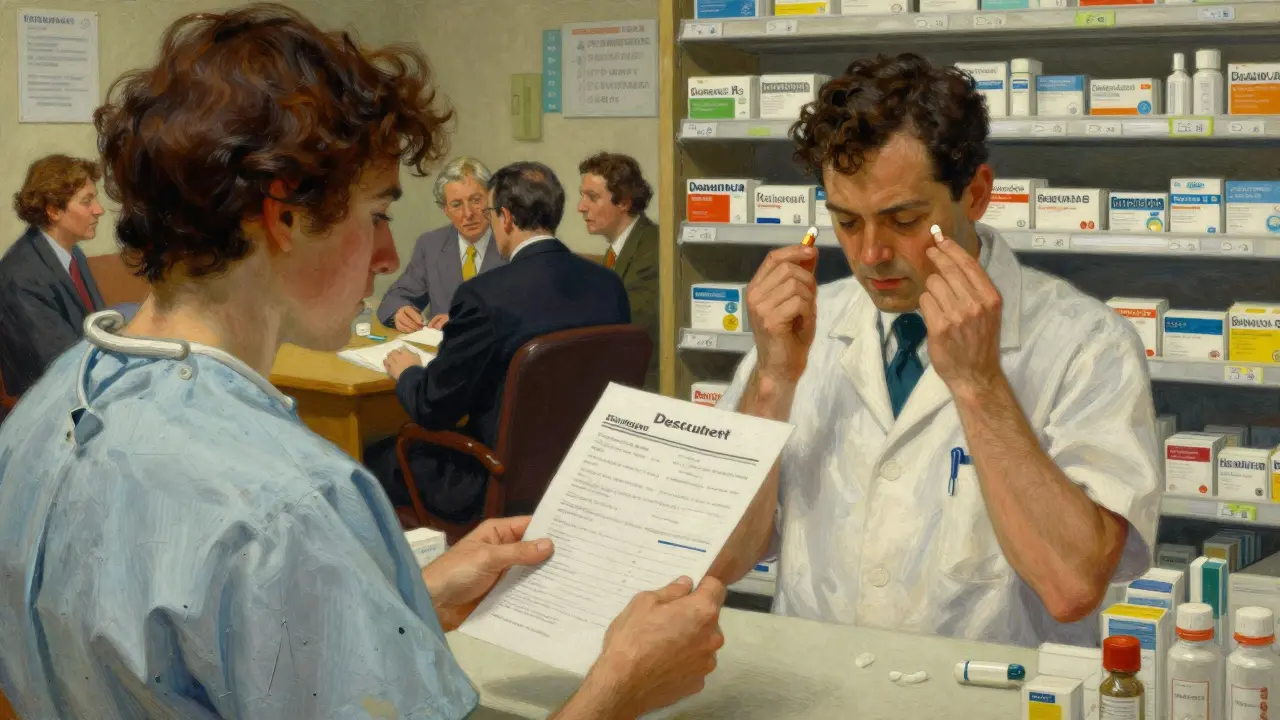
What Skills Do Pharmacists Need?
Retail pharmacists need to be experts in state laws, insurance rules, and patient communication. You can’t just hand someone a pill and say "here you go." You have to explain why it looks different, answer their fears, and sometimes fight with insurance companies for prior authorizations. One pharmacist on Reddit said they called the insurer three times just to get a generic approved for a blood pressure med. Hospital pharmacists need deep clinical knowledge. They have to understand pharmacokinetics, drug interactions, antimicrobial stewardship, and how to interpret clinical trial data. They don’t just fill prescriptions-they help design treatment protocols. One hospital pharmacist described having to educate 15 different medical teams on a new substitution policy. That’s not customer service-that’s clinical leadership.What’s Changing?
The gap between retail and hospital substitution is starting to narrow. The 2023 CMS Interoperability Rule, effective July 2024, will force both settings to share substitution records electronically. Epic and Cerner are building new tools to show a patient’s substitution history across hospital and pharmacy systems by 2025. This means your retail pharmacist will soon see that you were switched to a generic in the hospital-and won’t accidentally refill the brand. The push for value-based care is also driving alignment. When hospitals are paid based on patient outcomes-not just how many pills they dispense-they have a bigger incentive to make sure substitutions don’t cause harm. And when retail pharmacies are part of accountable care organizations, they’re more likely to coordinate with hospitals instead of working in silos. But the core difference won’t disappear. Retail substitution will always be about cost and convenience. Hospital substitution will always be about safety and science. One isn’t better than the other-they’re designed for different jobs. The challenge now is making sure they don’t work against each other.What Should You Do?
If you’re a patient: Always ask, "Is this the same as what I was taking before?" Whether you’re in the hospital or at the pharmacy. Keep a list of your meds-including substitutions-and bring it to every appointment. Don’t assume a change is safe just because it’s cheaper. If you’re a healthcare provider: Communicate substitutions clearly at discharge. Don’t just write "generic" on the script. Name the drug. Write the strength. Explain why it was changed. If you’re a pharmacist: Know your system’s rules. In retail, know your state’s notification laws. In hospital, know your P&T protocols. And always, always check what happened before. The system isn’t broken-it’s just complex. And complexity without coordination is a risk. But with better communication, better tech, and better teamwork, we can make sure substitution helps patients instead of hurting them.Can a retail pharmacist refuse to substitute a brand-name drug for a generic?
Yes, but only under specific conditions. All 50 states allow pharmacists to substitute generics unless the prescriber writes "Do Not Substitute" on the prescription or the patient explicitly refuses the generic. Some states also allow pharmacists to refuse if they believe the substitution could harm the patient, though this is rare. Most often, refusal happens because of insurance restrictions-like when a prior authorization is denied, and the brand isn’t covered.
Are hospital substitutions always approved by a doctor?
Not at the point of dispensing, but yes, ultimately. Hospital substitutions are approved by the Pharmacy and Therapeutics (P&T) committee, which includes physicians. Once a therapeutic interchange protocol is approved, pharmacists can implement it without calling the doctor each time. But the doctor must be notified within 24 hours under Joint Commission standards. If the doctor objects, the original drug is reinstated. It’s a team decision, not a pharmacist’s solo call.
Why can’t hospital pharmacies just use the same generics as retail pharmacies?
They often do-but not always. Hospitals prioritize clinical outcomes over cost savings. Sometimes a generic version isn’t available in the right formulation-for example, an IV solution or a capsule with a special coating. Other times, the hospital’s P&T committee chooses a different brand-name drug because it has better evidence for a specific patient population, like elderly patients or those with kidney disease. The goal isn’t to pick the cheapest option; it’s to pick the safest and most effective one for the clinical setting.
Do biosimilars follow the same substitution rules as generics?
No. Biosimilars are not considered interchangeable by default like generics are. In retail, 23 states have laws allowing pharmacists to substitute a biosimilar for its reference biologic-but only if the FDA has designated it as "interchangeable," and only if the prescriber hasn’t blocked it. In hospitals, substitution of biosimilars is almost always governed by P&T committee protocols, not pharmacist discretion. The process is stricter because biosimilars are more complex and have less long-term safety data than traditional generics.
What’s the biggest risk when substitution happens between hospital and retail settings?
The biggest risk is confusion during transitions. A patient might be switched to a generic in the hospital, but the discharge summary doesn’t clearly say which generic was used. When they go to the pharmacy, the pharmacist fills the original brand because that’s what’s on the old prescription. Or the insurance denies the generic, and the patient gets the brand without knowing. This mismatch can lead to dangerous fluctuations in drug levels-especially with drugs like warfarin, thyroid meds, or seizure medications. That’s why coordinated discharge planning and electronic health record sharing are now critical.




Roisin Kelly
Let me guess - the ‘P&T committee’ is just Big Pharma’s puppet show in scrubs. They swap drugs to push cheaper stuff that’s barely tested, then act like it’s ‘clinical science.’ Meanwhile, patients are guinea pigs while pharmacists get bonuses for cutting costs. I’ve seen people crash after a ‘safe’ switch. They don’t care. They just want the next quarterly report to look pretty.
lokesh prasanth
retail = money
hospital = control
both = lies
Sangeeta Isaac
soooo… the hospital’s ‘clinical leadership’ is just a fancy way of saying ‘we did a PowerPoint and now you’re stuck with this new pill that looks like a neon gummy bear’? 😅
Also, I love that retail pharmacists are out here playing insurance ninja while hospital pharmacists are in lab coats doing quantum chemistry on my IV bag. Respect to both, but also… why does my brain feel like it’s been through a blender after a hospital stay?
Philip Williams
The distinction between retail and hospital substitution practices reflects a fundamental divergence in healthcare philosophy: one prioritizes efficiency and economic sustainability, the other clinical precision and systemic safety. This dichotomy is not a flaw-it is a necessary adaptation to divergent operational contexts. However, the absence of interoperable data standards between these systems represents a critical vulnerability in patient care continuity. The upcoming CMS interoperability mandates represent a long-overdue step toward alignment, but implementation must be rigorously monitored to prevent unintended consequences.
Jerry Rodrigues
Just think about how wild it is that the same pill can be a routine cost-saver in one place and a high-stakes clinical decision in another
no one’s evil here
just systems that don’t talk
Jarrod Flesch
Man, I’ve been a pharmacy tech for 12 years and this post nails it 🙌
At retail, I’ve had grandmas cry because their ‘special’ pill turned into a white oval. At the hospital, I’ve seen pharmacists argue with ICU docs for 45 minutes over switching an antibiotic because the new one had a 0.3% better survival rate in elderly patients.
Both are right. Both are exhausting.
And yeah, the discharge mess? That’s where people die. Not because of bad intent - just because nobody checked the box.
Also, biosimilars are a whole other nightmare 😅
Barbara Mahone
It’s fascinating how the same medication can carry such different weight depending on context. In retail, it’s a transaction. In hospital, it’s a narrative woven into a patient’s entire clinical story. The challenge lies not in the substitution itself, but in the silence between these two narratives. Documentation must bridge them - not as an afterthought, but as a core requirement.
Kelly McRainey Moore
My aunt got switched to a generic blood thinner after her hip surgery and ended up back in the ER because the pharmacy gave her the brand again. She didn’t even know the difference until the bleeding started. 😢
People need to talk. Like, actually talk. Not just check a box.
Stephen Rock
Pharmacists are just glorified cashiers in retail
Hospital pharmacists? They’re bureaucrats with stethoscopes
Both are part of the machine
And the machine doesn’t care if you live or die
It just wants to hit its KPIs
Amber Lane
My dad got a new generic in the hospital. The discharge papers didn’t say which one. The pharmacy gave him the brand. He didn’t know until his next blood test. Just… say the name. Please.
Ashok Sakra
you think this is bad? wait till you see what they do with insulin
they swap it and dont tell you
then you get dizzy and your kid has to call 911
and they say oh its just a generic
its not just a generic its your life
Andrew Rinaldi
It’s not about which system is better - it’s about whether they’re speaking the same language. Retail and hospital pharmacies aren’t enemies. They’re two parts of a system that forgot to introduce themselves. The real innovation won’t be in new drugs or new laws. It’ll be in a single button that says: ‘This patient was switched on [date]. Here’s why.’
Simple. Human. Necessary.