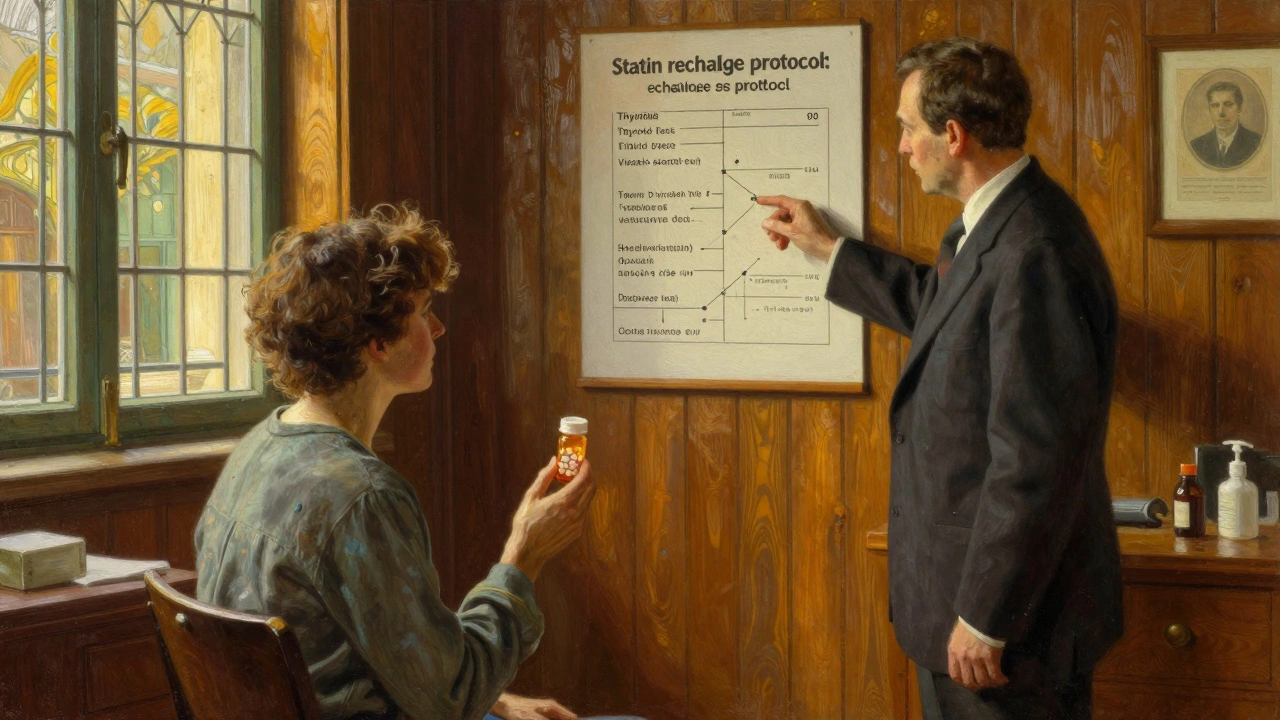
Statin Tolerance Assessment Tool
How long have you experienced muscle pain/weakness since starting statins?
Have these been checked?
When you stopped statins for 2+ weeks, did symptoms resolve?
What Is Statin Intolerance, Really?
Most people hear "statin" and think of a simple pill that lowers cholesterol. But for some, that pill brings more than just benefits-it brings muscle pain, weakness, or fatigue that doesn’t go away. This isn’t just "feeling a little sore." It’s a real barrier to life-saving treatment. About 7 to 29% of people on statins report muscle symptoms. But here’s the twist: only 5 to 15% of those people actually have true statin-associated muscle symptoms (SAMS). The rest? Often something else-low vitamin D, an underactive thyroid, or even a nocebo effect where the fear of side effects causes them.
That’s why statin intolerance clinics exist. These aren’t flashy new facilities. They’re specialized teams inside lipid or cardiology departments that follow strict, step-by-step rules to figure out who truly can’t take statins-and who just needs a different approach. Without these clinics, nearly half of patients who say they can’t tolerate statins stop them forever. That’s dangerous. Statins cut heart attacks and strokes by 20-25% for every 1 mmol/L drop in LDL cholesterol. Walking away from them without a plan isn’t a solution-it’s a risk.
The Four-Step Protocol That Changes Everything
Statin intolerance isn’t diagnosed by a single blood test or a quick chat. It’s a process. Major clinics like Cleveland Clinic and Kaiser Permanente follow a clear, proven path:
- Stop the statin. Patients stop taking their statin for at least two weeks. No guessing. No partial doses. Complete stop.
- Check for other causes. Doctors test thyroid function, vitamin D levels, and look for drug interactions. Alcohol, certain supplements like red yeast rice, or even intense exercise can mimic statin side effects.
- Rechallenge with a different statin. After symptoms clear, patients try a new statin-usually one that’s less likely to cause muscle issues. Hydrophilic statins like rosuvastatin or pravastatin are preferred because they don’t easily enter muscle tissue. Lipophilic ones like simvastatin or atorvastatin? They’re more likely to cause trouble.
- Adjust the dose or schedule. If even a low dose causes symptoms, switching to an intermittent schedule helps. Taking rosuvastatin twice a week instead of daily can cut LDL by 20-40% without triggering pain. In one study of over 1,200 patients, 76% tolerated this approach.
This isn’t theory. It’s practice. At the VA system, which runs this protocol across 170 centers, false diagnoses of statin intolerance dropped by 38%. That means thousands of people who thought they couldn’t take statins were given a real chance-and many succeeded.
What Works When Statins Still Don’t Fit
Some people still can’t take any statin-even at low doses or once a week. That’s where non-statin options come in. And not all are expensive or complicated.
- Ezetimibe is the first-line choice. It’s a simple pill, costs about $35 a month, and reduces LDL by 15-20%. The IMPROVE-IT trial showed it cuts major heart events by 6% when added to statins-and even on its own, it helps.
- Bempedoic acid (Nexletol) is newer. Approved in 2020, it lowers LDL by 18% without muscle side effects. It’s taken orally, works in the liver, and bypasses the muscle entirely. The CLEAR Outcomes trial tracked over 14,000 people for years and found no increase in muscle pain.
- PCSK9 inhibitors like evolocumab are injectables. They’re powerful-cutting LDL by 50-60%-but cost about $5,850 a year. Insurance often blocks them unless patients prove they’ve tried everything else. Four appeals over 11 weeks? That’s not unusual.
Here’s the reality: ezetimibe and bempedoic acid work. They’re not perfect, but they’re effective and safe. And for someone who’s been told they can’t take statins, they’re a lifeline.
How Clinics Are Changing Outcomes
At Kaiser Permanente, patients in their statin intolerance program were 82% more likely to restart lipid-lowering therapy than those treated in regular clinics. At Cleveland Clinic, 68% of patients reached their LDL target using their protocol. The secret? Structure.
These clinics don’t just hand out prescriptions. They track symptoms with daily diaries. Patients rate pain on a 0-10 scale. They note when it started, how long it lasts, and whether it’s symmetric (both legs, both arms). That’s how you tell if it’s truly statin-related or something else.
Pharmacists play a huge role. In Cleveland’s model, pharmacists lead the rechallenge process. They know the drugs inside out-how they’re absorbed, how they interact, which ones are safest for each body type. That’s why their success rate is 22% higher than clinics without pharmacist involvement.
And it’s working. One patient on Reddit shared: "After being labeled statin intolerant for 5 years, the lipid clinic had me on rosuvastatin 5mg twice weekly with CoQ10-LDL dropped from 142 to 89 without muscle pain." That’s not luck. That’s protocol.
The Hidden Barriers: Wait Times and Insurance
Despite the success, access is still a problem. Wait times for specialist appointments average 6 to 8 weeks. In rural areas or smaller hospitals, they might be longer-or nonexistent. Only 63 of the 100 largest U.S. health systems have formal protocols. Community hospitals? Just 42% do.
Insurance is another wall. Even if a doctor says you need bempedoic acid or a PCSK9 inhibitor, insurers often demand proof you’ve tried and failed at least two statins, plus ezetimibe. One patient described spending 11 weeks appealing a denial. That’s not care-that’s bureaucracy.
Medicare now covers 80% of lipid specialist visits for statin intolerance, which helps. But private insurers lag. And without coverage, many patients give up. They go back to high cholesterol, higher risk, and no plan.
What’s Next? Genetics and New Delivery Systems
The field is moving fast. Mayo Clinic started testing for the SLCO1B1 gene variant in 2023. This gene affects how the body handles simvastatin. People with certain versions have a much higher risk of muscle damage. Knowing this upfront can prevent problems before they start.
Even more promising? New ways to deliver statins. Nanoparticle formulations are in phase 2 trials. Early results show 92% of patients tolerate them without muscle pain. These tiny carriers deliver statins straight to the liver-bypassing muscle tissue entirely.
And intermittent dosing? It’s becoming mainstream. As of 2024, 78% of lipid specialists plan to use it more often. Why? Because it works. It’s cheaper. And it gives people back control.
What You Should Do If You Can’t Tolerate Statins
If you’ve been told you’re statin intolerant, don’t accept it as final. Ask these questions:
- Did they stop the statin completely for two weeks and see if symptoms went away?
- Were your thyroid and vitamin D levels checked?
- Did they try switching to rosuvastatin or pravastatin at a low dose?
- Was intermittent dosing considered?
- Have you tried ezetimibe or bempedoic acid?
Most people who think they can’t take statins can-with the right plan. You don’t need to live with high cholesterol. You just need the right team.
Why This Matters More Than You Think
Cardiovascular disease is still the number one killer worldwide. Statins are one of the most effective tools we have. But if we keep labeling people as "intolerant" without checking, we’re letting preventable deaths happen.
Structured clinics don’t just help patients. They save money long-term. One heart attack costs over $100,000. Preventing it with a $35 pill and a few specialist visits? That’s not just smart medicine. It’s essential.
The data is clear. The protocols are proven. The tools are here. What’s missing is access. And awareness. If you’re struggling with statin side effects, you’re not alone. And you’re not out of options. You just need to ask for the right kind of help.


Jennifer Patrician
Oh please. Statins are just Big Pharma’s way of turning healthy people into drug-dependent zombies. Who says cholesterol is bad anyway? My grandma ate butter every day and lived to 98. They’re hiding the truth - statins cause dementia, diabetes, and erectile dysfunction. And don’t get me started on CoQ10 scams. This whole clinic thing? Just a profit machine disguised as medicine.
They want you scared. They want you dependent. Wake up.
Ali Bradshaw
Honestly, this is one of the most helpful posts I’ve read in months. I was told I was statin intolerant two years ago and just gave up. After reading this, I went back to my doc and asked about rosuvastatin twice a week. Low and behold - no pain, LDL down 30%. It’s not magic. It’s just good medicine.
Thanks for laying it out so clearly.
an mo
The data is statistically significant but clinically irrelevant. The 76% tolerance rate in intermittent dosing cohorts is confounded by selection bias - only low-risk patients are referred to these clinics. The VA study’s 38% reduction in false positives? That’s a function of algorithmic triage, not clinical insight. And let’s not forget the economic externalities: ezetimibe and bempedoic acid are cost-shifting mechanisms that inflate administrative overhead while delivering marginal CV benefit. This is not a breakthrough. It’s a bureaucratic rebranding of pharmacological triage under the guise of patient-centered care.
Jimmy Jude
I used to think statins were the answer... until I started asking the deeper questions. What if cholesterol isn’t the enemy? What if the body is trying to heal itself? Statins silence the symptoms - but what if the pain is the body’s way of saying, ‘I’m not meant for this’?
We’ve turned medicine into a factory. Patients into numbers. Doctors into clerks. And now we’re told to just ‘try another statin’ like it’s a pair of shoes that don’t fit.
Maybe the real intolerance isn’t to the drug... it’s to a system that treats the soul like a glitch.
Mark Ziegenbein
The structural integrity of the protocol described here is fundamentally sound but woefully underimplemented at the population level due to systemic fragmentation of primary care infrastructure and the commodification of specialist access which in turn creates what I can only describe as a medical apartheid wherein those with socioeconomic capital gain access to evidence-based lipid management while the working class are left to suffer the consequences of institutional neglect and pharmaceutical gatekeeping and frankly this is not just a healthcare failure it is a moral failure and the fact that insurance companies require eleven weeks of appeals for a drug that prevents myocardial infarction speaks volumes about the degradation of the social contract in this country and I am not being dramatic I am being factual
Rupa DasGupta
I tried statins once... felt like my legs were made of concrete 😭
Then I found turmeric + niacin + yoga 🙏
My LDL is 95 now and I feel like a new person 💖
Why do they never tell you about natural healing? 🤔
Norene Fulwiler
I’m a nurse in rural Texas. We don’t have a lipid clinic within 120 miles. I’ve had patients cry because they were told they can’t take statins - then I showed them this protocol. One woman started rosuvastatin 5mg twice a week. Six months later, she brought me a homemade pie. Said she could finally play with her grandkids again.
This isn’t just science. It’s dignity.
Carole Nkosi
You’re all missing the point. The real issue isn’t statins or clinics. It’s the illusion of control. We think we can engineer our biology with pills and protocols. But the body isn’t a machine. Pain isn’t a bug to be fixed - it’s a signal. You’re treating symptoms because you’re afraid of the silence that comes when you stop trying to fix everything.
Maybe the answer isn’t more medicine. Maybe it’s less control.